
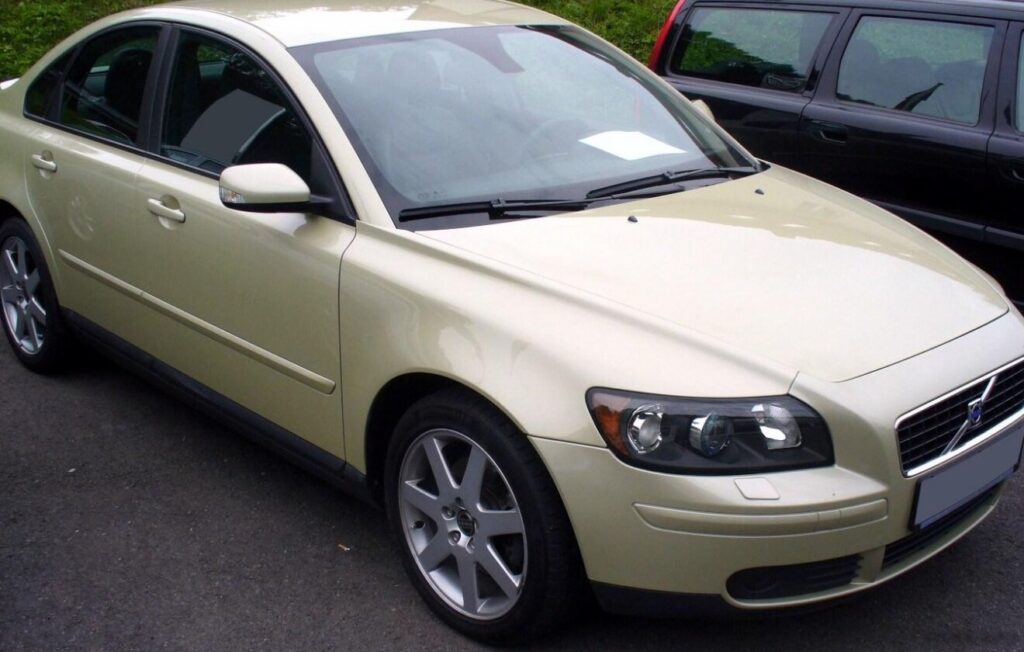
The Volvo S40 II 1.6 16V, produced between 2004 and 2007, represented the entry point into the second generation of Volvo’s compact sedan. Positioned within the broader S40 II range (chassis 1HX0), this variant offered a balance of affordability and Volvo’s renowned safety features. It served as a crucial model for attracting buyers seeking a premium small car experience without the higher price tag of the more powerful engine options. This model was primarily aimed at the European market, where compact sedans were highly popular, but also saw limited sales in North America.
Technical Specifications
| Brand | Volvo |
| Model | S40 |
| Generation | S40 II |
| Type (Engine) | 1.6 16V (100 Hp) |
| Start of production | 2004 |
| End of production | 2007 |
| Powertrain Architecture | Internal Combustion engine |
| Body type | Sedan |
| Seats | 5 |
| Doors | 4 |
| Fuel consumption (urban) | 9.5 l/100 km (24.8 US mpg) |
| Fuel consumption (extra urban) | 5.8 l/100 km (40.6 US mpg) |
| Fuel consumption (combined) | 7.2 l/100 km (32.7 US mpg) |
| CO2 emissions | 171 g/km |
| Fuel Type | Petrol (Gasoline) |
| Acceleration 0 – 100 km/h | 11.9 sec |
| Acceleration 0 – 62 mph | 11.9 sec |
| Acceleration 0 – 60 mph | 11.3 sec |
| Maximum speed | 185 km/h (114.95 mph) |
| Emission standard | Euro 4 |
| Weight-to-power ratio | 12.5 kg/Hp |
| Weight-to-torque ratio | 8.3 kg/Nm |
| Power | 100 Hp @ 6000 rpm |
| Torque | 150 Nm @ 4000 rpm (110.63 lb.-ft. @ 4000 rpm) |
| Engine layout | Front, Transverse |
| Engine Model/Code | B4164S3 |
| Engine displacement | 1596 cm3 (97.39 cu. in.) |
| Number of cylinders | 4 |
| Engine configuration | Inline |
| Cylinder Bore | 79 mm (3.11 in.) |
| Piston Stroke | 81.4 mm (3.2 in.) |
| Compression ratio | 11:1 |
| Number of valves per cylinder | 4 |
| Fuel injection system | Multi-port manifold injection |
| Engine aspiration | Naturally aspirated engine |
| Valvetrain | DOHC |
| Engine oil capacity | 4 l (4.23 US qt | 3.52 UK qt) |
| Coolant capacity | 6.2 l (6.55 US qt | 5.46 UK qt) |
| Kerb Weight | 1250 kg (2755.78 lbs.) |
| Max. weight | 1800 kg (3968.32 lbs.) |
| Max load | 550 kg (1212.54 lbs.) |
| Trunk (boot) space – minimum | 404 l (14.27 cu. ft.) |
| Trunk (boot) space – maximum | 883 l (31.18 cu. ft.) |
| Fuel tank capacity | 55 l (14.53 US gal | 12.1 UK gal) |
| Length | 4476 mm (176.22 in.) |
| Width | 1770 mm (69.69 in.) |
| Height | 1454 mm (57.24 in.) |
| Wheelbase | 2640 mm (103.94 in.) |
| Front track | 1535 mm (60.43 in.) |
| Rear track | 1531 mm (60.28 in.) |
| Minimum turning circle | 11.1 m (36.42 ft.) |
| Drivetrain Architecture | Front wheel drive |
| Number of gears | 5 |
| Gearbox type | Manual transmission |
| Front suspension | Transverse stabilizer |
| Rear suspension | Transverse stabilizer |
| Front brakes | Ventilated discs |
| Rear brakes | Disc |
| Assisting systems | ABS (Anti-lock braking system) |
| Steering type | Steering rack and pinion |
| Power steering | Hydraulic Steering |
| Tires size | 195/65 R15 |
| Wheel rims size | 15 |
Powertrain & Engine Architecture
The S40 II 1.6 16V utilized Volvo’s B4164S3 engine, a 1.6-liter inline-four cylinder gasoline engine. This engine featured a double overhead camshaft (DOHC) valvetrain with four valves per cylinder, contributing to its relatively efficient breathing. Fuel delivery was managed by a multi-port fuel injection system. The engine produced 100 horsepower at 6000 rpm and 150 Nm (110.63 lb-ft) of torque at 4000 rpm. The engine’s 11:1 compression ratio was typical for naturally aspirated engines of the era. The engine was transversely mounted in the front of the vehicle, driving the front wheels. The standard transmission was a five-speed manual gearbox, although a four-speed automatic transmission was also available, albeit less common. The automatic transmission was designed for smooth operation and fuel efficiency, but at the cost of some performance.
Driving Characteristics
The 1.6-liter engine, paired with the five-speed manual transmission, provided adequate, but not exhilarating, performance. Acceleration from 0 to 60 mph took approximately 11.3 seconds, and the top speed was around 115 mph. The engine felt somewhat strained when pushed hard, particularly when fully loaded or climbing hills. The automatic transmission version further diminished acceleration, making it more suited for relaxed city driving. Gear ratios were tuned for fuel economy rather than outright speed. Compared to the higher-output 2.0-liter and turbocharged variants of the S40 II, the 1.6-liter model offered a more economical driving experience, but lacked the responsiveness and power of its siblings. The suspension was tuned for comfort, providing a relatively smooth ride, but handling was not as sharp as some competitors.
Equipment & Trim Levels
The 1.6 16V S40 II typically came with a reasonable level of standard equipment. This included power windows, power door locks, air conditioning, and an audio system. Safety features, a Volvo hallmark, were also standard, including ABS brakes, front airbags, and side airbags. Interior upholstery was typically cloth, with options for leather available at an extra cost. Optional extras included alloy wheels, a sunroof, and upgraded audio systems. Trim levels were relatively simple, with the 1.6 16V often serving as the base model. Higher trim levels added features like automatic climate control, heated seats, and more luxurious interior finishes.
Chassis & Braking
The S40 II 1.6 16V utilized a MacPherson strut front suspension and a multi-link rear suspension, providing a good balance of ride comfort and handling. Front brakes were ventilated discs, while rear brakes were solid discs. The hydraulic power steering provided light and easy steering, making it well-suited for urban driving. The car’s relatively light weight (approximately 2756 lbs) helped to offset the modest engine power. Stabilizer bars were fitted to both the front and rear axles to reduce body roll during cornering.
Market Reception & Comparison
The S40 II 1.6 16V was generally well-received by critics as an affordable and safe entry-level luxury car. However, its performance was often criticized as being underwhelming, particularly when compared to competitors like the Audi A3 and BMW 1 Series. Fuel economy was considered good for its class, averaging around 33 mpg in combined driving. Reliability was generally good, although some owners reported issues with the electronic systems. Compared to the 2.0-liter and turbocharged S40 II models, the 1.6-liter version offered a lower purchase price and better fuel economy, but sacrificed performance and refinement. The 1.9L diesel variant offered better fuel economy and torque, but at the expense of refinement and initial cost.
Legacy
The Volvo S40 II 1.6 16V remains a relatively affordable and practical used car today. The B4164S3 engine is known for its durability, although regular maintenance is essential. The car’s strong safety credentials continue to be a selling point. While not a performance car, the S40 II 1.6 16V offers a comfortable and reliable driving experience, making it a good choice for those seeking a safe and economical compact sedan. Parts availability is generally good, and the car’s relatively simple mechanical design makes it relatively easy to maintain. However, potential buyers should be aware of potential issues with the electronic systems and ensure that the car has been properly maintained.
