
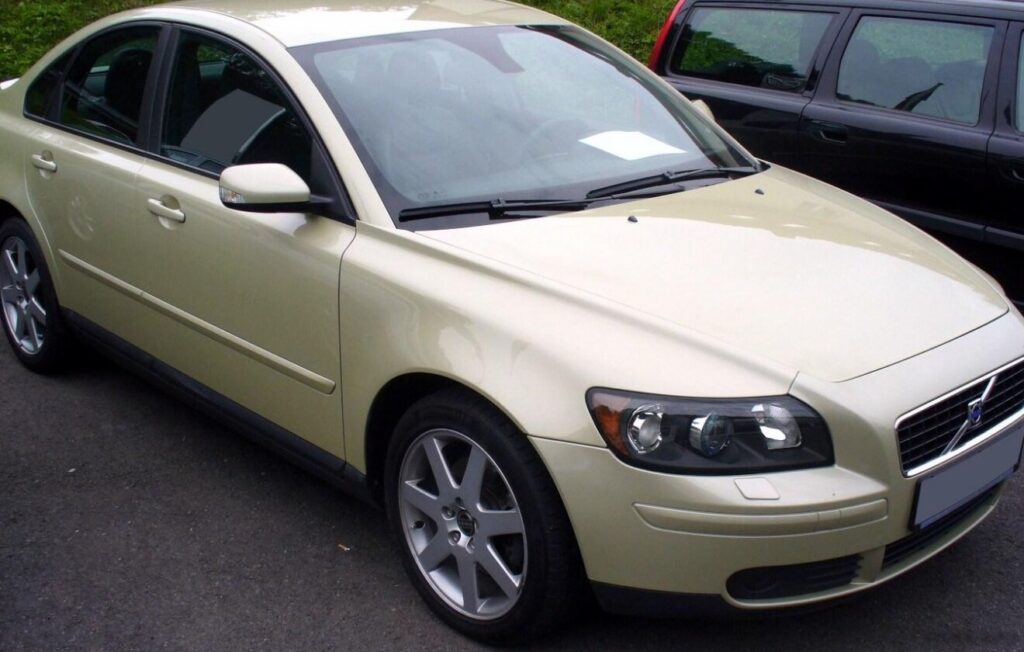
The Volvo S40 II 2.0i 16V, produced from 2006 to 2007, represented a key iteration within the second generation of Volvo’s compact executive car. Positioned as a mainstream offering within the S40 range, it served as a bridge between the more economical base models and the higher-performance variants. Built on the Volvo P1 platform (shared with the Mazda 3 of the same era following Ford’s ownership of both brands), the S40 II aimed to provide a blend of Scandinavian practicality, safety, and a reasonably engaging driving experience. This particular 2.0-liter, 145 horsepower version was primarily aimed at buyers seeking a balance between fuel efficiency and adequate performance for daily commuting and family use, particularly in European markets.
Technical Specifications
| Brand | Volvo |
| Model | S40 |
| Generation | S40 II |
| Type (Engine) | 2.0 i 16V (145 Hp) |
| Start of production | 2006 |
| End of production | 2007 |
| Powertrain Architecture | Internal Combustion engine |
| Body type | Sedan |
| Seats | 5 |
| Doors | 4 |
| Fuel consumption (urban) | 9.8 l/100 km (24 US mpg) |
| Fuel consumption (extra urban) | 5.7 l/100 km (41.3 US mpg) |
| Fuel consumption (combined) | 7.4 l/100 km (31.8 US mpg) |
| CO2 emissions | 177 g/km |
| Fuel Type | Petrol (Gasoline) |
| Acceleration 0 – 100 km/h | 9.5 sec |
| Acceleration 0 – 62 mph | 9.5 sec |
| Acceleration 0 – 60 mph | 9 sec |
| Maximum speed | 210 km/h (130.49 mph) |
| Emission standard | Euro 3 |
| Weight-to-power ratio | 8.9 kg/Hp |
| Weight-to-torque ratio | 7 kg/Nm |
| Power | 145 Hp @ 6000 rpm |
| Torque | 185 Nm @ 4500 rpm (136.45 lb.-ft. @ 4500 rpm) |
| Engine layout | Front, Transverse |
| Engine Model/Code | B4204S3 |
| Engine displacement | 1999 cm3 (121.99 cu. in.) |
| Number of cylinders | 4 |
| Engine configuration | Inline |
| Cylinder Bore | 87.5 mm (3.44 in.) |
| Piston Stroke | 83.1 mm (3.27 in.) |
| Compression ratio | 10.8:1 |
| Number of valves per cylinder | 4 |
| Fuel injection system | Multi-port manifold injection |
| Engine aspiration | Naturally aspirated engine |
| Valvetrain | DOHC |
| Engine oil capacity | 4.3 l (4.54 US qt | 3.78 UK qt) |
| Coolant capacity | 9.5 l (10.04 US qt | 8.36 UK qt) |
| Kerb Weight | 1295 kg (2854.99 lbs.) |
| Max. weight | 1850 kg (4078.55 lbs.) |
| Max load | 555 kg (1223.57 lbs.) |
| Trunk (boot) space – minimum | 404 l (14.27 cu. ft.) |
| Trunk (boot) space – maximum | 883 l (31.18 cu. ft.) |
| Fuel tank capacity | 62 l (16.38 US gal | 13.64 UK gal) |
| Length | 4476 mm (176.22 in.) |
| Width | 1770 mm (69.69 in.) |
| Height | 1454 mm (57.24 in.) |
| Wheelbase | 2640 mm (103.94 in.) |
| Front track | 1535 mm (60.43 in.) |
| Rear track | 1531 mm (60.28 in.) |
| Minimum turning circle | 11.1 m (36.42 ft.) |
| Drivetrain Architecture | Front wheel drive |
| Number of gears | 5 |
| Gearbox type | Manual transmission |
| Front suspension | Transverse stabilizer |
| Rear suspension | Transverse stabilizer |
| Front brakes | Ventilated discs |
| Rear brakes | Disc |
| Assisting systems | ABS (Anti-lock braking system) |
| Steering type | Steering rack and pinion |
| Power steering | Hydraulic Steering |
| Tires size | 205/55 R16 V |
| Wheel rims size | 16 |
Powertrain & Engine Architecture
The heart of the S40 II 2.0i 16V is the Volvo B4204S3 engine, a 1.999-liter inline-four cylinder gasoline engine. This engine is part of Volvo’s modular engine family, designed for flexibility and ease of manufacturing. The “16V” designation indicates the engine features four valves per cylinder, contributing to improved breathing and higher power output. Fuel delivery is managed by a multi-port fuel injection system, providing precise fuel metering for optimal combustion. The engine utilizes a double overhead camshaft (DOHC) valvetrain, further enhancing valve control and engine efficiency. The engine’s 145 horsepower and 185 Nm (136 lb-ft) of torque are respectable figures for its displacement, providing adequate performance for everyday driving. The engine is transversely mounted in the front of the vehicle, driving the front wheels. The standard transmission for this variant was a 5-speed manual gearbox, although an automatic transmission was also available as an option.
Driving Characteristics
The 2.0i 16V S40 offered a balanced driving experience. While not a sports sedan, it provided sufficient power for confident overtaking and highway cruising. The 5-speed manual transmission allowed drivers to make the most of the engine’s powerband, while the optional automatic transmission prioritized ease of use. Acceleration from 0-60 mph took around 9 seconds, which was competitive for its class at the time. The suspension, tuned for comfort, provided a relatively smooth ride, absorbing bumps and imperfections in the road. Compared to the more powerful 2.4i or the diesel variants, the 2.0i felt less urgent in its acceleration, but it offered better fuel economy and a more forgiving driving experience. The steering was light and precise, making it easy to maneuver in urban environments.
Equipment & Trim Levels
The S40 II 2.0i 16V typically came equipped with a reasonable level of standard features. These included power windows, power mirrors, central locking, and an audio system. Safety features, a hallmark of Volvo, were also standard, including ABS brakes, airbags, and side impact protection. Higher trim levels offered options such as leather upholstery, sunroof, automatic climate control, and upgraded audio systems. Interior materials were generally of good quality, reflecting Volvo’s commitment to Scandinavian design and comfort. The dashboard layout was clean and functional, with easy-to-read gauges and intuitive controls.
Chassis & Braking
The S40 II utilized a MacPherson strut front suspension and a multi-link rear suspension, providing a good balance of ride comfort and handling. Front brakes were ventilated discs, offering strong stopping power, while rear brakes were solid discs. The ABS anti-lock braking system helped to maintain control during emergency braking situations. The chassis was designed to be rigid and durable, contributing to the car’s overall stability and safety. Stabilizer bars were fitted to both the front and rear suspension, reducing body roll during cornering.
Market Reception & Comparison
The Volvo S40 II 2.0i 16V was generally well-received by automotive critics. It was praised for its safety, comfort, and fuel efficiency. However, some critics noted that its performance was not as exciting as some of its rivals. Compared to other compact executive cars of the time, such as the BMW 3 Series and the Audi A4, the S40 offered a more affordable alternative with a strong emphasis on safety and practicality. The 2.0i variant offered a compelling value proposition for buyers who prioritized fuel economy and a comfortable ride over outright performance. The diesel variants, while offering better fuel economy, were often more expensive to purchase and maintain.
Legacy
The Volvo S40 II 2.0i 16V has proven to be a relatively reliable vehicle in the used car market. The B4204S3 engine is known for its durability, and routine maintenance is relatively straightforward. However, like any used car, potential buyers should be aware of common issues such as oil leaks and worn suspension components. Today, the S40 II 2.0i 16V represents a practical and affordable option for buyers seeking a safe and comfortable compact executive car. Its blend of Scandinavian design, safety features, and reasonable running costs continue to make it a popular choice in the used car market.
