
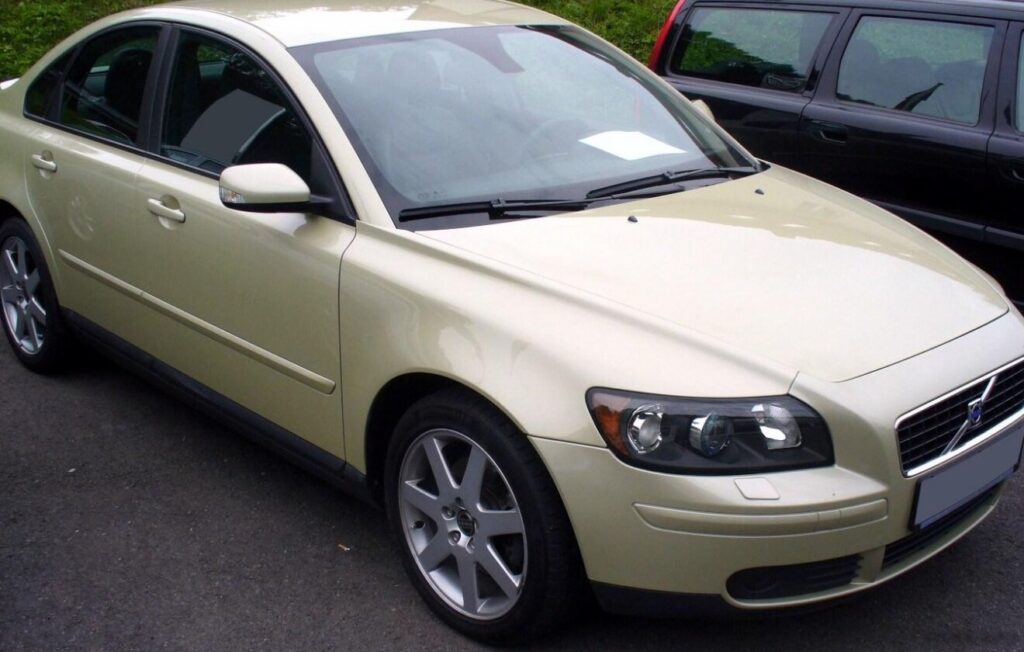
The Volvo S40 II 2.0 TDI, produced between 2004 and 2007, represented Volvo’s entry into the competitive compact executive car segment with a diesel offering. This variant, powered by the D4204T engine producing 136 horsepower, was positioned as a fuel-efficient and practical alternative to the gasoline-powered S40 models. It was a key component of the second-generation S40 (designated as the 1HX0 chassis code), which aimed to modernize Volvo’s image and appeal to a broader customer base. The S40 II, and its mechanically similar V50 wagon counterpart, were built upon the Ford C1 platform, a collaboration between Volvo and Ford following Volvo’s acquisition by the American automaker.
Technical Specifications
| Brand | Volvo |
| Model | S40 |
| Generation | S40 II |
| Type (Engine) | 2.0 TDI (136 Hp) |
| Start of production | 2004 |
| End of production | 2007 |
| Powertrain Architecture | Internal Combustion engine |
| Body type | Sedan |
| Seats | 5 |
| Doors | 4 |
| Fuel consumption (urban) | 7.5 l/100 km (31.4 US mpg) |
| Fuel consumption (extra urban) | 4.5 l/100 km (52.3 US mpg) |
| Fuel consumption (combined) | 5.6 l/100 km (42 US mpg) |
| CO2 emissions | 148 g/km |
| Fuel Type | Diesel |
| Power | 136 Hp @ 4000 rpm |
| Power per litre | 68.1 Hp/l |
| Torque | 340 Nm @ 2000 rpm (250.77 lb.-ft. @ 2000 rpm) |
| Engine layout | Front, Transverse |
| Engine Model/Code | D4204T |
| Engine displacement | 1998 cm3 (121.93 cu. in.) |
| Fuel injection system | Direct injection |
| Engine aspiration | Turbocharger, Intercooler |
| Engine oil capacity | 5.5 l (5.81 US qt | 4.84 UK qt) |
| Coolant capacity | 7.2 l (7.61 US qt | 6.34 UK qt) |
| Fuel tank capacity | 55 l (14.53 US gal | 12.1 UK gal) |
| Drivetrain Architecture | Front wheel drive |
| Front brakes | Ventilated discs |
| Assisting systems | ABS (Anti-lock braking system) |
Powertrain & Engine Architecture
The heart of the S40 II 2.0 TDI is the D4204T, a 1.998-liter inline-four cylinder diesel engine. This engine is a member of Volvo’s modular engine family, designed for flexibility and efficiency. It utilizes common-rail direct injection, a technology that allows for precise fuel delivery and improved combustion. The D4204T is equipped with a turbocharger and intercooler, which significantly boost power output and torque. The turbocharger forces more air into the engine, while the intercooler cools the compressed air, increasing its density and further enhancing performance. The engine’s valvetrain features four valves per cylinder (DOHC), contributing to its efficient operation. The engine was typically paired with a six-speed automatic transmission, although a six-speed manual was also available. The automatic transmission was chosen by many buyers for its ease of use, particularly in urban driving conditions.
Driving Characteristics
The 2.0 TDI variant of the S40 II offered a balance between fuel economy and acceptable performance. While not a sports car, the 136 horsepower and 340 Nm (250 lb-ft) of torque provided sufficient power for everyday driving and highway cruising. The automatic transmission, while smooth, did slightly diminish acceleration compared to the manual version. Gear ratios were tuned for fuel efficiency, meaning the engine didn’t rev as freely as it could. Real-world acceleration from 0 to 60 mph was typically in the 9-10 second range. The engine’s torque curve was relatively flat, providing good responsiveness across a wide range of engine speeds. Compared to the higher-output gasoline engines available in the S40 II, the 2.0 TDI prioritized fuel economy over outright speed.
Equipment & Trim Levels
The S40 II 2.0 TDI was generally offered in a single, well-equipped trim level. Standard features typically included air conditioning, power windows and locks, a CD stereo system, and alloy wheels. Safety was a key focus for Volvo, and the S40 II came standard with a comprehensive suite of safety features, including ABS brakes, traction control, and multiple airbags. Optional extras included leather upholstery, a sunroof, and a premium audio system. The interior design was typically Scandinavian in style – clean, functional, and comfortable. Dashboard materials were of reasonable quality, though not as luxurious as some of its German competitors.
Chassis & Braking
The S40 II utilized a MacPherson strut front suspension and a multi-link rear suspension. This setup provided a comfortable ride and decent handling characteristics. The front brakes were ventilated discs, providing adequate stopping power. Rear brakes were typically solid discs, although some earlier models may have featured drum brakes depending on the specific market. The steering was power-assisted, offering a light and responsive feel. Stabilizer bars were fitted to both the front and rear axles to reduce body roll during cornering. The chassis was designed to provide a balance between comfort and handling, leaning more towards the former.
Market Reception & Comparison
The Volvo S40 II 2.0 TDI was generally well-received by automotive critics. It was praised for its fuel efficiency, comfortable ride, and strong safety credentials. However, some critics noted that the interior was somewhat dated compared to its rivals, and the performance was not as exciting as some of the more powerful gasoline-powered options. Compared to other diesel-powered compact executive cars, such as the Audi A3 TDI and the BMW 1 Series diesel, the S40 II offered a competitive level of equipment and a more affordable price point. Its fuel economy was comparable to its rivals, and its reliability was generally considered to be good.
Legacy
The D4204T engine, while not without its issues (like any diesel engine of the era, DPF regeneration and potential turbocharger wear are common concerns), proved to be a relatively durable and reliable powertrain when properly maintained. Today, the S40 II 2.0 TDI can be found on the used car market at relatively affordable prices. It remains a practical and economical choice for those seeking a comfortable and safe compact sedan. However, potential buyers should be aware of the potential maintenance costs associated with diesel engines, particularly regarding the diesel particulate filter (DPF) and turbocharger. The S40 II 2.0 TDI represents a significant step forward for Volvo in terms of fuel efficiency and modern technology, and it remains a popular choice for budget-conscious buyers.
