
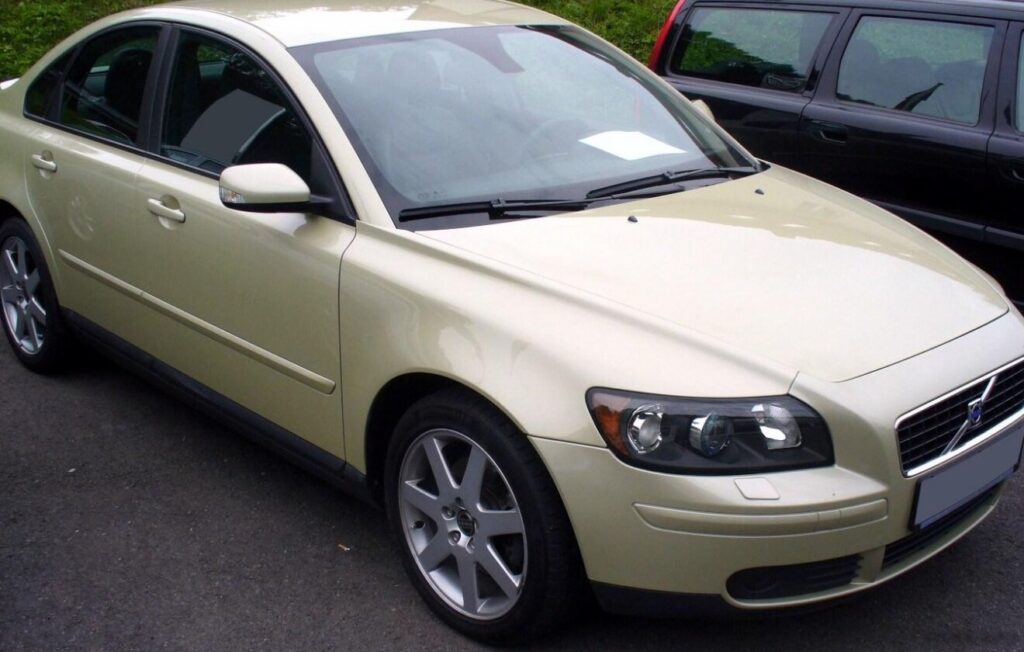
The Volvo S40 II 2.4i 20V, produced between 2004 and 2007, represented a significant step forward for Volvo’s compact sedan offering. Part of the second generation S40 (designated as the 447 series), this variant occupied a mid-range position within the lineup, offering a balance between performance and affordability. It was built on Volvo’s Y20 platform, shared with the Mazda 3, and aimed to compete with established European rivals like the Audi A3 and BMW 1 Series, as well as Japanese competitors like the Acura TSX. The 2.4i 20V model was particularly important in the North American market, where larger engines were generally preferred.
Technical Specifications
| Brand | Volvo |
| Model | S40 |
| Generation | S40 II |
| Type (Engine) | 2.4 i 20V (170 Hp) |
| Start of production | 2004 |
| End of production | 2007 |
| Powertrain Architecture | Internal Combustion engine |
| Body type | Sedan |
| Seats | 5 |
| Doors | 4 |
| Fuel consumption (urban) | 12.4 l/100 km (19 US mpg, 22.8 UK mpg, 8.1 km/l) |
| Fuel consumption (extra urban) | 6.6 l/100 km (35.6 US mpg, 42.8 UK mpg, 15.2 km/l) |
| Fuel consumption (combined) | 8.5 l/100 km (27.7 US mpg, 33.2 UK mpg, 11.8 km/l) |
| CO2 emissions | 203 g/km |
| Fuel Type | Petrol (Gasoline) |
| Acceleration 0 – 100 km/h | 8.2 sec |
| Acceleration 0 – 62 mph | 8.2 sec |
| Acceleration 0 – 60 mph | 7.8 sec |
| Maximum speed | 220 km/h (136.7 mph) |
| Emission standard | Euro 4 |
| Weight-to-power ratio | 8.2 kg/Hp, 121.4 Hp/tonne |
| Weight-to-torque ratio | 6.1 kg/Nm, 164.3 Nm/tonne |
| Power | 170 Hp @ 6000 rpm |
| Power per litre | 69.8 Hp/l |
| Torque | 230 Nm @ 4400 rpm (169.64 lb.-ft. @ 4400 rpm) |
| Engine layout | Front, Transverse |
| Engine Model/Code | B5244S4 |
| Engine displacement | 2435 cm3 (148.59 cu. in.) |
| Number of cylinders | 5 |
| Engine configuration | Inline |
| Cylinder Bore | 83 mm (3.27 in.) |
| Piston Stroke | 90 mm (3.54 in.) |
| Compression ratio | 10.3:1 |
| Number of valves per cylinder | 4 |
| Fuel injection system | Multi-port manifold injection |
| Engine aspiration | Naturally aspirated engine |
| Valvetrain | DOHC |
| Engine oil capacity | 5.8 l (6.13 US qt | 5.1 UK qt) |
| Coolant | 9.5 l (10.04 US qt | 8.36 UK qt) |
| Kerb Weight | 1400 kg (3086.47 lbs.) |
| Max. weight | 1940 kg (4276.97 lbs.) |
| Max load | 540 kg (1190.5 lbs.) |
| Trunk (boot) space – minimum | 404 l (14.27 cu. ft.) |
| Trunk (boot) space – maximum | 883 l (31.18 cu. ft.) |
| Fuel tank capacity | 62 l (16.38 US gal | 13.64 UK gal) |
| Length | 4476 mm (176.22 in.) |
| Width | 1770 mm (69.69 in.) |
| Height | 1454 mm (57.24 in.) |
| Wheelbase | 2640 mm (103.94 in.) |
| Front track | 1535 mm (60.43 in.) |
| Rear (Back) track | 1531 mm (60.28 in.) |
| Minimum turning circle | 11.1 m (36.42 ft.) |
| Drivetrain Architecture | The Internal combustion engine (ICE) drives the front wheels of the vehicle. |
| Drive wheel | Front wheel drive |
| Number of gears | 5 gears, manual transmission |
| Front suspension | Transverse stabilizer |
| Rear suspension | Transverse stabilizer |
| Front brakes | Ventilated discs |
| Rear brakes | Disc |
| Assisting systems | ABS (Anti-lock braking system) |
| Steering type | Steering rack and pinion |
| Power steering | Hydraulic Steering |
| Tires size | 205/55 R16 V |
| Wheel rims size | 16 |
Powertrain & Engine Architecture
The heart of the S40 II 2.4i 20V is the Volvo B5244S4 engine, a naturally aspirated, 2.4-liter inline-five cylinder powerplant. This engine is a descendant of Volvo’s long-running “Redblock” family, known for its robustness and relatively simple design. The “20V” designation refers to the engine’s five valves per cylinder (four intake, one exhaust), contributing to improved breathing and power output. Fuel delivery is managed by a multi-port fuel injection system, providing precise fuel metering for optimal combustion. The engine utilizes a double overhead camshaft (DOHC) valvetrain, further enhancing its volumetric efficiency. The engine was paired with a 5-speed manual transmission as standard, offering a direct and engaging driving experience.
Driving Characteristics
The 170 horsepower and 230 Nm (169.64 lb-ft) of torque provided by the 2.4i engine delivered respectable, if not exhilarating, performance. Acceleration from 0-60 mph took around 7.8 seconds, making it competitive within its class. The five-speed manual transmission offered precise shifts, and the engine’s torque curve provided adequate power for everyday driving and highway passing maneuvers. Compared to the base 1.8L models, the 2.4i offered a noticeable improvement in responsiveness and overall driving enjoyment. While not as sporty as some of its European rivals, the S40 II 2.4i provided a comfortable and composed ride, typical of Volvo’s focus on safety and practicality.
Equipment & Trim Levels
The S40 II 2.4i typically came standard with features such as air conditioning, power windows and locks, a CD player, and ABS brakes. Higher trim levels offered options like leather upholstery, a sunroof, automatic climate control, and premium audio systems. Safety was a key selling point for Volvo, and the S40 II 2.4i included features like side airbags, curtain airbags, and whiplash protection system (WHIPS) as standard equipment. The interior design was typically Scandinavian in its simplicity and functionality, with a focus on ergonomics and user-friendliness.
Chassis & Braking
The S40 II utilized an independent suspension system at all four wheels, featuring MacPherson struts at the front and a multi-link setup at the rear. This configuration provided a good balance between ride comfort and handling. The 2.4i models typically featured ventilated disc brakes at the front and solid disc brakes at the rear, providing adequate stopping power. Anti-lock braking system (ABS) was standard, enhancing safety and control during emergency braking situations. The chassis was designed to prioritize safety and stability, resulting in a slightly softer suspension tuning compared to some sportier competitors.
Market Reception & Comparison
The Volvo S40 II 2.4i was generally well-received by automotive critics, who praised its safety features, comfortable ride, and refined interior. However, some reviewers noted that its performance was not as exciting as some of its rivals, and its styling was considered somewhat conservative. Compared to the base 1.8L models, the 2.4i offered a significant improvement in performance and driving enjoyment, justifying its higher price tag. Fuel economy was average for its class, with combined fuel consumption around 27.7 US mpg. Reliability was generally good, although some owners reported issues with the electronic systems.
Legacy
The Volvo S40 II 2.4i remains a popular choice in the used car market, particularly for buyers seeking a safe, reliable, and comfortable compact sedan. The B5244S4 engine is known for its durability and relatively low maintenance costs. While not a performance icon, the 2.4i variant offers a good balance of power, efficiency, and practicality, making it a well-rounded and appealing option for those seeking a Scandinavian-designed vehicle. Parts availability remains good, and the S40 II continues to be a viable and affordable transportation option for many drivers.
