
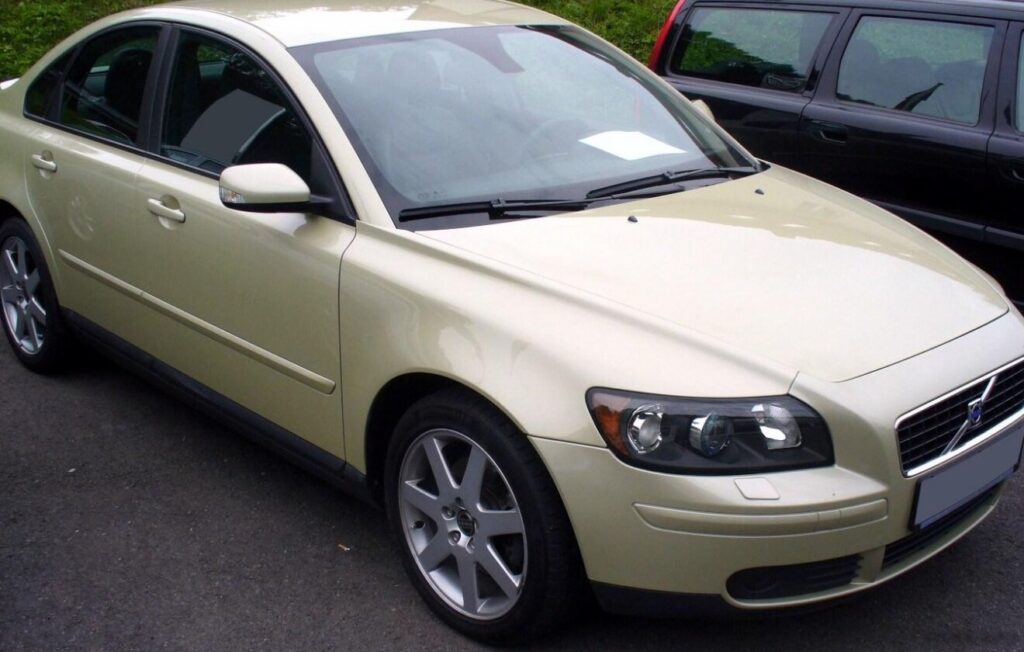
The Volvo S40 II 2.5 20V T5 AWD, produced between 2004 and 2007, represented a significant step forward for Volvo’s compact sedan offering. Positioned as the performance variant within the second-generation S40 (launched in 2004 and based on the Ford C1 platform, shared with the Mazda 3), the T5 model aimed to deliver a more engaging driving experience than the base 1.8L and 2.0L naturally aspirated engines. It was marketed towards buyers seeking a blend of Scandinavian practicality, safety, and respectable performance, particularly in markets where all-wheel drive was highly valued. This model year bridged the gap between Volvo’s traditional values and the increasing influence of Ford ownership, showcasing a more modern design and technology package.
Technical Specifications
| Brand | Volvo |
| Model | S40 |
| Generation | S40 II |
| Type (Engine) | 2.5 20V T5 (220 Hp) AWD |
| Start of production | 2004 |
| End of production | 2007 |
| Powertrain Architecture | Internal Combustion engine |
| Body type | Sedan |
| Seats | 5 |
| Doors | 4 |
| Fuel consumption (urban) | 13.5 l/100 km (17.4 US mpg, 20.9 UK mpg, 7.4 km/l) |
| Fuel consumption (extra urban) | 7.3 l/100 km (32.2 US mpg, 38.7 UK mpg, 13.7 km/l) |
| Fuel consumption (combined) | 9.5 l/100 km (24.8 US mpg, 29.7 UK mpg, 10.5 km/l) |
| CO2 emissions | 227 g/km |
| Fuel Type | Petrol (Gasoline) |
| Acceleration 0 – 100 km/h | 6.8 sec |
| Acceleration 0 – 62 mph | 6.8 sec |
| Acceleration 0 – 60 mph | 6.5 sec |
| Maximum speed | 230 km/h (142.92 mph) |
| Emission standard | Euro 4 |
| Weight-to-power ratio | 7 kg/Hp, 142.4 Hp/tonne |
| Weight-to-torque ratio | 4.8 kg/Nm, 207.1 Nm/tonne |
| Power | 220 Hp @ 5000 rpm |
| Power per litre | 87.3 Hp/l |
| Torque | 320 Nm @ 1500-4800 rpm (236.02 lb.-ft. @ 1500-4800 rpm) |
| Engine layout | Front, Transverse |
| Engine Model/Code | B5254T3 |
| Engine displacement | 2521 cm3 (153.84 cu. in.) |
| Number of cylinders | 5 |
| Engine configuration | Inline |
| Cylinder Bore | 83 mm (3.27 in.) |
| Piston Stroke | 93.2 mm (3.67 in.) |
| Compression ratio | 9:1 |
| Number of valves per cylinder | 4 |
| Fuel injection system | Multi-port manifold injection |
| Engine aspiration | Turbocharger, Intercooler |
| Engine oil capacity | 5.8 l (6.13 US qt | 5.1 UK qt) |
| Coolant | 8 l (8.45 US qt | 7.04 UK qt) |
| Kerb Weight | 1545 kg (3406.14 lbs.) |
| Max. weight | 2020 kg (4453.34 lbs.) |
| Max load | 475 kg (1047.2 lbs.) |
| Trunk (boot) space – minimum | 404 l (14.27 cu. ft.) |
| Trunk (boot) space – maximum | 883 l (31.18 cu. ft.) |
| Fuel tank capacity | 58 l (15.32 US gal | 12.76 UK gal) |
| Length | 4476 mm (176.22 in.) |
| Width | 1770 mm (69.69 in.) |
| Height | 1454 mm (57.24 in.) |
| Wheelbase | 2640 mm (103.94 in.) |
| Front track | 1535 mm (60.43 in.) |
| Rear (Back) track | 1531 mm (60.28 in.) |
| Minimum turning circle | 11.1 m (36.42 ft.) |
| Drive wheel | All wheel drive (4×4) |
| Number of gears | 6 gears, manual transmission |
| Front suspension | Transverse stabilizer |
| Rear suspension | Transverse stabilizer |
| Front brakes | Ventilated discs |
| Rear brakes | Disc |
| Assisting systems | ABS (Anti-lock braking system) |
| Steering type | Steering rack and pinion |
| Power steering | Hydraulic Steering |
| Tires size | 205/55 R16 V |
| Wheel rims size | 16 |
Powertrain & Engine Architecture
The heart of the S40 II T5 AWD is the Volvo B5254T3 engine, a 2.5-liter inline-five cylinder gasoline engine. This engine is a descendant of Volvo’s long-running white block engine family, but significantly updated with a turbocharger and variable valve timing on both the intake and exhaust camshafts (20V designation). The B5254T3 utilizes multi-port fuel injection and an intercooled turbocharger to produce 220 horsepower at 5000 rpm and 320 Nm (236 lb-ft) of torque between 1500 and 4800 rpm. The engine’s relatively flat torque curve, characteristic of turbocharged engines, provides good responsiveness across a wide range of engine speeds. The six-speed manual transmission was standard, offering precise shifts and contributing to the car’s sporty feel. The all-wheel-drive system is a viscous coupling system, providing full-time all-wheel drive without relying on electronic sensors or computers, offering a robust and reliable solution for enhanced traction.
Driving Characteristics
The S40 II T5 AWD delivers a noticeably more spirited driving experience compared to the lower-powered variants. The 6.5-second 0-60 mph acceleration time is respectable for a compact sedan of this era. The turbocharger provides a surge of power in the mid-range, making overtaking maneuvers effortless. The all-wheel-drive system enhances grip, particularly in inclement weather, providing a secure and confident feel. The six-speed manual transmission allows the driver to fully exploit the engine’s powerband. While not a dedicated sports sedan, the T5 offers a balanced and engaging driving experience, blending performance with everyday usability. The gear ratios are well-chosen to maximize acceleration and maintain reasonable fuel economy during highway cruising.
Equipment & Trim Levels
The T5 AWD trim generally included a higher level of standard equipment than the base S40 models. Standard features typically included leather upholstery, power-adjustable front seats, automatic climate control, a premium audio system, and alloy wheels. Optional extras included a sunroof, navigation system, and upgraded interior trim options. Safety features, a hallmark of Volvo, were comprehensive, including ABS, traction control, and multiple airbags. The interior design was typically Scandinavian – clean, functional, and focused on ergonomics.
Chassis & Braking
The S40 II utilized a MacPherson strut front suspension and a multi-link rear suspension. The T5 AWD models often featured slightly stiffer suspension components compared to the base models to improve handling. Brakes consisted of ventilated discs at the front and solid discs at the rear, providing adequate stopping power for the car’s performance capabilities. ABS (Anti-lock Braking System) was standard. The chassis was designed to provide a good balance between ride comfort and handling precision.
Market Reception & Comparison
The S40 II T5 AWD was generally well-received by automotive critics. It was praised for its strong engine, engaging driving dynamics, and standard all-wheel-drive system. However, some critics noted that the interior, while well-built, lacked the visual flair of some competitors. Compared to the naturally aspirated S40 models, the T5 offered a significant performance upgrade. Against rivals like the Audi A3 and BMW 1 Series, the S40 T5 offered a compelling value proposition, particularly in markets where all-wheel drive was a priority. Fuel economy, at around 24.8 mpg combined, was reasonable for a turbocharged, all-wheel-drive vehicle of this class.
Legacy
The Volvo S40 II 2.5 T5 AWD has proven to be a relatively reliable vehicle, with the B5254T3 engine generally considered durable. Common maintenance items include timing belt replacement (typically every 80,000-100,000 miles) and regular servicing of the turbocharger. On the used car market, these models hold their value reasonably well, particularly those in good condition with a well-documented service history. The combination of performance, practicality, and safety continues to appeal to buyers seeking a Scandinavian-designed compact sedan. While not a collector’s item, the S40 II T5 AWD remains a capable and enjoyable vehicle for everyday driving.
