
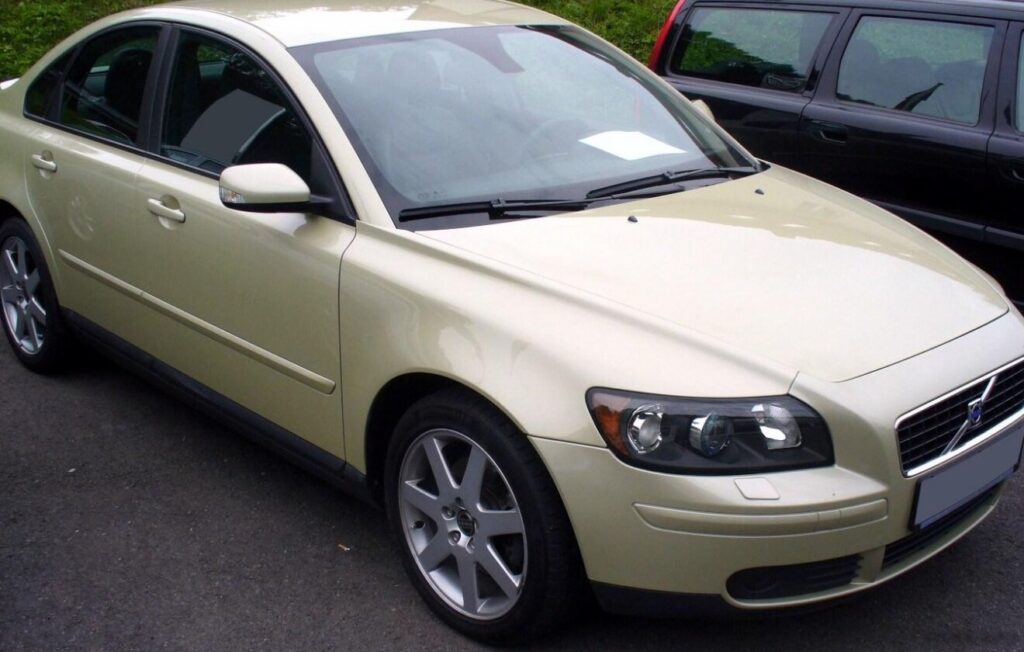
The Volvo S40 II 2.5 T5 AWD Geartronic, produced between 2004 and 2007, represented a significant step forward for Volvo’s compact executive sedan. Positioned as the performance variant within the second-generation S40 (launched in 2004 as a replacement for the first-generation S40/V40), the T5 model combined a turbocharged five-cylinder engine with all-wheel drive and a five-speed automatic transmission. This configuration aimed to deliver a blend of Scandinavian practicality, safety, and spirited driving dynamics, appealing to buyers seeking a premium compact car with all-weather capability. The S40 II was built on the Ford C1 platform, shared with the Mazda 3 and Ford Focus, marking a period of collaboration between the brands.
Technical Specifications
| Brand | Volvo |
| Model | S40 |
| Generation | S40 II |
| Type (Engine) | 2.5 T5 (220 Hp) AWD Geartronic |
| Start of production | 2004 |
| End of production | 2007 |
| Powertrain Architecture | Internal Combustion engine |
| Body type | Sedan |
| Seats | 5 |
| Doors | 4 |
| Fuel consumption (urban) | 15.1 l/100 km (15.6 US mpg, 18.7 UK mpg, 6.6 km/l) |
| Fuel consumption (extra urban) | 7.2 l/100 km (32.7 US mpg, 39.2 UK mpg, 13.9 km/l) |
| Fuel consumption (combined) | 10.1 l/100 km (23.3 US mpg, 28 UK mpg, 9.9 km/l) |
| CO2 emissions | 241 g/km |
| Fuel Type | Petrol (Gasoline) |
| Acceleration 0 – 100 km/h | 7.5 sec |
| Acceleration 0 – 62 mph | 7.5 sec |
| Acceleration 0 – 60 mph | 7.1 sec |
| Maximum speed | 225 km/h (139.81 mph) |
| Emission standard | Euro 4 |
| Weight-to-power ratio | 6.8 kg/Hp, 148 Hp/tonne |
| Weight-to-torque ratio | 4.6 kg/Nm, 215.3 Nm/tonne |
| Power | 220 Hp @ 5000 rpm |
| Power per litre | 87.3 Hp/l |
| Torque | 320 Nm @ 1500-4800 rpm (236.02 lb.-ft. @ 1500-4800 rpm) |
| Engine layout | Front, Transverse |
| Engine Model/Code | B5254T3 |
| Engine displacement | 2521 cm3 (153.84 cu. in.) |
| Number of cylinders | 5 |
| Engine configuration | Inline |
| Cylinder Bore | 83 mm (3.27 in.) |
| Piston Stroke | 93.2 mm (3.67 in.) |
| Compression ratio | 9:1 |
| Number of valves per cylinder | 4 |
| Fuel injection system | Multi-port manifold injection |
| Engine aspiration | Turbocharger, Intercooler |
| Valvetrain | DOHC |
| Engine oil capacity | 5.8 l (6.13 US qt | 5.1 UK qt) |
| Coolant | 9.5 l (10.04 US qt | 8.36 UK qt) |
| Kerb Weight | 1486 kg (3276.07 lbs.) |
| Max. weight | 2020 kg (4453.34 lbs.) |
| Max load | 534 kg (1177.27 lbs.) |
| Trunk (boot) space – minimum | 404 l (14.27 cu. ft.) |
| Trunk (boot) space – maximum | 883 l (31.18 cu. ft.) |
| Fuel tank capacity | 58 l (15.32 US gal | 12.76 UK gal) |
| Max. roof load | 75 kg (165.35 lbs.) |
| Permitted trailer load with brakes (12%) | 1500 kg (3306.93 lbs.) |
| Permitted trailer load without brakes | 700 kg (1543.24 lbs.) |
| Permitted towbar download | 75 kg (165.35 lbs.) |
| Length | 4468 mm (175.91 in.) |
| Width | 1770 mm (69.69 in.) |
| Height | 1452 mm (57.17 in.) |
| Wheelbase | 2640 mm (103.94 in.) |
| Front track | 1535 mm (60.43 in.) |
| Rear (Back) track | 1531 mm (60.28 in.) |
| Minimum turning circle | 10.6 m (34.78 ft.) |
| Drivetrain Architecture | All wheel drive (4×4). Internal Combustion engine. |
| Drive wheel | All wheel drive (4×4) |
| Number of gears and type of gearbox | 5 gears, automatic transmission Geartronic |
| Front suspension | Independent, type McPherson with coil spring and anti-roll bar |
| Rear suspension | Independent multi-link spring suspension with stabilizer |
| Front brakes | Ventilated discs |
| Rear brakes | Disc |
| Assisting systems | ABS (Anti-lock braking system) |
| Steering type | Steering rack and pinion |
| Power steering | Electric Steering |
| Tires size | 205/55 R16 |
| Wheel rims size | 6.5J x 16 |
INTRODUCTION
The Volvo S40 II 2.5 T5 AWD Geartronic, produced from 2004 to 2007, was the flagship model of the second-generation S40 lineup. It built upon the foundation of the redesigned S40, which moved to a front-wheel-drive platform (with optional all-wheel drive) and shared its architecture with the Mazda 3 and Ford Focus. The T5 variant distinguished itself with a potent turbocharged engine and standard all-wheel drive, offering a more engaging driving experience than the base 1.8L and 2.0L models. It was marketed as a premium compact sedan, emphasizing safety, comfort, and a touch of Scandinavian luxury.
Powertrain & Engine Architecture
At the heart of the S40 T5 lay the B5254T3 engine, a 2.5-liter inline-five cylinder gasoline engine. This engine was a hallmark of Volvo’s engineering, known for its smoothness and durability. The B5254T3 featured a light-pressure turbocharger with an intercooler, boosting power output to 220 horsepower at 5000 rpm and 320 Nm (236 lb-ft) of torque available from a low 1500 rpm all the way to 4800 rpm. Fuel delivery was managed by a multi-port fuel injection system. The engine utilized a double overhead camshaft (DOHC) valvetrain with four valves per cylinder, optimizing breathing and contributing to its power delivery. The engine was transversely mounted in the front of the vehicle.
The “Geartronic” transmission was a five-speed automatic gearbox. It offered a manual shift mode, allowing drivers some control over gear selection. The all-wheel-drive system was a viscous coupling system, providing on-demand power to the rear wheels when traction was lost. This system enhanced stability and grip, particularly in adverse weather conditions.
Driving Characteristics
The S40 T5 AWD Geartronic offered a noticeably more spirited driving experience compared to the lower-powered S40 variants. The turbocharged engine provided strong acceleration, with a 0-60 mph time of around 7.1 seconds. The automatic transmission, while smooth, wasn’t particularly quick to downshift, which could sometimes feel slightly sluggish during aggressive driving. The all-wheel-drive system instilled confidence in various road conditions, providing excellent traction and stability. The steering was precise, but lacked significant feedback. Compared to a manual transmission equipped T5, the automatic version sacrificed some driver engagement, but offered greater convenience for everyday driving.
Equipment & Trim Levels
The S40 T5 AWD Geartronic typically came well-equipped as the top-of-the-line model. Standard features included leather upholstery, power-adjustable front seats, a premium audio system, automatic climate control, and alloy wheels. Safety features were, as expected from Volvo, comprehensive, including ABS, traction control, and multiple airbags. Optional extras included a sunroof, navigation system, and upgraded audio options. Interior trim levels varied, with options for different wood or metallic finishes.
Chassis & Braking
The S40 II utilized an independent suspension system on all four wheels. The front suspension employed a McPherson strut design with coil springs and an anti-roll bar, while the rear featured a multi-link setup, also with coil springs and a stabilizer bar. This suspension configuration provided a comfortable ride while maintaining reasonable handling characteristics. Braking duties were handled by ventilated discs at the front and solid discs at the rear. ABS (Anti-lock Braking System) was standard, enhancing braking performance and stability.
Market Reception & Comparison
The S40 T5 AWD Geartronic was generally well-received by automotive critics. It was praised for its strong engine, comfortable ride, and comprehensive safety features. However, some reviewers noted that the automatic transmission could feel a bit slow to respond, and the interior, while well-built, lacked the visual flair of some competitors. Compared to the base 1.8L and 2.0L models, the T5 offered a significant performance upgrade, but at a higher price point. The T5 also competed with other premium compact sedans such as the Audi A3, BMW 1 Series, and Acura TSX.
Legacy
The Volvo S40 II 2.5 T5 AWD Geartronic has proven to be a relatively reliable vehicle, with the B5254T3 engine being known for its durability. However, like any vehicle of this age, maintenance is key. Common issues include occasional turbocharger wear and potential problems with the automatic transmission. On the used car market, the T5 models command a premium over the lower-powered variants, reflecting their performance and all-wheel-drive capability. The S40 T5 remains a popular choice for buyers seeking a safe, comfortable, and relatively sporty compact sedan with a unique Scandinavian character.
