
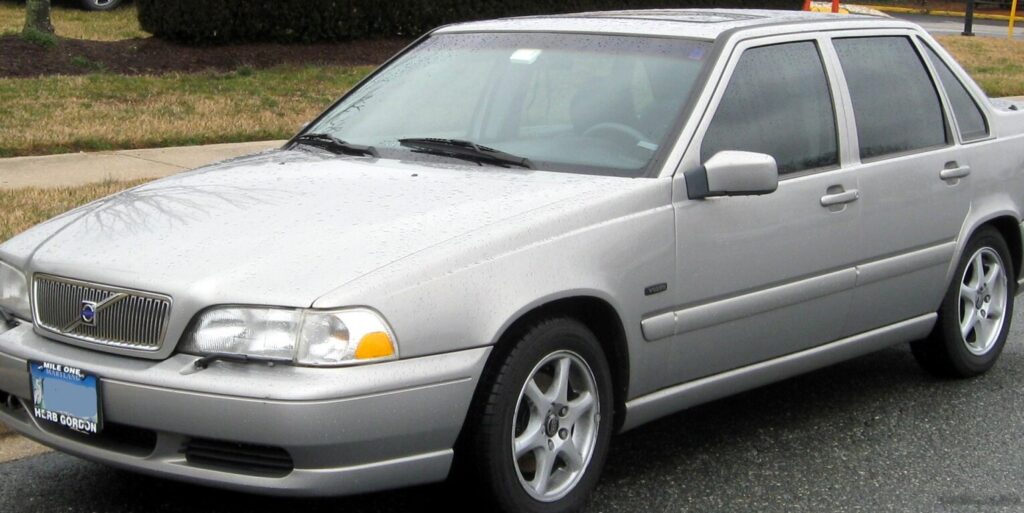
The Volvo S70 2.0 20V Turbo, produced between 1996 and 2000, represented a significant offering in Volvo’s mid-size sedan lineup. Positioned as a performance-oriented variant within the S70 range, it aimed to deliver a blend of Scandinavian practicality, safety, and respectable power. This model was a key part of Volvo’s transition period, built on the P80 platform (internally known as the 850 series update) and serving as a predecessor to the later S60. The 2.0 20V Turbo was aimed at buyers who desired more than the base engine offered, but didn’t necessarily require the larger, more expensive six-cylinder options.
Technical Specifications
| Brand | Volvo |
| Model | S70 |
| Generation | S70 |
| Type (Engine) | 2.0 20V Turbo (226 Hp) |
| Start of production | 1996 |
| End of production | 2000 |
| Powertrain Architecture | Internal Combustion engine |
| Body type | Sedan |
| Seats | 5 |
| Doors | 4 |
| Fuel consumption (urban) | 16.2 l/100 km (14.5 US mpg) |
| Fuel consumption (extra urban) | 8.2 l/100 km (28.7 US mpg) |
| Fuel Type | Petrol (Gasoline) |
| Acceleration 0 – 100 km/h | 7.7 sec |
| Acceleration 0 – 62 mph | 7.7 sec |
| Acceleration 0 – 60 mph | 7.3 sec |
| Maximum speed | 240 km/h (149.13 mph) |
| Weight-to-power ratio | 6.5 kg/Hp |
| Weight-to-torque ratio | 4.7 kg/Nm |
| Power | 226 Hp @ 5700 rpm |
| Power per litre | 113.9 Hp/l |
| Torque | 310 Nm @ 2700 rpm (228.64 lb.-ft. @ 2700 rpm) |
| Engine layout | Front, Transverse |
| Engine Model/Code | B5204T3 |
| Engine displacement | 1984 cm3 (121.07 cu. in.) |
| Number of cylinders | 5 |
| Engine configuration | Inline |
| Cylinder Bore | 81 mm (3.19 in.) |
| Piston Stroke | 77 mm (3.03 in.) |
| Compression ratio | 8.4:1 |
| Number of valves per cylinder | 4 |
| Fuel injection system | Multi-port manifold injection |
| Engine aspiration | Turbocharger |
| Valvetrain | DOHC |
| Engine oil capacity | 5.8 l (6.13 US qt | 5.1 UK qt) |
| Coolant | 7 l (7.4 US qt | 6.16 UK qt) |
| Kerb Weight | 1460 kg (3218.75 lbs.) |
| Max. weight | 1910 kg (4210.83 lbs.) |
| Max load | 450 kg (992.08 lbs.) |
| Trunk (boot) space – minimum | 470 l (16.6 cu. ft.) |
| Fuel tank capacity | 70 l (18.49 US gal | 15.4 UK gal) |
| Length | 4720 mm (185.83 in.) |
| Width | 1760 mm (69.29 in.) |
| Height | 1400 mm (55.12 in.) |
| Wheelbase | 2660 mm (104.72 in.) |
| Front track | 1520 mm (59.84 in.) |
| Rear (Back) track | 1470 mm (57.87 in.) |
| Drivetrain Architecture | The Internal combustion engine (ICE) drives the front wheels of the vehicle. |
| Drive wheel | Front wheel drive |
| Number of gears and type of gearbox | 5 gears, manual transmission |
| Front suspension | Wishbone |
| Rear suspension | Coil spring |
| Front brakes | Ventilated discs |
| Rear brakes | Disc |
| Assisting systems | ABS (Anti-lock braking system) |
| Steering type | Steering rack and pinion |
| Power steering | Hydraulic Steering |
| Tires size | 205/50 R16 |
| Wheel rims size | 16 |
Powertrain & Engine Architecture
The heart of the S70 2.0 20V Turbo is the B5204T3 engine, a 1.984-liter inline-five cylinder powerplant. This engine is notable for its relatively smooth operation and distinctive sound, a characteristic of Volvo’s five-cylinder designs. The “20V” designation refers to the engine’s 20 valves (four valves per cylinder). The B5204T3 utilizes a low-pressure turbocharger, coupled with a Bosch Motronic fuel injection system and multi-port fuel injection. This setup provided a good balance between performance and fuel efficiency for its time. The engine’s design incorporated a cast iron block and an aluminum cylinder head, contributing to its durability. The five-speed manual transmission was the standard offering, providing direct control over the engine’s power. While an automatic transmission was available, it was less common and generally considered to slightly diminish the car’s performance.
Driving Characteristics
The S70 2.0 20V Turbo offered a noticeable step up in performance compared to the base 2.0-liter non-turbocharged engine. The turbocharger provided a boost in torque, making the car feel responsive in everyday driving situations. Acceleration from 0-60 mph was achieved in approximately 7.3-7.7 seconds, respectable for a mid-size sedan of the late 1990s. The manual transmission allowed for precise gear changes, enhancing the driving experience. Compared to the larger six-cylinder S70 models, the 2.0 Turbo offered a lighter front end, resulting in slightly more agile handling. However, it lacked the outright power and refined smoothness of the six-cylinder variants. The gear ratios in the five-speed manual were well-chosen, providing good acceleration in lower gears and comfortable cruising at highway speeds.
Equipment & Trim Levels
The S70 2.0 20V Turbo typically came with a fairly comprehensive list of standard features. These included power windows, power locks, power mirrors, air conditioning, and an AM/FM stereo with cassette player. Higher trim levels offered options such as leather upholstery, a sunroof, automatic climate control, and upgraded audio systems. Safety features were a Volvo hallmark, and the S70 2.0 Turbo included standard ABS brakes, side-impact protection systems (SIPS), and a driver-side airbag. Optional equipment could include a passenger-side airbag and traction control. Interior upholstery was typically cloth, with leather available as an upgrade. Dashboard configuration was relatively straightforward, prioritizing functionality and ease of use.
Chassis & Braking
The S70 utilized a MacPherson strut front suspension and a multi-link rear suspension, providing a comfortable ride and decent handling characteristics. The suspension was tuned to prioritize comfort over outright sportiness, reflecting Volvo’s focus on passenger well-being. Braking duties were handled by ventilated discs at the front and solid discs at the rear. ABS was standard, enhancing braking performance and stability, particularly in adverse conditions. The steering was a rack-and-pinion system with hydraulic power assistance, providing a reasonably direct and responsive feel. Stabilizer bars were fitted to both the front and rear axles to reduce body roll during cornering.
Market Reception & Comparison
The S70 2.0 20V Turbo was generally well-received by automotive critics. It was praised for its blend of performance, safety, and practicality. However, some reviewers noted that the engine, while capable, lacked the refinement of some of its competitors. Compared to other trims in the S70 lineup, the 2.0 Turbo offered a compelling value proposition for buyers who wanted more power than the base engine but didn’t want to pay the premium for the six-cylinder models. Fuel economy was reasonable for a turbocharged engine of its time, averaging around 28.7 US mpg on the highway. Reliability was generally good, although like any vehicle of this age, regular maintenance was crucial to prevent issues.
Legacy
The Volvo S70 2.0 20V Turbo has developed a modest following among enthusiasts. The B5204T3 engine is known for its durability and potential for modification. While not as highly sought after as some of the more iconic Volvo models, the S70 2.0 Turbo remains a relatively affordable and practical classic car. In the used car market, these vehicles are typically found with relatively high mileage, and condition varies widely. Common issues include wear and tear on suspension components, corrosion, and occasional problems with the turbocharger. However, with proper maintenance, the S70 2.0 20V Turbo can provide many years of reliable service, offering a unique blend of Scandinavian design, safety, and turbocharged performance.
