
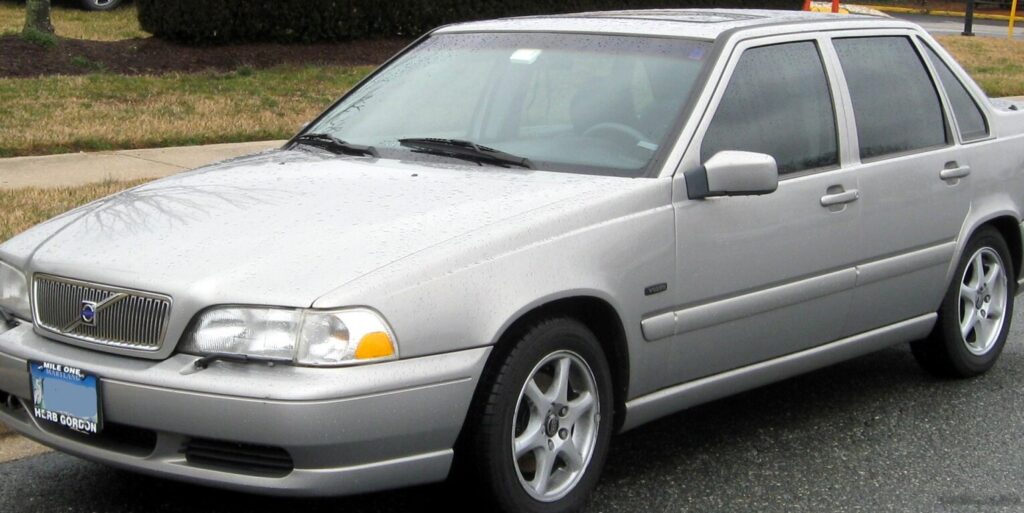
The Volvo S70 2.0 T 20V, produced between 1996 and 2000, represented a key offering in Volvo’s mid-size sedan lineup. Positioned as a more accessible entry point into the S70 range, it provided a blend of Scandinavian practicality, safety, and turbocharged performance. This variant sat below the higher-performance 2.4L models and the naturally aspirated 2.5L versions, targeting buyers who desired a comfortable and efficient sedan with a touch of sporting character. The S70 itself was a significant model for Volvo, replacing the 850 and forming part of the P80 platform family, which also included the V70 wagon.
Technical Specifications
| Brand | Volvo |
| Model | S70 |
| Generation | S70 |
| Type (Engine) | 2.0 T 20 V (180 Hp) Automatic |
| Start of production | 1996 |
| End of production | 2000 |
| Powertrain Architecture | Internal Combustion engine |
| Body type | Sedan |
| Seats | 5 |
| Doors | 4 |
| Fuel consumption (urban) | 16.9 l/100 km (13.9 US mpg, 16.7 UK mpg, 5.9 km/l) |
| Fuel consumption (extra urban) | 8.6 l/100 km (27.4 US mpg, 32.8 UK mpg, 11.6 km/l) |
| Fuel Type | Petrol (Gasoline) |
| Acceleration 0 – 100 km/h | 10 sec |
| Acceleration 0 – 62 mph | 10 sec |
| Acceleration 0 – 60 mph | 9.5 sec |
| Maximum speed | 205 km/h (127.38 mph) |
| Weight-to-power ratio | 7.9 kg/Hp, 125.9 Hp/tonne |
| Weight-to-torque ratio | 6.5 kg/Nm, 153.8 Nm/tonne |
| Power | 180 Hp @ 5700 rpm |
| Power per litre | 90.7 Hp/l |
| Torque | 220 Nm @ 2100 rpm (162.26 lb.-ft. @ 2100 rpm) |
| Engine layout | Front, Transverse |
| Engine Model/Code | B5204T2 |
| Engine displacement | 1984 cm3 (121.07 cu. in.) |
| Number of cylinders | 5 |
| Engine configuration | Inline |
| Cylinder Bore | 81 mm (3.19 in.) |
| Piston Stroke | 77 mm (3.03 in.) |
| Compression ratio | 8.4:1 |
| Number of valves per cylinder | 4 |
| Fuel injection system | Multi-port manifold injection |
| Engine aspiration | Turbocharger |
| Valvetrain | DOHC |
| Engine oil capacity | 5.8 l (6.13 US qt | 5.1 UK qt) |
| Coolant | 7 l (7.4 US qt | 6.16 UK qt) |
| Kerb Weight | 1430 kg (3152.61 lbs.) |
| Max. weight | 1890 kg (4166.74 lbs.) |
| Max load | 460 kg (1014.13 lbs.) |
| Trunk (boot) space – minimum | 470 l (16.6 cu. ft.) |
| Fuel tank capacity | 70 l (18.49 US gal | 15.4 UK gal) |
| Length | 4720 mm (185.83 in.) |
| Width | 1760 mm (69.29 in.) |
| Height | 1400 mm (55.12 in.) |
| Wheelbase | 2660 mm (104.72 in.) |
| Front track | 1520 mm (59.84 in.) |
| Rear (Back) track | 1470 mm (57.87 in.) |
| Drivetrain Architecture | The Internal combustion engine (ICE) drives the front wheels of the vehicle. |
| Drive wheel | Front wheel drive |
| Number of gears and type of gearbox | 4 gears, automatic transmission |
| Front suspension | Wishbone |
| Rear suspension | Coil spring |
| Front brakes | Ventilated discs |
| Rear brakes | Disc |
| Assisting systems | ABS (Anti-lock braking system) |
| Steering type | Steering rack and pinion |
| Power steering | Hydraulic Steering |
| Tires size | 205/55 R15 |
| Wheel rims size | 15 |
Powertrain & Engine Architecture
The heart of the S70 2.0 T was the B5204T2 engine, a 1.984-liter inline-five cylinder powerplant. This engine was a key part of Volvo’s modular engine family, known for its robustness and relatively simple design. The “20V” designation indicated the engine featured 20 valves – four valves per cylinder – enhancing breathing and contributing to its power output. The B5204T2 utilized a low-pressure turbocharger, providing a broad torque curve rather than a peaky power delivery. Fuel delivery was managed by a multi-port fuel injection system, and the engine employed a double overhead camshaft (DOHC) valvetrain. The automatic transmission was a four-speed unit, chosen for its ease of use and suitability for the target market. While not offering the quickest acceleration, it provided smooth shifts and contributed to the car’s overall refinement.
Driving Characteristics
The S70 2.0 T Automatic offered a comfortable and relaxed driving experience. With 180 horsepower and 220 Nm (162 lb-ft) of torque, acceleration was adequate for everyday driving, achieving 0-60 mph in around 9.5 seconds. However, it wasn’t a particularly sporty car. The automatic transmission, while smooth, did sap some of the engine’s potential, resulting in a slightly less responsive feel compared to the available manual transmission. The turbocharger provided a noticeable boost in power during acceleration, but the delivery was linear rather than dramatic. The focus was on usability and comfort, making it a good choice for commuting and long-distance journeys.
Equipment & Trim Levels
The S70 2.0 T typically came with a respectable level of standard equipment. This included power windows, power locks, central locking, and an AM/FM radio with cassette player. Air conditioning was often standard, though it could be optional depending on the specific market. Interior upholstery was typically cloth, with leather options available as an upgrade. Higher trim levels could add features like a sunroof, upgraded audio systems, and wood trim. Safety features were a Volvo hallmark, and the S70 2.0 T included standard ABS brakes and side impact protection systems (SIPS).
Chassis & Braking
The S70 utilized a front-wheel-drive layout with independent wishbone suspension at the front and a coil spring rear suspension. This setup provided a comfortable ride, absorbing bumps and imperfections in the road effectively. The front brakes were ventilated discs, offering good stopping power, while the rear brakes were solid discs. The steering was rack and pinion with hydraulic power assistance, providing a reasonably direct and responsive feel. The S70’s chassis was designed with safety in mind, incorporating a robust structure and crumple zones to protect occupants in the event of a collision.
Market Reception & Comparison
The S70 2.0 T Automatic was generally well-received by critics as a practical and comfortable family sedan. It offered a good balance of features and performance for its price point. Compared to the higher-output 2.4L models, the 2.0 T was less expensive to purchase and operate, but it lacked the same level of performance. The 2.5L naturally aspirated engine offered similar fuel economy but less torque. Fuel economy was reasonable for the time, averaging around 27 mpg on the highway. Reliability was generally good, although like all cars of this era, regular maintenance was crucial.
Legacy
The Volvo S70 2.0 T 20V Automatic has proven to be a relatively durable and reliable vehicle. Many examples are still on the road today, a testament to Volvo’s engineering and build quality. The B5204T2 engine, while not without its quirks, is generally considered a robust unit. In the used car market, the S70 2.0 T represents an affordable and practical option for buyers seeking a comfortable and safe sedan. Its classic Volvo styling and reputation for reliability continue to make it a popular choice among enthusiasts and those looking for a dependable daily driver. However, potential buyers should be aware of the age-related issues common to vehicles of this era, such as corrosion and wear and tear on suspension components.
