
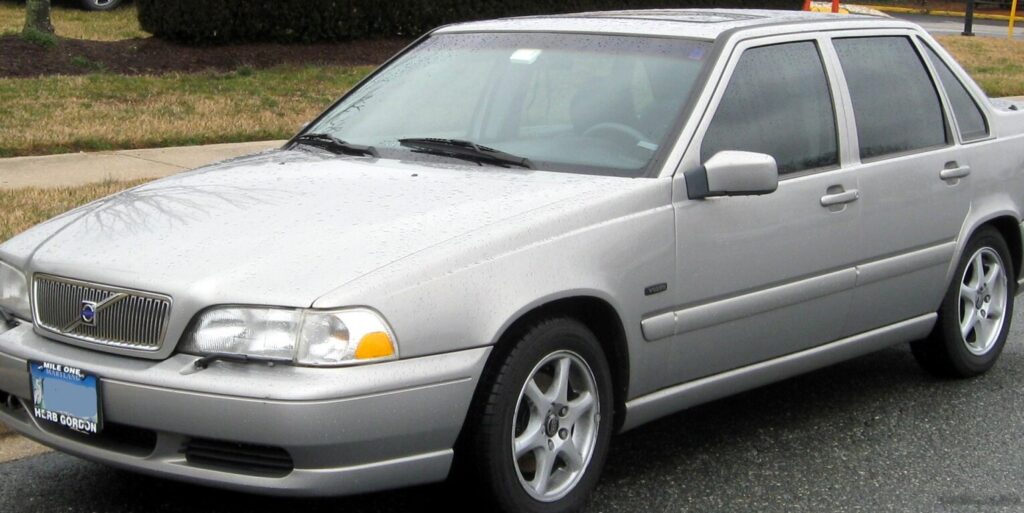
The Volvo S70 2.3 Turbo, produced between 1996 and 2000, represented a significant step forward for Volvo’s mid-size sedan offering. Positioned as the performance variant within the S70 range, it aimed to deliver a blend of Scandinavian practicality, safety, and respectable power. The S70, replacing the 850 series, was built on Volvo’s P80 platform, and the 2.3 Turbo model was a key component in attracting buyers seeking a more engaging driving experience. This model year bridged the gap between Volvo’s traditionally conservative styling and a more modern, aerodynamic aesthetic. It was primarily marketed in Europe and North America, competing with vehicles like the BMW 3 Series, Audi A4, and Saab 900.
Technical Specifications
| Brand | Volvo |
| Model | S70 |
| Generation | S70 |
| Type (Engine) | 2.3 Turbo (250 Hp) |
| Start of production | 1996 |
| End of production | 2000 |
| Powertrain Architecture | Internal Combustion engine |
| Body type | Sedan |
| Seats | 5 |
| Doors | 4 |
| Fuel consumption (economy) – urban | 16.2 l/100 km (14.5 US mpg, 17.4 UK mpg, 6.2 km/l) |
| Fuel consumption (economy) – extra urban | 8.2 l/100 km (28.7 US mpg, 34.4 UK mpg, 12.2 km/l) |
| Fuel Type | Petrol (Gasoline) |
| Acceleration 0 – 100 km/h | 6.7 sec |
| Acceleration 0 – 62 mph | 6.7 sec |
| Acceleration 0 – 60 mph | 6.4 sec |
| Maximum speed | 250 km/h (155.34 mph) |
| Weight-to-power ratio | 5.9 kg/Hp, 169.7 Hp/tonne |
| Weight-to-torque ratio | 4.2 kg/Nm, 237.6 Nm/tonne |
| Power | 250 Hp @ 6000 rpm |
| Power per litre | 107.8 Hp/l |
| Torque | 350 Nm @ 2400 rpm (258.15 lb.-ft. @ 2400 rpm) |
| Engine layout | Front, Transverse |
| Engine Model/Code | B5234T4 |
| Engine displacement | 2319 cm3 (141.51 cu. in.) |
| Number of cylinders | 5 |
| Engine configuration | Inline |
| Cylinder Bore | 81 mm (3.19 in.) |
| Piston Stroke | 90 mm (3.54 in.) |
| Compression ratio | 8.5:1 |
| Number of valves per cylinder | 4 |
| Fuel injection system | Multi-port manifold injection |
| Engine aspiration | Turbocharger |
| Valvetrain | DOHC |
| Engine oil capacity | 5.8 l (6.13 US qt | 5.1 UK qt) |
| Coolant | 7 l (7.4 US qt | 6.16 UK qt) |
| Kerb Weight | 1473 kg (3247.41 lbs.) |
| Max. weight | 1920 kg (4232.88 lbs.) |
| Max load | 447 kg (985.47 lbs.) |
| Trunk (boot) space – minimum | 470 l (16.6 cu. ft.) |
| Fuel tank capacity | 70 l (18.49 US gal | 15.4 UK gal) |
| Length | 4720 mm (185.83 in.) |
| Width | 1760 mm (69.29 in.) |
| Height | 1390 mm (54.72 in.) |
| Wheelbase | 2660 mm (104.72 in.) |
| Front track | 1520 mm (59.84 in.) |
| Rear (Back) track | 1470 mm (57.87 in.) |
| Drivetrain Architecture | The Internal combustion engine (ICE) drives the front wheels of the vehicle. |
| Drive wheel | Front wheel drive |
| Number of gears and type of gearbox | 5 gears, manual transmission |
| Front suspension | Wishbone |
| Rear suspension | Coil spring |
| Front brakes | Ventilated discs |
| Rear brakes | Disc |
| Assisting systems | ABS (Anti-lock braking system) |
| Steering type | Steering rack and pinion |
| Power steering | Hydraulic Steering |
| Tires size | 205/45 R17 |
| Wheel rims size | 17 |
Powertrain & Engine Architecture
The heart of the S70 2.3 Turbo was the B5234T4 engine, a 2.3-liter inline-five cylinder powerplant. This engine was a development of Volvo’s earlier five-cylinder designs, known for their smoothness and inherent balance. The ‘T’ designation indicated the presence of a turbocharger, and the ‘4’ denoted a specific iteration of the engine management system. The B5234T4 utilized a Mitsubishi TD04HL-13C turbocharger, boosting output to 250 horsepower at 6000 rpm and 350 Nm (258 lb-ft) of torque at a relatively low 2400 rpm. Fuel delivery was managed by Bosch multi-port fuel injection. The engine featured a double overhead camshaft (DOHC) valvetrain with four valves per cylinder, contributing to its strong performance across the rev range. The standard transmission for this model was a 5-speed manual gearbox, although a 4-speed automatic transmission was also available, albeit with a slight reduction in peak torque.
Driving Characteristics
The S70 2.3 Turbo with the manual transmission offered a genuinely engaging driving experience for its time. Acceleration to 60 mph was achieved in around 6.4 seconds, and the car felt responsive and capable on both winding roads and open highways. The turbocharger provided a noticeable surge of power, but it was relatively linear, avoiding the abruptness sometimes associated with turbocharged engines. The 5-speed manual gearbox was well-matched to the engine’s powerband, allowing drivers to keep the engine in its sweet spot. The automatic transmission, while offering convenience, did diminish some of the engine’s responsiveness and resulted in slightly slower acceleration times. Steering was precise, and the suspension provided a comfortable ride without sacrificing handling stability.
Equipment & Trim Levels
The S70 2.3 Turbo typically came well-equipped, reflecting Volvo’s commitment to safety and comfort. Standard features included power windows, power locks, a sunroof, and air conditioning. Higher trim levels added features such as leather upholstery, heated front seats, a premium sound system, and automatic climate control. Safety features were a hallmark of Volvo, and the S70 2.3 Turbo included standard ABS brakes, side airbags, and a reinforced safety cage. Optional extras included traction control and a rear park assist system.
Chassis & Braking
The S70’s chassis featured independent front suspension with MacPherson struts and a multi-link rear suspension. This setup provided a good balance between ride comfort and handling precision. Brakes were ventilated discs at the front and solid discs at the rear, providing ample stopping power. The ABS system helped to maintain control during hard braking maneuvers. The S70 2.3 Turbo typically came equipped with 17-inch alloy wheels and 205/45 R17 tires, contributing to its sporty appearance and improved grip.
Market Reception & Comparison
The S70 2.3 Turbo was generally well-received by automotive critics. It was praised for its strong performance, comfortable ride, and high levels of safety. However, some critics noted that its styling was somewhat conservative compared to its European rivals. Compared to the naturally aspirated S70 models, the 2.3 Turbo offered a significant performance upgrade. It also provided a more affordable alternative to the higher-performance models from German manufacturers. Fuel economy was reasonable for a turbocharged engine of its time, but it was not a class leader. Reliability was generally good, although some owners reported issues with the turbocharger and the electronic ignition system.
Legacy
The Volvo S70 2.3 Turbo remains a popular choice among enthusiasts today. Its combination of performance, practicality, and safety has made it a desirable used car. The B5234T4 engine is known for its durability and tunability, and many owners have modified their S70s to increase power output. While parts availability can be a concern for older vehicles, a dedicated community of Volvo enthusiasts ensures that support and information are readily available. The S70 2.3 Turbo represents a high point in Volvo’s engineering and design, and it continues to be appreciated for its unique character and Scandinavian charm.
