
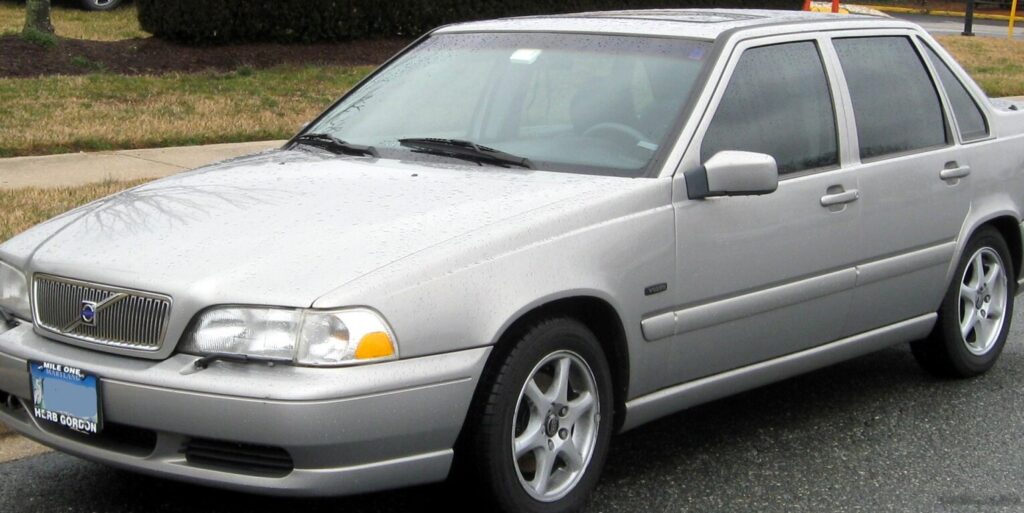
The Volvo S70 2.5i 10V, produced between 1996 and 2000, represented Volvo’s entry into the mid-size luxury sedan segment, succeeding the 850. Positioned as a more refined and mature offering compared to its predecessor, the S70 aimed to balance Scandinavian practicality with a touch of elegance. This particular variant, equipped with the 2.5-liter inline-five engine producing 144 horsepower, and a five-speed manual transmission, served as a core model within the S70 lineup, appealing to buyers seeking a comfortable and reliable daily driver. It was a key component of Volvo’s strategy to establish a stronger presence in the North American market, where sedans were favored over the more unconventional 850 wagon.
Technical Specifications
| Brand | Volvo |
| Model | S70 |
| Generation | S70 |
| Type (Engine) | 2.5 i 10V (144 Hp) |
| Start of production | 1996 |
| End of production | 2000 |
| Powertrain Architecture | Internal Combustion engine |
| Body type | Sedan |
| Seats | 5 |
| Doors | 4 |
| Fuel consumption (urban) | 14.2 l/100 km (16.6 US mpg) |
| Fuel consumption (extra urban) | 8 l/100 km (29.4 US mpg) |
| Fuel Type | Petrol (Gasoline) |
| Acceleration 0 – 100 km/h | 10.2 sec |
| Acceleration 0 – 62 mph | 10.2 sec |
| Acceleration 0 – 60 mph | 9.7 sec |
| Maximum speed | 205 km/h (127.38 mph) |
| Weight-to-power ratio | 9.9 kg/Hp |
| Weight-to-torque ratio | 6.9 kg/Nm |
| Power | 144 Hp @ 5400 rpm |
| Torque | 206 Nm @ 3600 rpm (151.94 lb.-ft. @ 3600 rpm) |
| Engine layout | Front, Transverse |
| Engine Model/Code | B5252S |
| Engine displacement | 2435 cm3 (148.59 cu. in.) |
| Number of cylinders | 5 |
| Engine configuration | Inline |
| Cylinder Bore | 83 mm (3.27 in.) |
| Piston Stroke | 90 mm (3.54 in.) |
| Compression ratio | 10:1 |
| Number of valves per cylinder | 2 |
| Fuel injection system | Multi-port manifold injection |
| Engine aspiration | Naturally aspirated engine |
| Valvetrain | DOHC |
| Engine oil capacity | 5.8 l (6.13 US qt | 5.1 UK qt) |
| Coolant | 7.2 l (7.61 US qt | 6.34 UK qt) |
| Kerb Weight | 1430 kg (3152.61 lbs.) |
| Max. weight | 1890 kg (4166.74 lbs.) |
| Max load | 460 kg (1014.13 lbs.) |
| Trunk (boot) space – minimum | 470 l (16.6 cu. ft.) |
| Fuel tank capacity | 70 l (18.49 US gal | 15.4 UK gal) |
| Length | 4720 mm (185.83 in.) |
| Width | 1760 mm (69.29 in.) |
| Height | 1400 mm (55.12 in.) |
| Wheelbase | 2660 mm (104.72 in.) |
| Front track | 1520 mm (59.84 in.) |
| Rear (Back) track | 1470 mm (57.87 in.) |
| Drivetrain Architecture | The Internal combustion engine (ICE) drives the front wheels of the vehicle. |
| Drive wheel | Front wheel drive |
| Number of gears and type of gearbox | 5 gears, manual transmission |
| Front suspension | Wishbone |
| Rear suspension | Coil spring |
| Front brakes | Ventilated discs |
| Rear brakes | Disc |
| Assisting systems | ABS (Anti-lock braking system) |
| Steering type | Steering rack and pinion |
| Power steering | Hydraulic Steering |
| Tires size | 195/60 R15 |
| Wheel rims size | 15 |
Powertrain & Engine Architecture
The heart of the S70 2.5i 10V is the B5252S engine, a 2.435-liter inline-five cylinder powerplant. This engine, a hallmark of Volvo’s engineering during the period, featured a cast iron block and an aluminum cylinder head. The ‘10V’ designation refers to the engine’s ten valves – two valves per cylinder (both intake and exhaust). Fuel delivery was managed by a Bosch multi-port fuel injection system, providing a balance between efficiency and performance. The engine’s DOHC (Double Overhead Camshaft) valvetrain contributed to improved breathing and power output. The five-speed manual transmission, a Getrag unit, was known for its smooth shifting and durability. This combination provided a reasonably responsive driving experience, although it wasn’t designed for outright speed.
Driving Characteristics
The S70 2.5i 10V with a manual transmission offered a comfortable and predictable driving experience. Acceleration from 0-60 mph took around 9.7 seconds, making it competitive with other mid-size sedans of the era. The engine delivered its peak torque at 3600 rpm, providing adequate pulling power for everyday driving and highway merging. The manual gearbox allowed for greater driver control, and the gear ratios were well-suited for both city and highway conditions. Compared to the higher-output 2.5T turbocharged version, the 2.5i felt noticeably less powerful, but it offered better fuel economy and a simpler mechanical layout. The handling was secure and predictable, typical of Volvo’s focus on safety and stability.
Equipment & Trim Levels
The S70 2.5i 10V typically came standard with features such as power windows, power locks, air conditioning, and an AM/FM stereo. Upholstery was generally cloth, although leather options were available. Higher trim levels offered upgrades like a sunroof, upgraded audio systems, and wood trim interior accents. Safety features were a Volvo hallmark, and the S70 included standard ABS brakes and side-impact protection systems. Optional extras included automatic climate control, heated front seats, and a rear window defroster.
Chassis & Braking
The S70 utilized a front-wheel-drive layout with an independent wishbone front suspension and a coil spring rear suspension. This setup provided a comfortable ride and decent handling characteristics. The braking system consisted of ventilated discs at the front and solid discs at the rear, providing adequate stopping power for the vehicle’s weight. ABS (Anti-lock Braking System) was standard, enhancing safety during emergency braking situations. The steering was rack-and-pinion with hydraulic power assistance, offering a responsive and precise feel.
Market Reception & Comparison
The S70 2.5i 10V was generally well-received by automotive critics as a comfortable, safe, and reliable sedan. However, it wasn’t considered a particularly exciting or sporty vehicle. Compared to the turbocharged 2.5T variant, the 2.5i offered better fuel economy – around 29.4 US mpg on the highway – but significantly less performance. Reliability was generally good, although some owners reported issues with the electronic climate control system. The S70 competed with other mid-size sedans such as the Honda Accord, Toyota Camry, and BMW 3 Series.
Legacy
The Volvo S70 2.5i 10V has proven to be a durable and long-lasting vehicle. Many examples are still on the road today, a testament to Volvo’s build quality and engineering. The B5252S engine is known for its robustness and relatively simple maintenance requirements. In the used car market, the S70 2.5i 10V represents an affordable and practical option for buyers seeking a safe and reliable sedan. While it may not offer the performance or features of more modern vehicles, its classic Volvo design and reputation for durability continue to appeal to a dedicated following.
