
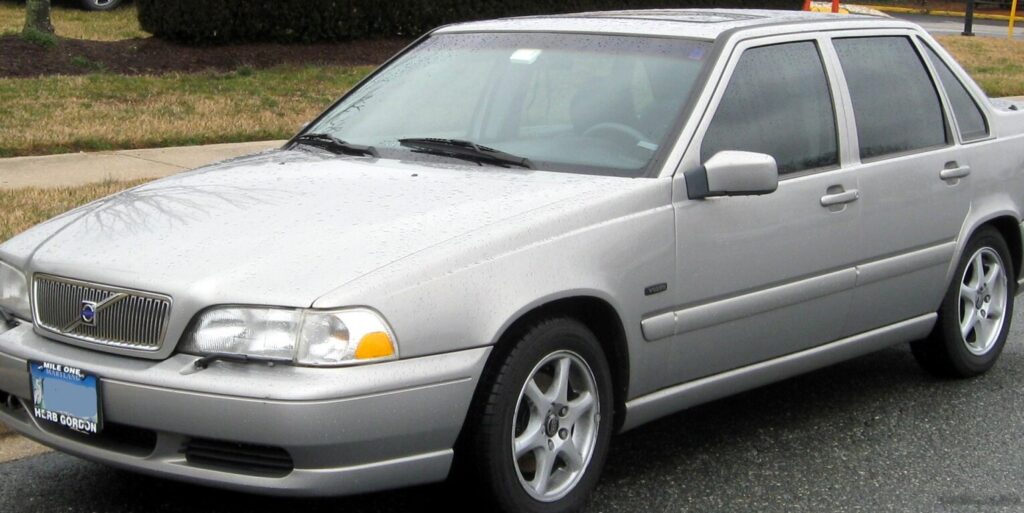
The Volvo S70 2.5 TDi, produced between 1996 and 2000, represented Volvo’s entry into the increasingly popular diesel sedan market, particularly in Europe. Positioned as a more fuel-efficient alternative to the gasoline-powered S70 models, the 2.5 TDi aimed to provide a balance of practicality, comfort, and reasonable performance. It was part of the first generation S70 (P24), which was based on the 850 platform, and served as a bridge between Volvo’s older designs and the more modern styling that would characterize later models. This variant was primarily sold in Europe, where diesel engines held a significant market share, and was not widely available in North America.
Technical Specifications
| Brand | Volvo |
| Model | S70 |
| Generation | S70 |
| Type (Engine) | 2.5 TDi (140 Hp) |
| Start of production | 1996 |
| End of production | 2000 |
| Powertrain Architecture | Internal Combustion engine |
| Body type | Sedan |
| Seats | 5 |
| Doors | 4 |
| Fuel consumption (urban) | 9 l/100 km (26.1 US mpg, 31.4 UK mpg, 11.1 km/l) |
| Fuel consumption (extra urban) | 5.2 l/100 km (45.2 US mpg, 54.3 UK mpg, 19.2 km/l) |
| Fuel consumption (combined) | 6.6 l/100 km (35.6 US mpg, 42.8 UK mpg, 15.2 km/l) |
| Fuel Type | Diesel |
| Acceleration 0 – 100 km/h | 9.9 sec |
| Acceleration 0 – 62 mph | 9.9 sec |
| Acceleration 0 – 60 mph | 9.4 sec |
| Maximum speed | 200 km/h (124.27 mph) |
| Weight-to-power ratio | 10.8 kg/Hp, 92.7 Hp/tonne |
| Weight-to-torque ratio | 5.2 kg/Nm, 192.1 Nm/tonne |
| Power | 140 Hp @ 4000 rpm |
| Power per litre | 56.9 Hp/l |
| Torque | 290 Nm @ 1900 rpm (213.89 lb.-ft. @ 1900 rpm) |
| Engine layout | Front, Transverse |
| Engine Model/Code | D5252T |
| Engine displacement | 2461 cm3 (150.18 cu. in.) |
| Number of cylinders | 5 |
| Engine configuration | Inline |
| Cylinder Bore | 81 mm (3.19 in.) |
| Piston Stroke | 95.5 mm (3.76 in.) |
| Compression ratio | 20.5:1 |
| Number of valves per cylinder | 2 |
| Fuel injection system | Direct injection |
| Engine aspiration | Turbocharger |
| Valvetrain | OHC |
| Engine oil capacity | 6 l (6.34 US qt | 5.28 UK qt) |
| Coolant | 12.5 l (13.21 US qt | 11 UK qt) |
| Kerb Weight | 1510 kg (3328.98 lbs.) |
| Max. weight | 1960 kg (4321.06 lbs.) |
| Max load | 450 kg (992.08 lbs.) |
| Trunk (boot) space – minimum | 470 l (16.6 cu. ft.) |
| Fuel tank capacity | 70 l (18.49 US gal | 15.4 UK gal) |
| Length | 4720 mm (185.83 in.) |
| Width | 1760 mm (69.29 in.) |
| Height | 1400 mm (55.12 in.) |
| Wheelbase | 2660 mm (104.72 in.) |
| Front track | 1520 mm (59.84 in.) |
| Rear (Back) track | 1470 mm (57.87 in.) |
| Drivetrain Architecture | The Internal combustion engine (ICE) drives the front wheels of the vehicle. |
| Drive wheel | Front wheel drive |
| Number of gears and type of gearbox | 5 gears, manual transmission |
| Front suspension | Wishbone |
| Rear suspension | Coil spring |
| Front brakes | Ventilated discs |
| Rear brakes | Disc |
| Assisting systems | ABS (Anti-lock braking system) |
| Steering type | Steering rack and pinion |
| Power steering | Hydraulic Steering |
| Tires size | 190/60 R15 |
| Wheel rims size | 15 |
Powertrain & Engine Architecture
The heart of the S70 2.5 TDi is the Volvo D5252T engine, a 2.5-liter inline five-cylinder diesel. This engine, developed in collaboration with Renault, was a significant step forward for Volvo in diesel technology. It featured direct fuel injection, a turbocharger, and an overhead camshaft (OHC) valvetrain. The direct injection system, crucial for modern diesel performance, allowed for precise fuel delivery and improved combustion efficiency. The turbocharger boosted power output, compensating for the inherent limitations of diesel engines in terms of horsepower. The D5252T produced 140 horsepower at 4000 rpm and a substantial 290 Nm (213.89 lb-ft) of torque at a low 1900 rpm. This torque curve provided strong low-end and mid-range acceleration, making it well-suited for everyday driving and overtaking. The engine was paired with a 5-speed manual transmission, offering a balance between fuel economy and driver control. An automatic transmission was also available, though it was less common and generally resulted in slightly reduced fuel efficiency.
Driving Characteristics
The S70 2.5 TDi with the manual transmission offered a surprisingly engaging driving experience. While not a sports sedan, the ample torque made it feel responsive in most situations. The 0-60 mph time of around 9.4 seconds was respectable for the era, and the top speed of 200 km/h (124 mph) was adequate for highway cruising. The manual gearbox was well-matched to the engine’s characteristics, allowing drivers to exploit the torque band effectively. The automatic transmission, while providing convenience, did diminish the sense of control and resulted in slightly slower acceleration. Compared to the gasoline-powered S70 variants, the 2.5 TDi prioritized fuel economy over outright performance. It lacked the higher horsepower figures of the petrol engines, but it offered significantly better fuel consumption, making it a more economical choice for long-distance driving.
Equipment & Trim Levels
The S70 2.5 TDi typically came with a reasonable level of standard equipment. This included power windows, central locking, power steering, and an anti-lock braking system (ABS). Interior upholstery was generally cloth, though leather options were available. Dashboard configuration was typical of Volvo at the time, prioritizing functionality and ergonomics. Optional extras included a sunroof, upgraded audio systems, and climate control. Trim levels varied depending on the market, but generally, the 2.5 TDi occupied a mid-range position in the S70 lineup, offering a good balance of features and affordability.
Chassis & Braking
The S70 2.5 TDi utilized a front-wheel-drive layout with a wishbone front suspension and a coil spring rear suspension. This setup provided a comfortable ride quality, although it wasn’t particularly sporty. The front brakes were ventilated discs, offering good stopping power, while the rear brakes were solid discs. The ABS system enhanced braking safety, particularly in slippery conditions. The chassis was designed to accommodate the added weight of the diesel engine and its associated components. Stabilizer bars were fitted to both the front and rear axles to reduce body roll during cornering.
Market Reception & Comparison
The S70 2.5 TDi was generally well-received by automotive critics in Europe. It was praised for its fuel efficiency, comfortable ride, and strong torque output. However, some critics noted that it lacked the refinement and performance of some of its competitors. Compared to other trims in the S70 lineup, the 2.5 TDi offered a more economical alternative to the gasoline engines. It was particularly appealing to drivers who prioritized fuel economy and low-running costs. The 2.5 TDi was often compared to similar diesel sedans from German manufacturers, such as the Volkswagen Passat TDI and the Audi A4 TDI.
Legacy
The Volvo S70 2.5 TDi, while not a groundbreaking vehicle, played an important role in establishing Volvo as a competitor in the European diesel market. The D5252T engine proved to be a reliable and durable powerplant, and many examples are still on the road today. However, like all older diesel engines, they can be susceptible to issues related to fuel injectors, turbochargers, and emissions control systems. In the used car market, the S70 2.5 TDi remains a relatively affordable and practical option, particularly for those seeking a comfortable and fuel-efficient sedan. Its simple mechanical design and readily available parts make it a relatively easy vehicle to maintain, though finding qualified mechanics familiar with older Volvo diesels can sometimes be a challenge.
