
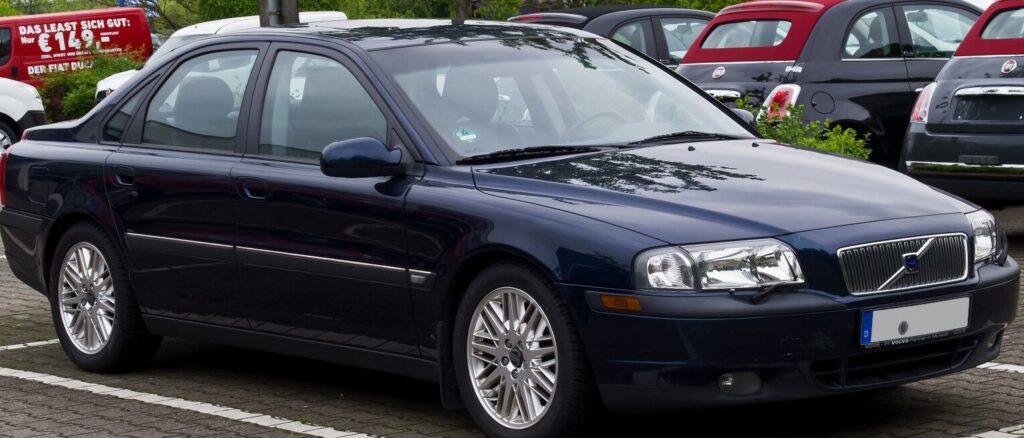
The Volvo S80 2.0T, produced from 1998 to 1999, represented an entry point into Volvo’s flagship sedan range during the first generation (P1) of the S80. Positioned below the more powerful 2.8L and 3.0L six-cylinder models, the 2.0T offered a balance of Scandinavian luxury and reasonable performance, aimed at buyers prioritizing fuel efficiency and a more accessible price point. It was built on Volvo’s P2 platform, shared with the contemporary Volvo V70 estate. This variant was primarily sold in European markets, where smaller displacement engines were favored due to taxation and fuel costs.
Technical Specifications
| Brand | Volvo |
| Model | S80 |
| Generation | S80 (P1) |
| Type (Engine) | 2.0T (163 Hp) |
| Start of production | 1998 |
| End of production | 1999 |
| Powertrain Architecture | Internal Combustion Engine |
| Body type | Sedan |
| Seats | 5 |
| Doors | 4 |
| Fuel consumption (urban) | 11.4 l/100 km (20.6 US mpg) |
| Fuel consumption (extra urban) | 7.6 l/100 km (30.9 US mpg) |
| Fuel consumption (combined) | 9.5 l/100 km (24.8 US mpg) |
| Fuel Type | Petrol (Gasoline) |
| Acceleration 0 – 100 km/h | 9.2 sec |
| Acceleration 0 – 62 mph | 9.2 sec |
| Acceleration 0 – 60 mph | 8.7 sec |
| Maximum speed | 220 km/h (136.7 mph) |
| Weight-to-power ratio | 9.2 kg/Hp |
| Weight-to-torque ratio | 6.5 kg/Nm |
| Power | 163 Hp @ 5100 rpm |
| Torque | 230 Nm @ 1800 rpm (169.64 lb.-ft. @ 1800 rpm) |
| Engine layout | Front, Transverse |
| Engine Model/Code | B5204T4 |
| Engine displacement | 1984 cm3 (121.07 cu. in.) |
| Number of cylinders | 5 |
| Engine configuration | Inline |
| Cylinder Bore | 81 mm (3.19 in.) |
| Piston Stroke | 77 mm (3.03 in.) |
| Compression ratio | 9.7:1 |
| Number of valves per cylinder | 4 |
| Fuel injection system | Multi-port manifold injection |
| Engine aspiration | Turbocharger |
| Valvetrain | DOHC |
| Engine oil capacity | 5.8 l (6.13 US qt | 5.1 UK qt) |
| Coolant capacity | 8.8 l (9.3 US qt | 7.74 UK qt) |
| Kerb Weight | 1500 kg (3306.93 lbs.) |
| Max. weight | 2000 kg (4409.25 lbs.) |
| Max load | 500 kg (1102.31 lbs.) |
| Trunk (boot) space – minimum | 440 l (15.54 cu. ft.) |
| Trunk (boot) space – maximum | 1106 l (39.06 cu. ft.) |
| Fuel tank capacity | 80 l (21.13 US gal | 17.6 UK gal) |
| Length | 4820 mm (189.76 in.) |
| Width | 1830 mm (72.05 in.) |
| Height | 1440 mm (56.69 in.) |
| Wheelbase | 2790 mm (109.84 in.) |
| Front track | 1580 mm (62.2 in.) |
| Rear track | 1560 mm (61.42 in.) |
| Drivetrain Architecture | Front Wheel Drive |
| Number of gears | 5 |
| Gearbox type | Manual Transmission |
| Front suspension | Wishbone |
| Rear suspension | Coil spring |
| Front brakes | Ventilated discs |
| Rear brakes | Disc |
| Assisting systems | ABS (Anti-lock braking system) |
| Steering type | Steering rack and pinion |
| Power steering | Hydraulic |
| Tires size | 215/55 R16 |
| Wheel rims size | 16 |
Powertrain & Engine Architecture
The S80 2.0T was powered by Volvo’s B5204T4 engine, a 1984cc (121.07 cubic inches) inline-five cylinder gasoline engine. This engine was a key part of Volvo’s modular engine family, known for its robustness and relatively simple design. The ‘T’ designation indicated the presence of a turbocharger, boosting power output. The B5204T4 utilized a single overhead camshaft (SOHC) design per cylinder bank, operating four valves per cylinder (DOHC). Fuel delivery was managed by a multi-port fuel injection system, providing precise fuel metering for improved efficiency and performance. The turbocharger, a Mitsubishi unit, provided increased air intake, allowing for a higher compression ratio of 9.7:1. The engine was transversely mounted in the front of the vehicle, driving the front wheels. The standard transmission was a five-speed manual gearbox, although a four-speed automatic transmission was also available as an option. The automatic transmission, while offering convenience, did slightly diminish acceleration compared to the manual version.
Driving Characteristics
The S80 2.0T with the manual transmission offered a reasonably engaging driving experience for its time. The 163 horsepower and 230 Nm (169.64 lb-ft) of torque provided adequate acceleration, with a 0-60 mph time of around 8.7 seconds. The turbocharger provided a noticeable boost in power, particularly in the mid-range, making overtaking maneuvers relatively effortless. However, the engine did exhibit some turbo lag, requiring the driver to downshift to access peak power. The automatic transmission version, while smoother, felt noticeably slower due to the transmission’s less efficient power delivery and wider gear ratios. The S80’s suspension, tuned for comfort, provided a smooth ride, but handling was not particularly sporty. The front-wheel-drive configuration could lead to understeer when pushed hard through corners.
Equipment & Trim Levels
The S80 2.0T typically came equipped with a respectable level of standard features for a luxury sedan of its era. These included power windows, power locks, central locking, and air conditioning. Interior upholstery was typically cloth, although leather was available as an optional upgrade. The dashboard featured a clean, Scandinavian design with intuitive controls. Optional extras included a sunroof, upgraded audio system, and heated front seats. Safety was a key focus for Volvo, and the S80 2.0T came standard with ABS anti-lock brakes and a driver’s side airbag. Passenger airbags were often included as an option.
Chassis & Braking
The S80 2.0T utilized a MacPherson strut front suspension and a multi-link rear suspension, providing a comfortable ride and reasonable handling. The front brakes were ventilated discs, offering good stopping power, while the rear brakes were solid discs. The steering was a rack-and-pinion system with hydraulic power assistance, providing a light and responsive feel. The standard tire size was 215/55 R16, mounted on 16-inch alloy wheels. The chassis was designed to provide a balance of rigidity and weight reduction, contributing to the car’s overall stability.
Market Reception & Comparison
The S80 2.0T was generally well-received by automotive critics as an affordable entry point into the S80 range. It was praised for its comfortable ride, spacious interior, and standard safety features. However, some critics noted that the engine lacked the refinement and power of the larger six-cylinder engines. Compared to the S80 2.8L and 3.0L models, the 2.0T offered significantly lower performance but also better fuel economy. It was also more affordable to purchase and maintain. In terms of reliability, the B5204T4 engine proved to be relatively robust, although turbocharger failures could occur over time. The automatic transmission, while convenient, was sometimes criticized for its sluggishness and potential for long-term issues.
Legacy
The Volvo S80 2.0T, while not the most powerful or prestigious version of the S80, remains a popular choice among Volvo enthusiasts and used car buyers. Its relatively simple mechanical design and robust engine make it a relatively affordable and reliable classic. Parts availability is generally good, and maintenance costs are reasonable. Today, well-maintained examples of the S80 2.0T can still provide comfortable and reliable transportation, offering a taste of Scandinavian luxury at an accessible price point. The inline-five engine, in particular, has gained a cult following among Volvo aficionados for its unique sound and character.
