
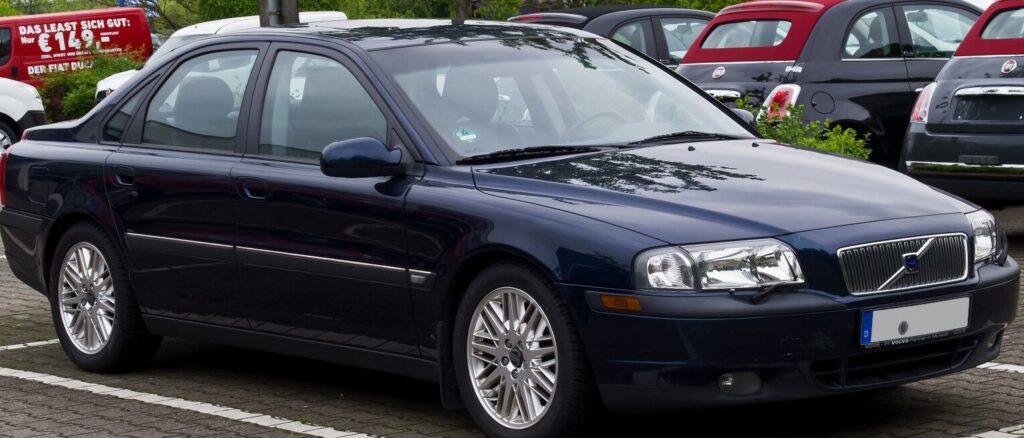
The Volvo S80 2.0T Automatic, produced from 1998 to 1999, represented an entry point into Volvo’s flagship sedan range during the first generation (P1) of the S80. Positioned below the more powerful 2.9L and later V6 models, the 2.0T offered a balance of Volvo’s renowned safety and comfort with a more accessible price point. It was primarily aimed at buyers seeking a refined, spacious sedan with decent performance and fuel economy, rather than outright sporting prowess. This variant was built on Volvo’s P1 platform, shared with the first-generation S70 and V70 models, and served as a crucial volume seller for the brand.
Technical Specifications
| Brand | Volvo |
| Model | S80 |
| Generation | S80 (P1) |
| Type (Engine) | 2.0T (163 Hp) Automatic |
| Start of production | 1998 |
| End of production | 1999 |
| Powertrain Architecture | Internal Combustion Engine |
| Body type | Sedan |
| Seats | 5 |
| Doors | 4 |
| Fuel consumption (urban) | 11.4 l/100 km (20.6 US mpg) |
| Fuel consumption (extra urban) | 7.6 l/100 km (30.9 US mpg) |
| Fuel consumption (combined) | 9.9 l/100 km (23.8 US mpg) |
| Fuel Type | Petrol (Gasoline) |
| Acceleration 0 – 100 km/h | 10.1 sec |
| Acceleration 0 – 62 mph | 10.1 sec |
| Acceleration 0 – 60 mph | 9.6 sec |
| Maximum speed | 210 km/h (130.49 mph) |
| Weight-to-power ratio | 9.2 kg/Hp |
| Weight-to-torque ratio | 6.5 kg/Nm |
| Power | 163 Hp @ 5100 rpm |
| Torque | 230 Nm @ 1800 rpm (169.64 lb.-ft. @ 1800 rpm) |
| Engine layout | Front, Transverse |
| Engine Model/Code | B5204T4 |
| Engine displacement | 1984 cm3 (121.07 cu. in.) |
| Number of cylinders | 5 |
| Engine configuration | Inline |
| Cylinder Bore | 81 mm (3.19 in.) |
| Piston Stroke | 77 mm (3.03 in.) |
| Compression ratio | 9.7:1 |
| Number of valves per cylinder | 4 |
| Fuel injection system | Multi-port manifold injection |
| Engine aspiration | Turbocharger |
| Valvetrain | DOHC |
| Engine oil capacity | 5.8 l (6.13 US qt | 5.1 UK qt) |
| Coolant capacity | 8.8 l (9.3 US qt | 7.74 UK qt) |
| Kerb Weight | 1500 kg (3306.93 lbs.) |
| Max. weight | 2000 kg (4409.25 lbs.) |
| Max load | 500 kg (1102.31 lbs.) |
| Trunk (boot) space – minimum | 440 l (15.54 cu. ft.) |
| Trunk (boot) space – maximum | 1106 l (39.06 cu. ft.) |
| Fuel tank capacity | 80 l (21.13 US gal | 17.6 UK gal) |
| Length | 4820 mm (189.76 in.) |
| Width | 1830 mm (72.05 in.) |
| Height | 1440 mm (56.69 in.) |
| Wheelbase | 2790 mm (109.84 in.) |
| Front track | 1580 mm (62.2 in.) |
| Rear track | 1560 mm (61.42 in.) |
| Drivetrain Architecture | Front Wheel Drive |
| Number of gears | 4 |
| Gearbox type | Automatic Transmission |
| Front suspension | Wishbone |
| Rear suspension | Coil spring |
| Front brakes | Ventilated discs |
| Rear brakes | Disc |
| Assisting systems | ABS (Anti-lock braking system) |
| Steering type | Steering rack and pinion |
| Power steering | Hydraulic |
| Tires size | 215/55 R16 |
| Wheel rims size | 16 |
Powertrain & Engine Architecture
The heart of the S80 2.0T was the Volvo B5204T4 engine, a 1.984-liter inline-five cylinder gasoline engine. This engine was a key part of Volvo’s modular engine family, known for its robustness and relatively simple design. The ‘T’ designation indicated the presence of a turbocharger, which significantly boosted power output compared to the naturally aspirated 2.0L variants. The B5204T4 utilized a multi-port fuel injection system, delivering fuel directly into the intake ports, and a double overhead camshaft (DOHC) valvetrain for efficient cylinder filling. The turbocharger itself was a Mitsubishi unit, providing approximately 8 psi of boost. The engine was transversely mounted in the front of the vehicle. The automatic transmission was a four-speed unit, sourced from Aisin-Warner. While not particularly advanced by modern standards, it provided smooth shifts and adequate performance for the intended market.
Driving Characteristics
The S80 2.0T Automatic offered a comfortable and refined driving experience, prioritizing smoothness over outright performance. With 163 horsepower and 230 Nm (169.64 lb-ft) of torque, acceleration from 0-60 mph took around 9.6 seconds, and 0-100 km/h in 10.1 seconds. The four-speed automatic transmission, while reliable, did contribute to a noticeable lack of urgency compared to the five-speed manual versions. Gear ratios were tuned for fuel efficiency and comfortable cruising, rather than aggressive acceleration. The turbocharger provided a noticeable boost in power during overtaking maneuvers, but turbo lag was present, particularly at lower engine speeds. The front-wheel-drive configuration offered predictable handling, but lacked the dynamic capabilities of all-wheel-drive Volvos.
Equipment & Trim Levels
The S80 2.0T Automatic typically came with a respectable level of standard equipment, reflecting Volvo’s commitment to safety and comfort. Standard features included power windows, power locks, air conditioning, and an AM/FM stereo. Safety features were a major selling point, with standard ABS brakes and a driver’s side airbag. Upholstery was typically cloth, although leather was available as an option. Optional extras included a sunroof, upgraded audio systems, and heated front seats. Trim levels were relatively simple, with the 2.0T serving as the base model. Higher trim levels, available with the larger engines, offered more luxurious appointments and additional features.
Chassis & Braking
The S80 2.0T utilized a conventional front suspension with MacPherson struts and a multi-link rear suspension with coil springs. This setup provided a comfortable ride, absorbing bumps and imperfections in the road effectively. The braking system consisted of ventilated discs on the front wheels and solid discs on the rear. ABS (Anti-lock Braking System) was standard, enhancing braking performance and stability, particularly in adverse conditions. The steering was a hydraulic rack-and-pinion system, providing responsive and precise steering feel. Stabilizer bars were fitted to both the front and rear axles to reduce body roll during cornering.
Market Reception & Comparison
The S80 2.0T Automatic was generally well-received by critics as a comfortable, safe, and practical sedan. However, its performance was often criticized as being somewhat underwhelming, particularly compared to the more powerful engine options. Fuel economy was considered reasonable for its class, averaging around 23.8 US mpg in combined driving. Compared to the 2.9L inline-six and later V6 models, the 2.0T offered a lower purchase price but sacrificed performance. The 2.0T was also often compared to its German rivals, such as the Audi A6 and BMW 5 Series, but typically offered a more comfortable ride and a stronger emphasis on safety.
Legacy
The Volvo S80 2.0T Automatic, while not the most sought-after variant, has proven to be a relatively reliable and durable vehicle. The B5204T4 engine is known for its longevity, and the four-speed automatic transmission is generally robust. Today, these cars are relatively affordable on the used car market, making them an attractive option for buyers seeking a comfortable and safe sedan. However, potential buyers should be aware of potential issues such as turbocharger wear and oil leaks. Despite its age, the S80 2.0T remains a testament to Volvo’s commitment to safety, comfort, and durability.
