
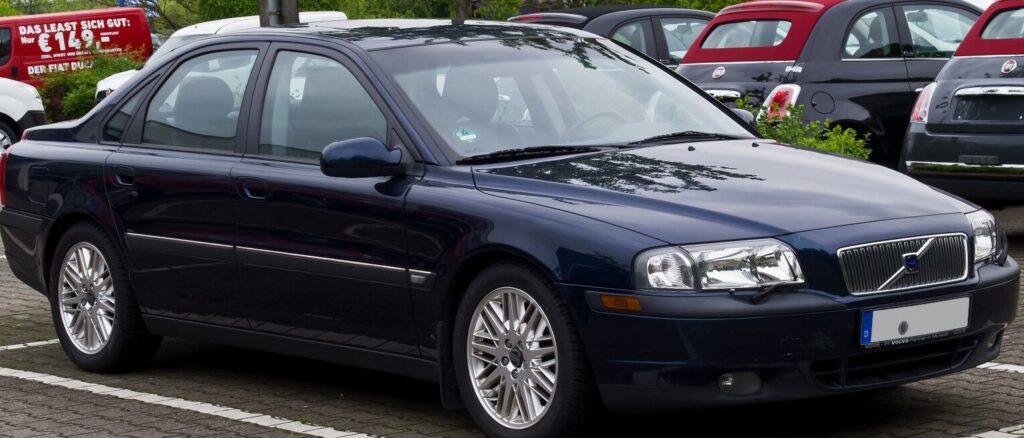
The Volvo S80 2.0T Automatic, produced between 2000 and 2003, represented an entry point into Volvo’s flagship sedan range for European and select international markets. Positioned below the higher-specification 2.4L and 2.9L models, the 2.0T offered a balance of performance, fuel efficiency, and Volvo’s renowned safety features. It was part of the second-generation S80 (designated as the TS platform), which aimed to elevate Volvo’s presence in the premium executive car segment. This variant catered to buyers seeking a comfortable and refined driving experience without the higher price tag associated with the more powerful engine options.
Technical Specifications
| Brand | Volvo |
| Model | S80 |
| Generation | S80 |
| Type (Engine) | 2.0T (180 Hp) Automatic |
| Start of production | 2000 year |
| End of production | 2003 year |
| Powertrain Architecture | Internal Combustion engine |
| Body type | Sedan |
| Seats | 5 |
| Doors | 4 |
| Fuel consumption (economy) – urban | 14.7 l/100 km (16 US mpg, 19.2 UK mpg, 6.8 km/l) |
| Fuel consumption (economy) – extra urban | 7.9 l/100 km (29.8 US mpg, 35.8 UK mpg, 12.7 km/l) |
| Fuel Type | Petrol (Gasoline) |
| Acceleration 0 – 100 km/h | 9.8 sec |
| Acceleration 0 – 62 mph | 9.8 sec |
| Acceleration 0 – 60 mph | 9.3 sec |
| Maximum speed | 215 km/h (133.59 mph) |
| Weight-to-power ratio | 8.3 kg/Hp, 120.8 Hp/tonne |
| Weight-to-torque ratio | 6.2 kg/Nm, 161.1 Nm/tonne |
| Power | 180 Hp @ 5300 rpm |
| Power per litre | 90.7 Hp/l |
| Torque | 240 Nm @ 2200 rpm (177.01 lb.-ft. @ 2200 rpm) |
| Engine layout | Front, Transverse |
| Engine Model/Code | B5204T5 |
| Engine displacement | 1984 cm3 (121.07 cu. in.) |
| Number of cylinders | 5 |
| Engine configuration | Inline |
| Cylinder Bore | 81 mm (3.19 in.) |
| Piston Stroke | 77 mm (3.03 in.) |
| Compression ratio | 9.5:1 |
| Number of valves per cylinder | 4 |
| Fuel injection system | Multi-port manifold injection |
| Engine aspiration | Turbocharger |
| Valvetrain | DOHC |
| Engine oil capacity | 5.5 l (5.81 US qt | 4.84 UK qt) |
| Coolant | 8.8 l (9.3 US qt | 7.74 UK qt) |
| Kerb Weight | 1490 kg (3284.89 lbs.) |
| Max. weight | 2050 kg (4519.48 lbs.) |
| Max load | 560 kg (1234.59 lbs.) |
| Trunk (boot) space – minimum | 460 l (16.24 cu. ft.) |
| Trunk (boot) space – maximum | 1126 l (39.76 cu. ft.) |
| Fuel tank capacity | 80 l (21.13 US gal | 17.6 UK gal) |
| Length | 4822 mm (189.84 in.) |
| Width | 1832 mm (72.13 in.) |
| Height | 1434 mm (56.46 in.) |
| Wheelbase | 2791 mm (109.88 in.) |
| Front track | 1562 mm (61.5 in.) |
| Rear (Back) track | 1560 mm (61.42 in.) |
| Drivetrain Architecture | The Internal combustion engine (ICE) drives the front wheels of the vehicle. |
| Drive wheel | Front wheel drive |
| Number of gears and type of gearbox | 5 gears, automatic transmission |
| Front suspension | Wishbone |
| Rear suspension | Coil spring |
| Front brakes | Ventilated discs |
| Rear brakes | Disc |
| Assisting systems | ABS (Anti-lock braking system) |
| Steering type | Steering rack and pinion |
| Power steering | Hydraulic Steering |
| Tires size | 215/55 R16 |
| Wheel rims size | 16 |
Powertrain & Engine Architecture
The heart of the S80 2.0T was the B5204T5 engine, a 1.984-liter inline-five cylinder gasoline engine. This engine was a key component of Volvo’s modular engine family, known for its robustness and relatively simple design. The B5204T5 featured a light-pressure turbocharger, providing a boost in power and torque without the complexities of more advanced turbocharging systems. Fuel delivery was handled by a multi-port fuel injection system, ensuring efficient combustion. The engine utilized a double overhead camshaft (DOHC) valvetrain with four valves per cylinder, optimizing airflow for improved performance. The five-speed automatic transmission, sourced from Aisin Warner, was chosen for its smooth shifting characteristics and reliability. This transmission was calibrated to prioritize comfort and ease of driving, rather than outright performance.
Driving Characteristics
The S80 2.0T Automatic offered a comfortable and refined driving experience. While not particularly sporty, the 180 horsepower engine provided adequate power for everyday driving and highway cruising. Acceleration from 0-60 mph took approximately 9.3 seconds, and the car had a top speed of 133.59 mph. The automatic transmission, while smooth, did contribute to a slight loss of responsiveness compared to the available manual transmission. Gear ratios were optimized for fuel efficiency and relaxed cruising, meaning the engine could feel somewhat strained during hard acceleration. The front-wheel-drive configuration provided predictable handling, but lacked the dynamic capabilities of all-wheel-drive Volvos.
Equipment & Trim Levels
The S80 2.0T typically came equipped with a respectable level of standard features. These included power windows, power locks, air conditioning, a basic audio system, and ABS brakes. Interior upholstery was typically cloth, with optional leather available. Dashboard design was functional and understated, reflecting Volvo’s focus on practicality and safety. Common optional extras included a sunroof, upgraded audio systems, heated front seats, and automatic climate control. The trim level could vary depending on the market, but generally, the 2.0T represented a mid-range offering, bridging the gap between the base models and the more luxurious trims.
Chassis & Braking
The S80 2.0T utilized a front suspension system based on independent wishbones, providing a comfortable ride and decent handling. The rear suspension employed a coil spring setup. Braking duties were handled by ventilated discs at the front and solid discs at the rear. The ABS anti-lock braking system was standard, enhancing safety during emergency braking situations. Steering was rack and pinion, with hydraulic power assistance. The chassis was designed to prioritize comfort and stability, rather than sporty handling. Stabilizer bars were fitted to both the front and rear axles to reduce body roll during cornering.
Market Reception & Comparison
The S80 2.0T Automatic received generally positive reviews, particularly for its comfort, safety features, and fuel efficiency. Critics noted that it wasn’t the most exciting car to drive, but it provided a refined and relaxing experience. Compared to the higher-output 2.4L and 2.9L models, the 2.0T offered a more affordable entry point into the S80 range. Fuel economy was noticeably better with the 2.0T, making it a more practical choice for drivers covering long distances. Reliability was generally good, although the turbocharger could require maintenance over time. Compared to competitors like the BMW 5 Series and Mercedes-Benz E-Class, the S80 2.0T offered a unique blend of Scandinavian design, safety, and practicality.
Legacy
The Volvo S80 2.0T Automatic has proven to be a relatively durable and reliable vehicle. Many examples are still on the road today, testament to Volvo’s engineering quality. The B5204T5 engine, while not without its potential issues (such as oil leaks and turbocharger wear), is generally considered to be a robust and long-lasting unit. In the used car market, the S80 2.0T represents a good value proposition for buyers seeking a comfortable, safe, and relatively affordable executive sedan. However, potential buyers should be aware of the age-related maintenance requirements and the potential for turbocharger issues. The S80 2.0T remains a popular choice for those who appreciate Volvo’s understated elegance and commitment to safety.
