
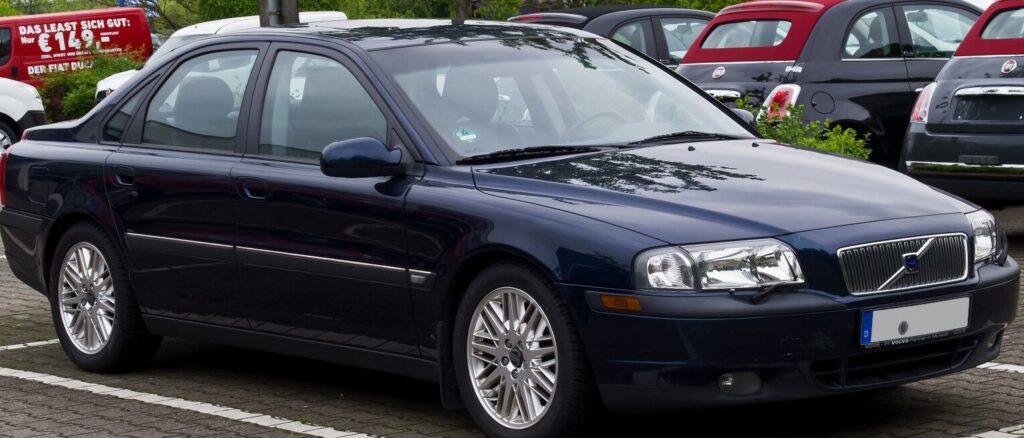
The Volvo S80 2.4 20V, producing 140 horsepower, was a mainstay of the second-generation S80 (1998-2006) lineup from 1999 to 2003. Positioned as an entry-level to mid-range offering, it provided a balance of Volvo’s renowned safety features and comfortable ride with a more accessible price point. This variant played a crucial role in establishing the S80 as a competitor in the executive sedan segment, particularly in European and North American markets where Volvo sought to expand its presence beyond its traditional niche.
Technical Specifications
| Brand | Volvo |
| Model | S80 |
| Generation | S80 |
| Type (Engine) | 2.4 20V (140 Hp) |
| Start of production | 1999 |
| End of production | 2003 |
| Powertrain Architecture | Internal Combustion engine |
| Body type | Sedan |
| Seats | 5 |
| Doors | 4 |
| Fuel consumption (urban) | 12.9 l/100 km (18.2 US mpg) |
| Fuel consumption (extra urban) | 6.9 l/100 km (34.1 US mpg) |
| Fuel consumption (combined) | 8.6 l/100 km (27.4 US mpg) |
| Fuel Type | Petrol (Gasoline) |
| Acceleration 0 – 100 km/h | 11 sec |
| Acceleration 0 – 62 mph | 11 sec |
| Acceleration 0 – 60 mph | 10.5 sec |
| Maximum speed | 205 km/h (127.38 mph) |
| Weight-to-power ratio | 10.6 kg/Hp |
| Weight-to-torque ratio | 6.8 kg/Nm |
| Power | 140 Hp @ 4500 rpm |
| Power per litre | 57.5 Hp/l |
| Torque | 220 Nm @ 3750 rpm (162.26 lb.-ft. @ 3750 rpm) |
| Engine layout | Front, Transverse |
| Engine Model/Code | B5244S2 |
| Engine displacement | 2435 cm3 (148.59 cu. in.) |
| Number of cylinders | 5 |
| Engine configuration | Inline |
| Cylinder Bore | 83 mm (3.27 in.) |
| Piston Stroke | 90 mm (3.54 in.) |
| Compression ratio | 10.3:1 |
| Number of valves per cylinder | 4 |
| Fuel injection system | Multi-port manifold injection |
| Engine aspiration | Naturally aspirated engine |
| Valvetrain | DOHC |
| Engine oil capacity | 5.5 l (5.81 US qt | 4.84 UK qt) |
| Coolant | 8 l (8.45 US qt | 7.04 UK qt) |
| Kerb Weight | 1490 kg (3284.89 lbs.) |
| Max. weight | 2140 kg (4717.89 lbs.) |
| Max load | 650 kg (1433 lbs.) |
| Trunk (boot) space – minimum | 440 l (15.54 cu. ft.) |
| Trunk (boot) space – maximum | 1106 l (39.06 cu. ft.) |
| Fuel tank capacity | 80 l (21.13 US gal | 17.6 UK gal) |
| Length | 4822 mm (189.84 in.) |
| Width | 1832 mm (72.13 in.) |
| Height | 1434 mm (56.46 in.) |
| Wheelbase | 2791 mm (109.88 in.) |
| Front track | 1562 mm (61.5 in.) |
| Rear (Back) track | 1560 mm (61.42 in.) |
| Drivetrain Architecture | The Internal combustion engine (ICE) drives the front wheels of the vehicle. |
| Drive wheel | Front wheel drive |
| Number of gears and type of gearbox | 5 gears, manual transmission |
| Front suspension | Wishbone |
| Rear suspension | Coil spring |
| Front brakes | Ventilated discs |
| Rear brakes | Disc |
| Assisting systems | ABS (Anti-lock braking system) |
| Steering type | Steering rack and pinion |
| Power steering | Hydraulic Steering |
| Tires size | 205/65 R15 |
| Wheel rims size | 15 |
Powertrain & Engine Architecture
The S80 2.4 20V was powered by Volvo’s B5244S2 engine, a 2.4-liter inline-five cylinder gasoline engine. This engine was a cornerstone of Volvo’s mid-size and large car offerings for many years. The “20V” designation refers to the engine’s 20 valves (four valves per cylinder). The B5244S2 utilized a multi-port fuel injection system, delivering fuel directly into the intake ports, and a double overhead camshaft (DOHC) valvetrain for optimized airflow and efficient combustion. The engine’s design prioritized smooth operation and reasonable fuel economy over outright performance. The 5-cylinder configuration offered a unique engine note and a good balance between refinement and power delivery. The engine was transversely mounted in the front of the vehicle, driving the front wheels. The standard transmission for this variant was a 5-speed manual, though a 4-speed automatic transmission was also available, impacting performance and fuel economy.
Driving Characteristics
The 140 horsepower and 220 Nm (162 lb-ft) of torque provided by the 2.4-liter engine delivered adequate, but not exhilarating, performance. Acceleration from 0 to 60 mph took around 10.5 to 11 seconds, making it competitive with other executive sedans of the era, but noticeably slower than the higher-powered S80 variants like the T6 with its turbocharged engine. The manual transmission offered a more engaging driving experience and slightly improved fuel economy, while the automatic provided convenience, particularly in urban driving. The automatic’s gear ratios were tuned for comfort and fuel efficiency rather than sporty acceleration. The S80 2.4 20V prioritized a comfortable ride and predictable handling over sharp cornering ability. The front-wheel-drive configuration provided good traction in most conditions, but lacked the all-weather capability of Volvo’s all-wheel-drive systems.
Equipment & Trim Levels
The S80 2.4 20V typically came standard with features expected of an executive sedan, including power windows, power locks, air conditioning, and an AM/FM stereo. Upholstery was typically cloth, though leather was available as an option. Higher trim levels offered features such as a sunroof, upgraded audio systems, and wood trim interior accents. Safety features were a Volvo hallmark, and the S80 2.4 20V included standard ABS brakes and front airbags. Optional safety equipment included side airbags and traction control. The dashboard layout was functional and ergonomically designed, prioritizing ease of use.
Chassis & Braking
The S80 2.4 20V utilized a front suspension featuring independent wishbones and coil springs, providing a comfortable ride and reasonable handling. The rear suspension employed a semi-independent coil spring setup. Braking duties were handled by ventilated discs at the front and solid discs at the rear. The ABS anti-lock braking system was standard, enhancing braking performance and stability. Steering was rack-and-pinion with hydraulic power assistance, providing a light and responsive feel. The standard tire size was 205/65 R15, mounted on 15-inch steel or alloy wheels.
Market Reception & Comparison
The S80 2.4 20V was generally well-received by automotive critics as a comfortable, safe, and practical executive sedan. However, its performance was often criticized as being somewhat underwhelming compared to competitors. Fuel economy was considered average for its class. Compared to the more powerful S80 T6, the 2.4 20V offered a more affordable entry point into the S80 range, appealing to buyers who prioritized value and fuel efficiency over outright performance. Compared to the diesel variants available in Europe, the 2.4 20V offered a smoother and quieter driving experience, but at the expense of fuel economy.
Legacy
The B5244S2 engine proved to be a durable and reliable powerplant, and many S80 2.4 20V models remain on the road today. While not known for being particularly complex, regular maintenance, including oil changes and timing belt replacements, is crucial for long-term reliability. The S80 2.4 20V represents a significant step forward in Volvo’s design and engineering, showcasing the company’s commitment to safety, comfort, and Scandinavian design. In the used car market, these models are often sought after for their affordability and reputation for reliability, making them a practical choice for budget-conscious buyers seeking a comfortable and safe sedan.
