
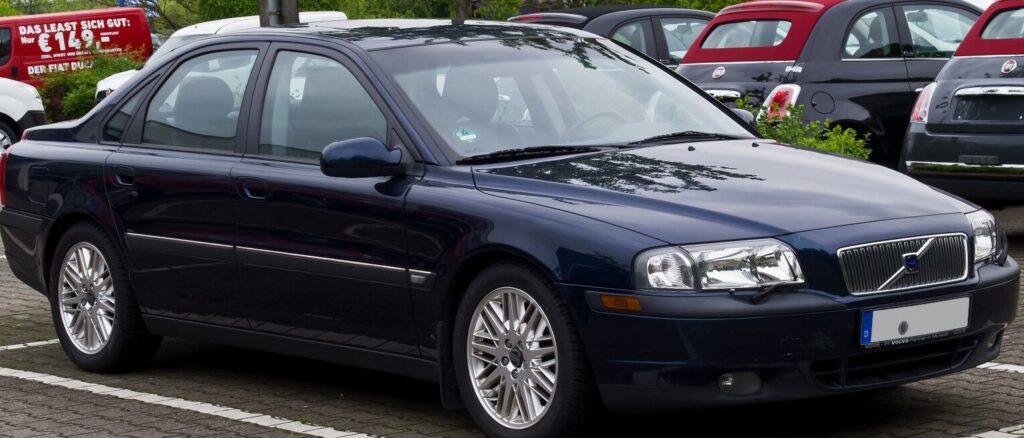
The Volvo S80 2.4 TDi, produced between 2001 and 2003, represented Volvo’s foray into offering a diesel-powered executive sedan, primarily aimed at the European market where diesel engines held significant popularity. This variant occupied a mid-range position within the second-generation S80 (P2 platform) lineup, offering a balance between fuel efficiency and reasonable performance. It served as an alternative to the gasoline-powered S80 models, appealing to drivers prioritizing economy and long-distance comfort. While not officially sold in the United States during this period, the S80 2.4 TDi is increasingly appreciated by enthusiasts for its robust build quality and relatively simple diesel technology.
Technical Specifications
| Brand | Volvo |
| Model | S80 |
| Generation | S80 (P2) |
| Type (Engine) | 2.4 TDi (130 Hp) |
| Start of production | 2001 |
| End of production | 2003 |
| Powertrain Architecture | Internal Combustion Engine |
| Body type | Sedan |
| Seats | 5 |
| Doors | 4 |
| Fuel consumption (urban) | 8.8 l/100 km (26.7 US mpg) |
| Fuel consumption (extra urban) | 5.1 l/100 km (46.1 US mpg) |
| Fuel consumption (combined) | 6.5 l/100 km (36.2 US mpg) |
| Fuel Type | Diesel |
| Acceleration 0 – 100 km/h | 11.9 sec |
| Acceleration 0 – 62 mph | 11.9 sec |
| Acceleration 0 – 60 mph | 11.3 sec |
| Maximum speed | 200 km/h (124.27 mph) |
| Weight-to-power ratio | 12.1 kg/Hp |
| Weight-to-torque ratio | 5.6 kg/Nm |
| Power | 130 Hp @ 4000 rpm |
| Torque | 280 Nm @ 1750 rpm (206.52 lb.-ft. @ 1750 rpm) |
| Engine layout | Front, Transverse |
| Engine Model/Code | D5244T2 |
| Engine displacement | 2401 cm3 (146.52 cu. in.) |
| Number of cylinders | 5 |
| Engine configuration | Inline |
| Cylinder Bore | 81 mm (3.19 in.) |
| Piston Stroke | 93 mm (3.66 in.) |
| Compression ratio | 18:1 |
| Number of valves per cylinder | 4 |
| Fuel injection system | Diesel Commonrail |
| Engine aspiration | Turbocharger, Intercooler |
| Valvetrain | DOHC |
| Engine oil capacity | 6.5 l (6.87 US qt) |
| Coolant capacity | 12.5 l (13.21 US qt) |
| Kerb Weight | 1570 kg (3461.26 lbs.) |
| Max. weight | 2070 kg (4563.57 lbs.) |
| Max load | 500 kg (1102.31 lbs.) |
| Trunk (boot) space (minimum) | 440 l (15.54 cu. ft.) |
| Trunk (boot) space (maximum) | 1106 l (39.06 cu. ft.) |
| Fuel tank capacity | 80 l (21.13 US gal) |
| Length | 4820 mm (189.76 in.) |
| Width | 1830 mm (72.05 in.) |
| Height | 1450 mm (57.09 in.) |
| Wheelbase | 2790 mm (109.84 in.) |
| Front track | 1580 mm (62.2 in.) |
| Rear track | 1560 mm (61.42 in.) |
| Drivetrain | Front Wheel Drive |
| Number of gears | 5 |
| Gearbox type | Manual Transmission |
| Front suspension | Wishbone |
| Rear suspension | Coil spring |
| Front brakes | Ventilated discs |
| Rear brakes | Disc |
| Assisting systems | ABS (Anti-lock braking system) |
| Steering type | Steering rack and pinion |
| Power steering | Hydraulic |
| Tires size | 215/55 R16 |
| Wheel rims size | 16 |
INTRODUCTION
The Volvo S80 2.4 TDi, launched in 2001, was a key component of Volvo’s strategy to broaden the appeal of its flagship sedan. Built on the P2 platform, which underpinned the second-generation S80, this diesel variant offered a compelling alternative to the petrol engines available. The 2.4 TDi was primarily targeted at European buyers who valued fuel efficiency and torque for long-distance driving. It represented a shift for Volvo, which had traditionally focused on gasoline engines, and aimed to capture a larger share of the growing diesel market. Production continued until 2003, with the model being superseded by updated diesel offerings.
Powertrain & Engine Architecture
At the heart of the S80 2.4 TDi lies the Volvo D5244T2 engine, a 2.4-liter inline-five cylinder diesel. This engine is notable for its robust construction and relatively simple design, contributing to its longevity. The D5244T2 utilizes a common rail direct injection system, delivering fuel directly into the cylinders at extremely high pressure for optimized combustion. A turbocharger with an intercooler is employed to boost power output and improve torque across the rev range. The engine features a double overhead camshaft (DOHC) valvetrain with four valves per cylinder, enhancing breathing and efficiency. The engine’s 18:1 compression ratio is typical for a diesel engine, maximizing thermal efficiency. The 2.4 TDi was paired with a five-speed manual transmission, providing a balance between fuel economy and driver control. While an automatic transmission was available on other S80 models, it wasn’t commonly offered with the 2.4 TDi.
Driving Characteristics
The S80 2.4 TDi, with its 130 horsepower and 280 Nm (206 lb-ft) of torque, offered a comfortable and relaxed driving experience. Acceleration from 0-60 mph took around 11.3 seconds, which was adequate for everyday driving but not particularly sporty. The engine’s strength lay in its mid-range torque, making it well-suited for overtaking and cruising on highways. The five-speed manual transmission provided precise shifts, although the gear ratios were geared towards fuel efficiency rather than outright performance. Compared to the higher-output petrol S80 variants, the 2.4 TDi felt less responsive, but it compensated with significantly better fuel economy. The manual transmission also offered a more engaging driving experience than the optional automatic found on other S80 trims.
Equipment & Trim Levels
The S80 2.4 TDi typically came equipped with a respectable level of standard features, reflecting its position as an executive sedan. Standard equipment generally included power windows, power mirrors, central locking, and an air conditioning system. Interior upholstery was typically cloth, although leather options were available. Dashboard configuration was consistent across the S80 range, featuring a clean and functional design. Optional extras included a sunroof, upgraded audio system, and heated front seats. Safety features, a hallmark of Volvo, were also prominent, with ABS brakes and airbags as standard equipment.
Chassis & Braking
The S80 2.4 TDi utilized a front-engine, front-wheel-drive layout. The front suspension employed a wishbone configuration, providing a comfortable ride and good handling characteristics. The rear suspension featured coil springs, contributing to the car’s overall stability. Braking duties were handled by ventilated discs at the front and solid discs at the rear, providing adequate stopping power. ABS (Anti-lock Braking System) was standard, enhancing safety during emergency braking situations. The chassis was tuned to prioritize comfort and refinement, rather than sporty handling.
Market Reception & Comparison
The S80 2.4 TDi was generally well-received by automotive critics in Europe, who praised its fuel efficiency, comfortable ride, and robust build quality. However, some reviewers noted that the engine lacked the refinement and performance of some of its competitors. Compared to the petrol-powered S80 models, the 2.4 TDi offered significantly better fuel economy, making it an attractive option for high-mileage drivers. Compared to other diesel-powered executive sedans of the time, such as the BMW 5 Series and Mercedes-Benz E-Class, the S80 2.4 TDi offered a competitive package in terms of price and features.
Legacy
The Volvo S80 2.4 TDi has proven to be a relatively reliable vehicle, thanks to its robust engine and simple diesel technology. The D5244T2 engine is known for its durability, and with proper maintenance, it can withstand high mileage. In the used car market, the S80 2.4 TDi remains a popular choice for buyers seeking a comfortable, fuel-efficient, and well-built executive sedan. While parts availability may be becoming more challenging as the car ages, the engine’s simplicity makes it relatively easy to maintain. The S80 2.4 TDi represents a significant chapter in Volvo’s history, marking its successful entry into the diesel executive sedan market.
