
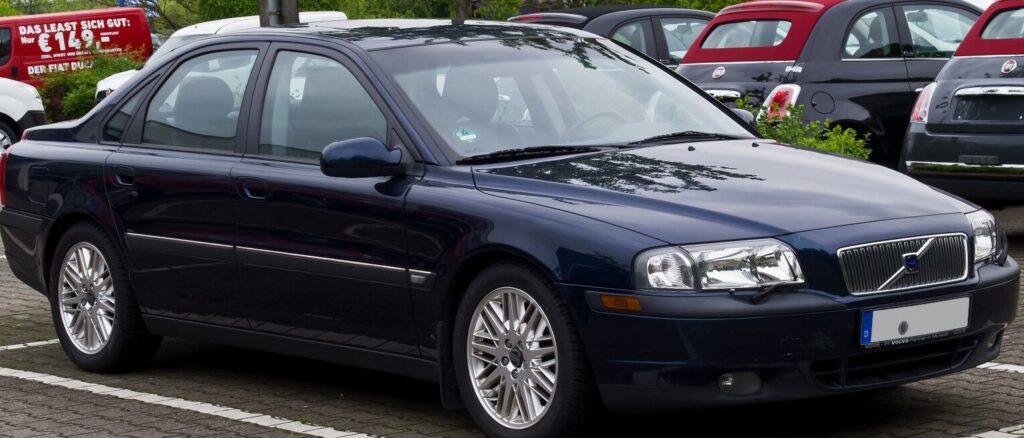
The Volvo S80 2.5 TDI, produced between 1999 and 2000, represented Volvo’s foray into offering a diesel-powered executive sedan, primarily aimed at the European market where diesel engines enjoyed significant popularity due to fuel economy and taxation benefits. This variant occupied a middle ground within the first-generation (P1) S80 lineup, positioned below the more powerful petrol-fueled options like the 2.9 and above the base 2.4 models. It offered a blend of reasonable performance and improved fuel efficiency compared to its gasoline counterparts, appealing to drivers prioritizing long-distance comfort and lower running costs. The S80 itself was Volvo’s flagship sedan, intended to compete with established German rivals like the BMW 5 Series and Mercedes-Benz E-Class.
Technical Specifications
| Brand | Volvo |
| Model | S80 |
| Generation | S80 (P1) |
| Type (Engine) | 2.5 TDI (140 Hp) |
| Start of production | 1999 |
| End of production | 2000 |
| Powertrain Architecture | Internal Combustion engine |
| Body type | Sedan |
| Seats | 5 |
| Doors | 4 |
| Fuel consumption (urban) | 7.8 l/100 km (30.2 US mpg) |
| Fuel consumption (extra urban) | 5.2 l/100 km (45.2 US mpg) |
| Fuel consumption (combined) | 6.5 l/100 km (36.2 US mpg) |
| Fuel Type | Diesel |
| Acceleration 0 – 100 km/h | 11 sec |
| Acceleration 0 – 62 mph | 11 sec |
| Acceleration 0 – 60 mph | 10.5 sec |
| Maximum speed | 205 km/h (127.38 mph) |
| Weight-to-power ratio | 11.1 kg/Hp |
| Weight-to-torque ratio | 5.3 kg/Nm |
| Power | 140 Hp @ 4000 rpm |
| Torque | 290 Nm @ 1900 rpm (213.89 lb.-ft. @ 1900 rpm) |
| Engine layout | Front, Transverse |
| Engine Model/Code | D5252T |
| Engine displacement | 2461 cm3 (150.18 cu. in.) |
| Number of cylinders | 5 |
| Engine configuration | Inline |
| Cylinder Bore | 81 mm (3.19 in.) |
| Piston Stroke | 95.5 mm (3.76 in.) |
| Compression ratio | 20.5:1 |
| Number of valves per cylinder | 2 |
| Fuel injection system | Direct injection |
| Engine aspiration | Turbocharger |
| Valvetrain | OHC |
| Engine oil capacity | 6 l (6.34 US qt | 5.28 UK qt) |
| Coolant capacity | 12.5 l (13.21 US qt | 11 UK qt) |
| Kerb Weight | 1550 kg (3417.17 lbs.) |
| Max. weight | 2140 kg (4717.89 lbs.) |
| Max load | 590 kg (1300.73 lbs.) |
| Trunk (boot) space – minimum | 440 l (15.54 cu. ft.) |
| Trunk (boot) space – maximum | 1106 l (39.06 cu. ft.) |
| Fuel tank capacity | 70 l (18.49 US gal | 15.4 UK gal) |
| Length | 4822 mm (189.84 in.) |
| Width | 1832 mm (72.13 in.) |
| Height | 1434 mm (56.46 in.) |
| Wheelbase | 2791 mm (109.88 in.) |
| Front track | 1562 mm (61.5 in.) |
| Rear track | 1560 mm (61.42 in.) |
| Drivetrain | Front wheel drive |
| Number of gears | 5 |
| Gearbox type | Manual transmission |
| Front suspension | Wishbone |
| Rear suspension | Coil spring |
| Front brakes | Ventilated discs |
| Rear brakes | Disc |
| Assisting systems | ABS (Anti-lock braking system) |
| Steering type | Steering rack and pinion |
| Power steering | Hydraulic |
| Tires size | 205/65 R15 |
| Wheel rims size | 15 |
Introduction
The Volvo S80 2.5 TDI, launched in 1999 and continuing through 2000, was a key variant in the first generation of Volvo’s full-size sedan. Built on the P1 platform, it aimed to broaden the S80’s appeal by offering a diesel alternative to the existing petrol engines. This model was particularly significant in European markets, where diesel fuel was more affordable and offered better fuel economy than gasoline. The 2.5 TDI utilized Volvo’s D5252T engine, a five-cylinder turbocharged diesel, and was typically paired with a five-speed manual transmission, though automatic options were sometimes available depending on the specific market.
Powertrain & Engine Architecture
At the heart of the S80 2.5 TDI lies the D5252T engine, a 2.5-liter inline five-cylinder diesel. This engine featured direct fuel injection, a technology that improved combustion efficiency and reduced emissions. The turbocharger, a key component, boosted power output by forcing more air into the cylinders. The engine produced 140 horsepower at 4000 rpm and a respectable 290 Nm (213.89 lb.-ft.) of torque at a low 1900 rpm. This torque curve provided good low-end responsiveness, making it suitable for everyday driving and overtaking maneuvers. The five-speed manual transmission was the most common pairing, offering a balance between fuel efficiency and driver control. The transmission’s gear ratios were tuned to maximize the engine’s torque, providing adequate acceleration without excessive engine speed. While an automatic transmission was offered in some markets, it generally resulted in slightly reduced fuel economy and a less engaging driving experience.
Driving Characteristics
The S80 2.5 TDI, with its 140 hp and manual transmission, offered a comfortable and refined driving experience. Acceleration from 0 to 60 mph took around 10.5 seconds, which was adequate for the time but not particularly sporty. The engine’s strong low-end torque made it easy to drive in urban environments and provided sufficient power for highway cruising. Compared to the higher-output petrol versions of the S80, the 2.5 TDI felt less eager to rev, but it compensated with better fuel economy. The manual transmission allowed for precise gear selection, and the clutch was relatively light and easy to operate. The suspension, tuned for comfort, absorbed bumps and imperfections in the road well, providing a smooth ride. However, the S80 2.5 TDI wasn’t designed for spirited driving; its focus was on providing a relaxed and comfortable experience for both driver and passengers.
Equipment & Trim Levels
The S80 2.5 TDI typically came with a reasonable level of standard equipment. This included power windows, power locks, air conditioning, and an AM/FM radio. Higher trim levels offered options such as leather upholstery, a sunroof, and upgraded audio systems. Safety features were a Volvo hallmark, and the S80 2.5 TDI included standard ABS brakes and airbags. The interior design was typically Scandinavian, characterized by clean lines and a focus on functionality. The dashboard layout was straightforward and easy to use, with clearly labeled controls. The seats were comfortable and supportive, providing good long-distance comfort.
Chassis & Braking
The S80 2.5 TDI utilized a front-wheel-drive layout with independent wishbone suspension at the front and a coil spring rear suspension. This setup provided a good balance between ride comfort and handling. The front brakes were ventilated discs, offering good stopping power, while the rear brakes were solid discs. ABS (Anti-lock Braking System) was standard, enhancing safety by preventing wheel lockup during hard braking. The steering was a rack-and-pinion system with hydraulic power assistance, providing precise and responsive steering feel. The tires were typically 205/65 R15, offering a good compromise between comfort and grip.
Market Reception & Comparison
The S80 2.5 TDI was generally well-received by automotive critics, particularly in Europe. It was praised for its fuel efficiency, comfortable ride, and strong low-end torque. However, some critics noted that its acceleration was not as brisk as that of the petrol-powered models. Compared to the 2.4 petrol version, the 2.5 TDI offered significantly better fuel economy, making it a more economical choice for high-mileage drivers. Compared to the more powerful 2.9 and 3.0 petrol engines, the 2.5 TDI was less expensive to purchase and maintain, but it lacked the same level of performance. The 2.5 TDI appealed to buyers who prioritized fuel economy and comfort over outright speed.
Legacy
The Volvo S80 2.5 TDI, while a relatively short-lived variant, played a role in establishing Volvo as a provider of diesel-powered luxury sedans. The D5252T engine proved to be a reliable and durable unit, and many examples are still on the road today. In the used car market, the S80 2.5 TDI represents a relatively affordable entry point into Volvo ownership. However, potential buyers should be aware of the typical maintenance requirements for a diesel engine, such as regular servicing of the fuel injection system and turbocharger. Overall, the S80 2.5 TDI remains a comfortable, economical, and reasonably reliable choice for those seeking a classic Volvo sedan.
