
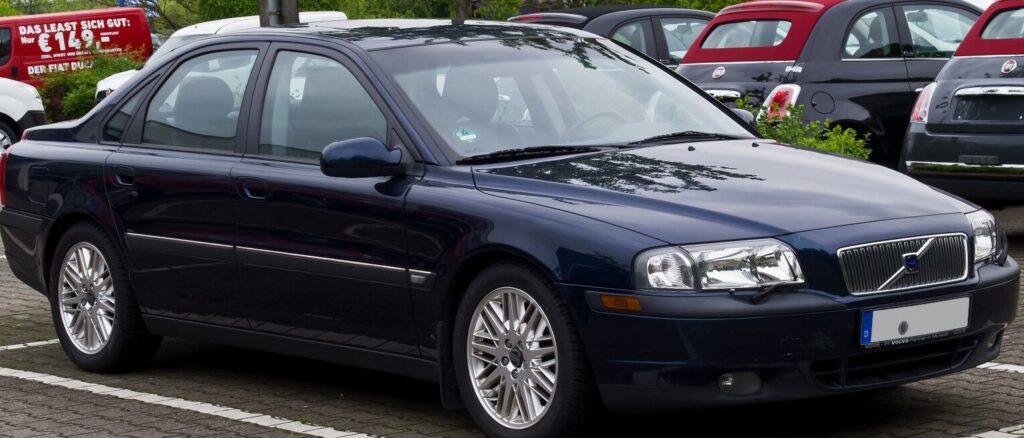
The Volvo S80 2.8 24V T6, produced between 1998 and 2001, represented a significant step forward for Volvo’s flagship sedan. Part of the first generation (P2 platform) S80 lineup, this variant occupied the premium position within the range, offering a potent combination of performance and luxury. It was designed to compete with established German rivals like the BMW 5 Series and Mercedes-Benz E-Class, aiming to deliver Scandinavian safety and comfort with a sporting edge. The T6 designation signified Volvo’s top-tier engine offering at the time, and this model was primarily sold in European and North American markets.
Technical Specifications
| Brand | Volvo |
| Model | S80 |
| Generation | S80 |
| Type (Engine) | 2.8 24V T6 (272 Hp) |
| Start of production | 1998 |
| End of production | 2001 |
| Powertrain Architecture | Internal Combustion engine |
| Body type | Sedan |
| Seats | 5 |
| Doors | 4 |
| Fuel consumption (urban) | 16.6 l/100 km (14.2 US mpg, 17 UK mpg) |
| Fuel consumption (extra urban) | 8.2 l/100 km (28.7 US mpg, 34.4 UK mpg) |
| Fuel consumption (combined) | 12.4 l/100 km (19 US mpg, 22.8 UK mpg) |
| Fuel Type | Petrol (Gasoline) |
| Acceleration 0 – 100 km/h | 7.2 sec |
| Acceleration 0 – 62 mph | 7.2 sec |
| Acceleration 0 – 60 mph | 6.8 sec |
| Maximum speed | 250 km/h (155.34 mph) |
| Weight-to-power ratio | 6 kg/Hp |
| Weight-to-torque ratio | 4.3 kg/Nm |
| Power | 272 Hp @ 5400 rpm |
| Torque | 380 Nm @ 2000-5000 rpm (280.27 lb.-ft. @ 2000-5000 rpm) |
| Engine layout | Front, Transverse |
| Engine Model/Code | B6284T |
| Engine displacement | 2783 cm3 (169.83 cu. in.) |
| Number of cylinders | 6 |
| Engine configuration | Inline |
| Cylinder Bore | 81 mm (3.19 in.) |
| Piston Stroke | 90 mm (3.54 in.) |
| Compression ratio | 8.5:1 |
| Number of valves per cylinder | 4 |
| Fuel injection system | Multi-port manifold injection |
| Engine aspiration | Twin-Turbo |
| Valvetrain | DOHC |
| Engine oil capacity | 6.6 l (6.97 US qt | 5.81 UK qt) |
| Coolant | 9.6 l (10.14 US qt | 8.45 UK qt) |
| Kerb Weight | 1630 kg (3593.53 lbs.) |
| Max. weight | 2210 kg (4872.22 lbs.) |
| Max load | 580 kg (1278.68 lbs.) |
| Trunk (boot) space – minimum | 440 l (15.54 cu. ft.) |
| Trunk (boot) space – maximum | 1106 l (39.06 cu. ft.) |
| Fuel tank capacity | 80 l (21.13 US gal | 17.6 UK gal) |
| Length | 4822 mm (189.84 in.) |
| Width | 1832 mm (72.13 in.) |
| Height | 1434 mm (56.46 in.) |
| Wheelbase | 2791 mm (109.88 in.) |
| Front track | 1562 mm (61.5 in.) |
| Rear (Back) track | 1560 mm (61.42 in.) |
| Drivetrain Architecture | The Internal combustion engine (ICE) drives the front wheels of the vehicle. |
| Drive wheel | Front wheel drive |
| Number of gears and type of gearbox | 4 gears, automatic transmission |
| Front suspension | Wishbone |
| Rear suspension | Coil spring |
| Front brakes | Ventilated discs |
| Rear brakes | Disc |
| Assisting systems | ABS (Anti-lock braking system) |
| Steering type | Steering rack and pinion |
| Power steering | Hydraulic Steering |
| Tires size | 225/50 R17 |
| Wheel rims size | 17 |
Powertrain & Engine Architecture
The heart of the S80 2.8 T6 was the B6284T engine, a 2.8-liter inline-six cylinder powerplant. This engine was notable for its twin-turbocharged configuration, a relatively uncommon feature for the time, especially in a front-wheel-drive vehicle. The twin-turbo setup utilized a low-pressure turbocharger for enhanced low-end response and a high-pressure turbocharger to maintain power throughout the rev range. Fuel delivery was managed by a multi-port fuel injection system. The engine featured a double overhead camshaft (DOHC) valvetrain with four valves per cylinder, contributing to its high specific output. The engine’s 8.5:1 compression ratio was a compromise between performance and the demands of running on lower octane fuel. Paired with the engine was a 4-speed automatic transmission, designed to provide smooth shifts and complement the engine’s torque characteristics. This transmission wasn’t known for its sportiness, prioritizing comfort and refinement over rapid gear changes.
Driving Characteristics
The S80 2.8 T6 offered a distinctly different driving experience compared to lower-powered S80 variants. The twin-turbocharged engine delivered strong acceleration, with 0-60 mph times around 6.8 seconds. While not a sports sedan in the truest sense, the T6 provided ample power for confident overtaking and highway cruising. The automatic transmission, while smooth, could feel somewhat sluggish, particularly when downshifting. The front-wheel-drive configuration, combined with the engine’s substantial torque, could lead to some torque steer under hard acceleration. The suspension was tuned for comfort, providing a relatively soft ride, but it wasn’t as engaging as some of its rear-wheel-drive competitors. The gear ratios were optimized for relaxed cruising, rather than aggressive cornering.
Equipment & Trim Levels
The S80 2.8 T6 typically came well-equipped, reflecting its position as the range-topping model. Standard features included leather upholstery, power-adjustable front seats with memory function, automatic climate control, a premium audio system, and alloy wheels. Optional extras included a sunroof, navigation system (a rarity for the time), and upgraded interior trim options. Safety features were, as expected from Volvo, comprehensive, including ABS brakes, airbags, and side impact protection systems. The interior design emphasized Scandinavian minimalism, with a clean and functional dashboard layout.
Chassis & Braking
The S80’s chassis featured an independent wishbone front suspension and a coil spring rear suspension. The front suspension geometry was designed to minimize body roll and provide stable handling. The braking system consisted of ventilated discs at the front and solid discs at the rear. ABS (Anti-lock Braking System) was standard, enhancing braking performance and stability, particularly on slippery surfaces. The steering was a hydraulic rack and pinion system, providing reasonably precise control, although it lacked the direct feel of some competitors.
Market Reception & Comparison
The S80 2.8 T6 was generally well-received by automotive critics, who praised its powerful engine, comfortable ride, and comprehensive safety features. However, some reviewers noted the automatic transmission’s lack of responsiveness and the front-wheel-drive configuration’s limitations in terms of handling. Compared to the naturally aspirated 2.4-liter S80 models, the T6 offered a significant performance upgrade, but at a higher price point. Fuel economy was considerably worse than the lower-powered variants, reflecting the engine’s increased output and turbocharging. Reliability was generally good, although the complex twin-turbo system required careful maintenance.
Legacy
The Volvo S80 2.8 T6 remains a desirable classic among Volvo enthusiasts. The B6284T engine, while complex, is known to be durable when properly maintained. Finding parts can sometimes be challenging, but a dedicated aftermarket exists. Today, these cars are often sought after for their unique combination of performance, luxury, and Scandinavian design. The twin-turbocharged inline-six engine is considered a highlight, and well-maintained examples command a premium in the used car market. The S80 2.8 T6 represents a bold attempt by Volvo to challenge the established order in the luxury sedan segment, and it remains a testament to the brand’s engineering prowess.
