
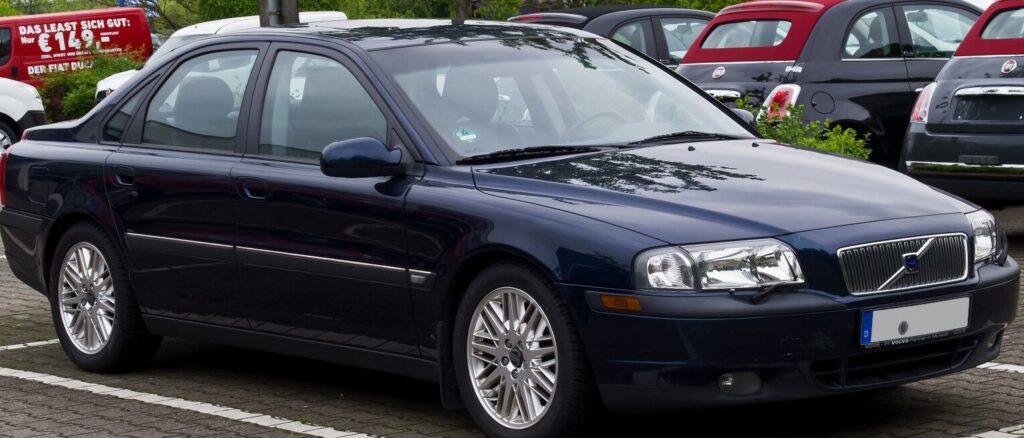
The Volvo S80 2.9 24V, produced between 2001 and 2003, represented a significant step forward for Volvo’s flagship sedan. Falling within the second generation (1998-2006) of the S80, this variant occupied a middle ground in the lineup, offering a balance between performance and affordability. It served as a key model in Volvo’s North American and European markets, appealing to buyers seeking a comfortable, safe, and relatively powerful executive sedan. The 2.9-liter engine, paired with a five-speed automatic transmission, aimed to provide a smooth and refined driving experience, distinguishing itself from the base 2.4-liter models and the high-performance T6 variants.
Technical Specifications
| Brand | Volvo |
| Model | S80 |
| Generation | S80 |
| Type (Engine) | 2.9 24V (196 Hp) |
| Start of production | 2001 |
| End of production | 2003 |
| Powertrain Architecture | Internal Combustion engine |
| Body type | Sedan |
| Seats | 5 |
| Doors | 4 |
| Fuel consumption (urban) | 15.1 l/100 km (15.6 US mpg) |
| Fuel consumption (extra urban) | 8.5 l/100 km (27.7 US mpg) |
| Fuel Type | Petrol (Gasoline) |
| Acceleration 0 – 100 km/h | 8.8 sec |
| Acceleration 0 – 62 mph | 8.8 sec |
| Acceleration 0 – 60 mph | 8.4 sec |
| Maximum speed | 225 km/h (139.81 mph) |
| Weight-to-power ratio | 8.1 kg/Hp |
| Weight-to-torque ratio | 5.7 kg/Nm |
| Power | 196 Hp @ 5200 rpm |
| Power per litre | 67.1 Hp/l |
| Torque | 280 Nm @ 3900 rpm (206.52 lb.-ft. @ 3900 rpm) |
| Engine layout | Front, Transverse |
| Engine Model/Code | B6294S2 |
| Engine displacement | 2922 cm3 (178.31 cu. in.) |
| Number of cylinders | 6 |
| Engine configuration | Inline |
| Cylinder Bore | 83 mm (3.27 in.) |
| Piston Stroke | 90 mm (3.54 in.) |
| Compression ratio | 10.5:1 |
| Number of valves per cylinder | 4 |
| Fuel injection system | Multi-port manifold injection |
| Engine aspiration | Naturally aspirated engine |
| Engine oil capacity | 6 l (6.34 US qt | 5.28 UK qt) |
| Coolant | 8.8 l (9.3 US qt | 7.74 UK qt) |
| Kerb Weight | 1585 kg (3494.33 lbs.) |
| Max. weight | 2090 kg (4607.66 lbs.) |
| Max load | 505 kg (1113.33 lbs.) |
| Trunk (boot) space – minimum | 460 l (16.24 cu. ft.) |
| Trunk (boot) space – maximum | 1126 l (39.76 cu. ft.) |
| Fuel tank capacity | 80 l (21.13 US gal | 17.6 UK gal) |
| Length | 4822 mm (189.84 in.) |
| Width | 1832 mm (72.13 in.) |
| Height | 1434 mm (56.46 in.) |
| Wheelbase | 2791 mm (109.88 in.) |
| Front track | 1562 mm (61.5 in.) |
| Rear (Back) track | 1560 mm (61.42 in.) |
| Drivetrain Architecture | The Internal combustion engine (ICE) drives the front wheels of the vehicle. |
| Drive wheel | Front wheel drive |
| Number of gears and type of gearbox | 5 gears, automatic transmission |
| Front suspension | Wishbone |
| Rear suspension | Coil spring |
| Front brakes | Ventilated discs |
| Rear brakes | Disc |
| Assisting systems | ABS (Anti-lock braking system) |
| Steering type | Steering rack and pinion |
| Power steering | Hydraulic Steering |
| Tires size | 215/55 R16 |
| Wheel rims size | 16 |
Powertrain & Engine Architecture
The heart of the S80 2.9 was the B6294S2 engine, a naturally aspirated 2.9-liter inline-six cylinder powerplant. This engine was a descendant of Volvo’s long-running six-cylinder family, known for its smoothness and durability. It featured a cast iron block and an aluminum cylinder head, incorporating four valves per cylinder and multi-port fuel injection. The 24-valve configuration (hence the “24V” designation) contributed to its respectable power output. The engine’s design prioritized refinement over outright performance, focusing on a broad torque curve for comfortable cruising. The five-speed automatic transmission, sourced from Aisin Warner, was chosen for its smooth shifting characteristics and reliability. While not a performance-oriented transmission, it was well-suited to the engine’s power delivery and the S80’s intended role as a luxury cruiser.
Driving Characteristics
The S80 2.9 Automatic offered a comfortable and composed driving experience. Acceleration from 0-60 mph took approximately 8.4 seconds, which was adequate for the time but not particularly sporty. The automatic transmission, while smooth, could feel somewhat hesitant during quick overtaking maneuvers. The gear ratios were tuned for fuel efficiency and relaxed cruising, rather than aggressive acceleration. Compared to the more powerful T6 model with its turbocharged engine, the 2.9 felt noticeably less responsive. However, it offered a more relaxed and predictable driving experience, appealing to drivers who prioritized comfort over outright speed. The front-wheel-drive configuration provided good traction in most conditions, but lacked the dynamic handling of rear-wheel-drive competitors.
Equipment & Trim Levels
The S80 2.9 typically came well-equipped, reflecting its position as a premium sedan. Standard features included leather upholstery, power-adjustable front seats, automatic climate control, a premium audio system, and alloy wheels. Safety was a key Volvo selling point, and the S80 2.9 included features like ABS brakes, side airbags, and a robust safety cage. Optional extras included a sunroof, upgraded audio systems, and wood trim interior accents. The trim level often dictated the availability of these options, with higher trims offering more standard features and a more luxurious interior.
Chassis & Braking
The S80 2.9 utilized a front suspension system featuring independent wishbones and coil springs, providing a comfortable ride and predictable handling. The rear suspension employed a semi-independent coil spring setup. Braking duties were handled by ventilated discs at the front and solid discs at the rear, assisted by an ABS system. The braking performance was adequate for the vehicle’s weight and power, but not exceptional. The steering was hydraulic power-assisted rack and pinion, offering a reasonable level of feel and responsiveness.
Market Reception & Comparison
The S80 2.9 was generally well-received by automotive critics. It was praised for its comfortable ride, spacious interior, and strong safety credentials. However, some reviewers noted that the engine lacked the punch of its turbocharged counterparts and that the automatic transmission could be slow to respond. Compared to the 2.4-liter base model, the 2.9 offered a noticeable improvement in performance. When compared to the T6, it represented a more affordable option, sacrificing some performance for a lower price point. Fuel economy was reasonable for a vehicle of its size and class, averaging around 15.1 l/100 km in urban driving and 8.5 l/100 km on the highway.
Legacy
The Volvo S80 2.9 24V has proven to be a relatively reliable vehicle, with many examples still on the road today. The inline-six engine is known for its durability, although regular maintenance is essential. Common issues include oil leaks and wear on the timing belt. The automatic transmission is generally reliable, but can require servicing over time. In the used car market, the S80 2.9 represents a good value for buyers seeking a comfortable, safe, and well-equipped sedan. While it may not offer the performance of more modern vehicles, it remains a stylish and practical choice for those who appreciate classic Volvo engineering.
