
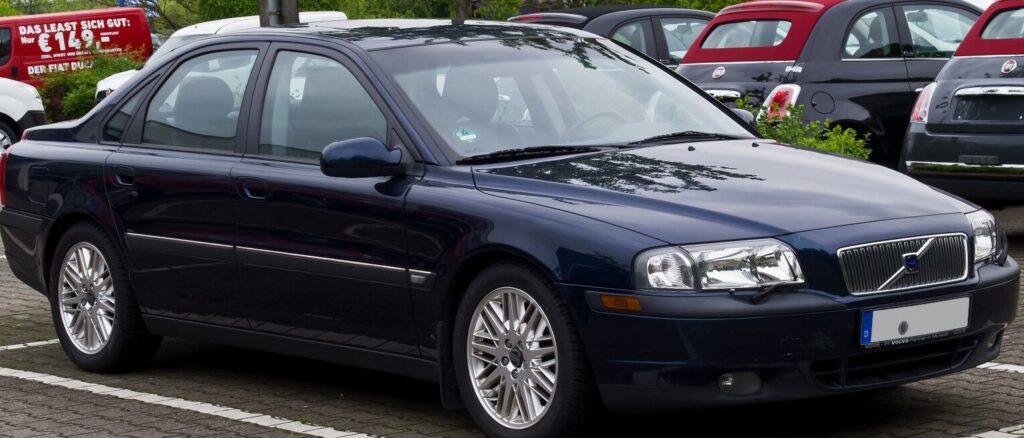
The Volvo S80 2.9 24V, produced between 1998 and 2001, represented a significant step forward for Volvo as its first truly global luxury sedan. Positioned as a mid-range offering within the first generation (1998-2006) S80 lineup, it slotted between the base 2.4-liter models and the flagship T6 with its turbocharged engine. The 2.9-liter variant aimed to provide a balance of performance and refinement for buyers seeking a comfortable and capable executive car. This model was primarily aimed at the North American and European markets, where Volvo had established a strong reputation for safety and durability.
Technical Specifications
| Brand | Volvo |
| Model | S80 |
| Generation | S80 |
| Type (Engine) | 2.9 24V (204 Hp) |
| Start of production | 1998 |
| End of production | 2001 |
| Powertrain Architecture | Internal Combustion engine |
| Body type | Sedan |
| Seats | 5 |
| Doors | 4 |
| Fuel consumption (combined) | 9.7 l/100 km |
| Fuel consumption (US mpg) | 24.2 US mpg |
| Fuel consumption (UK mpg) | 29.1 UK mpg |
| Fuel consumption (km/l) | 10.3 km/l |
| Fuel Type | Petrol (Gasoline) |
| Acceleration 0 – 100 km/h | 8.2 sec |
| Acceleration 0 – 62 mph | 8.2 sec |
| Acceleration 0 – 60 mph | 7.8 sec |
| Maximum speed | 235 km/h (146.02 mph) |
| Weight-to-power ratio | 7.6 kg/Hp, 131.6 Hp/tonne |
| Weight-to-torque ratio | 5.5 kg/Nm, 180.6 Nm/tonne |
| Power | 204 Hp @ 6000 rpm |
| Power per litre | 69.8 Hp/l |
| Torque | 280 Nm @ 4200 rpm (206.52 lb.-ft. @ 4200 rpm) |
| Engine layout | Front, Transverse |
| Engine Model/Code | B6304S |
| Engine displacement | 2922 cm3 (178.31 cu. in.) |
| Number of cylinders | 6 |
| Engine configuration | Inline |
| Cylinder Bore | 83 mm (3.27 in.) |
| Piston Stroke | 90 mm (3.54 in.) |
| Compression ratio | 10.5:1 |
| Number of valves per cylinder | 4 |
| Fuel injection system | Multi-port manifold injection |
| Engine aspiration | Naturally aspirated engine |
| Valvetrain | DOHC |
| Engine oil capacity | 6 l (6.34 US qt | 5.28 UK qt) |
| Kerb Weight | 1550 kg (3417.17 lbs.) |
| Max. weight | 2060 kg (4541.52 lbs.) |
| Max load | 510 kg (1124.36 lbs.) |
| Trunk (boot) space – minimum | 440 l (15.54 cu. ft.) |
| Trunk (boot) space – maximum | 1106 l (39.06 cu. ft.) |
| Fuel tank capacity | 80 l (21.13 US gal | 17.6 UK gal) |
| Length | 4822 mm (189.84 in.) |
| Width | 1832 mm (72.13 in.) |
| Height | 1434 mm (56.46 in.) |
| Wheelbase | 2791 mm (109.88 in.) |
| Front track | 1562 mm (61.5 in.) |
| Rear (Back) track | 1560 mm (61.42 in.) |
| Drivetrain Architecture | The Internal combustion engine (ICE) drives the front wheels of the vehicle. |
| Drive wheel | Front wheel drive |
| Number of gears and type of gearbox | 5 gears, manual transmission |
| Front suspension | Wishbone |
| Rear suspension | Coil spring |
| Front brakes | Ventilated discs |
| Rear brakes | Disc |
| Assisting systems | ABS (Anti-lock braking system) |
| Steering type | Steering rack and pinion |
| Power steering | Hydraulic Steering |
| Tires size | 215/55 R16 |
| Wheel rims size | 16 |
Powertrain & Engine Architecture
The heart of the S80 2.9 was the B6304S engine, a naturally aspirated 2.9-liter inline-six cylinder powerplant. This engine was a development of Volvo’s long-standing six-cylinder family, known for its smoothness and inherent balance. It featured a double overhead camshaft (DOHC) valvetrain with four valves per cylinder, contributing to its respectable power output. Fuel delivery was handled by a multi-port fuel injection system, optimizing combustion efficiency. The engine produced 204 horsepower at 6000 rpm and 280 Nm (206.52 lb-ft) of torque at 4200 rpm. The 5-speed manual transmission was the standard offering, providing drivers with direct control over the engine’s power. While an automatic transmission was available, it was a 4-speed unit, and generally considered less responsive than the manual.
Driving Characteristics
The S80 2.9 with the manual transmission offered a reasonably engaging driving experience. Acceleration from 0 to 60 mph took around 7.8 seconds, making it competitive with other mid-size luxury sedans of the era. The inline-six engine delivered smooth, linear power throughout the rev range, making it easy to modulate throttle response. The 5-speed manual gearbox was well-matched to the engine’s characteristics, allowing for precise gear changes. However, the automatic transmission version felt noticeably slower and less refined, with the 4-speed unit lacking the responsiveness of more modern transmissions. The front-wheel-drive configuration provided predictable handling, but didn’t offer the dynamic capabilities of rear-wheel-drive competitors.
Equipment & Trim Levels
The S80 2.9 typically came well-equipped, reflecting its luxury sedan positioning. Standard features included power windows, power locks, a power sunroof, and air conditioning. The interior featured comfortable cloth upholstery, although leather was available as an option. Higher trim levels offered features such as heated front seats, a premium audio system, and wood trim accents. Safety was a key Volvo selling point, and the S80 2.9 included standard features like ABS brakes and side airbags. Optional extras included a navigation system, automatic climate control, and a rear sunshade.
Chassis & Braking
The S80 2.9 utilized a front suspension with wishbones and a rear suspension with coil springs. This setup provided a comfortable ride quality, absorbing bumps and imperfections in the road effectively. The car was equipped with ventilated disc brakes at the front and solid disc brakes at the rear, providing adequate stopping power for most driving situations. ABS (Anti-lock Braking System) was standard, enhancing braking performance and stability. The steering was rack and pinion with hydraulic power assistance, offering a responsive and precise feel.
Market Reception & Comparison
The Volvo S80 2.9 was generally well-received by automotive critics. It was praised for its comfortable ride, spacious interior, and strong safety features. However, some reviewers noted that its styling was somewhat conservative compared to its European rivals. Compared to the base 2.4-liter models, the 2.9 offered a noticeable performance improvement. Against the higher-end T6, it provided a more affordable entry point into the S80 range, albeit with less power. Fuel economy was reasonable for a car of its size and class, averaging around 24.2 US mpg in combined driving. Reliability was generally good, although some owners reported minor issues with the electrical system.
Legacy
The Volvo S80 2.9 remains a popular choice among used car buyers seeking a comfortable, safe, and reliable luxury sedan. The B6304S engine is known for its durability, and with proper maintenance, can provide many years of service. While not a performance standout, the 2.9-liter variant offers a good balance of power and efficiency. Today, well-maintained examples are becoming increasingly collectible, representing a piece of Volvo’s history as a maker of sophisticated and dependable automobiles. The S80 2.9 laid the groundwork for future Volvo models, establishing the brand’s reputation for safety, comfort, and Scandinavian design.
