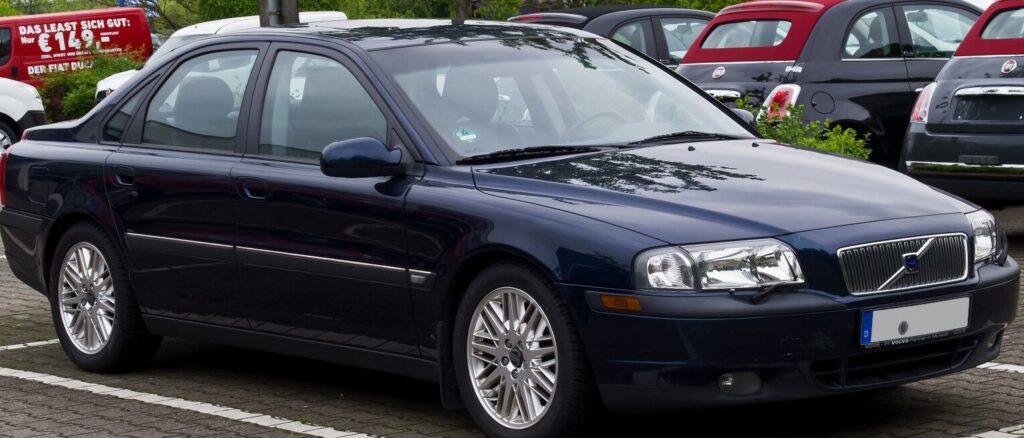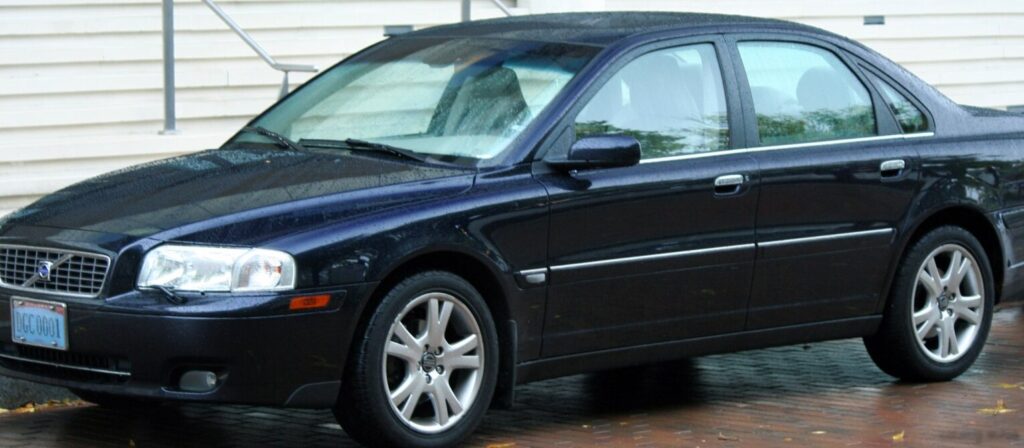
The Volvo S80 2.4 Bi-Fuel CNG (Compressed Natural Gas) was a variant of the second-generation S80, produced from 2003 to 2006 as part of the facelifted model range (designated as the 2003-2006 model years). This version offered drivers in select European markets a flexible-fuel option, capable of running on either gasoline or CNG, aiming to reduce emissions and operating costs. It occupied a unique position within the S80 lineup, catering to environmentally conscious buyers and those seeking to benefit from CNG infrastructure and incentives. The S80, in general, was Volvo’s flagship sedan, intended to compete with executive cars from German manufacturers like BMW and Mercedes-Benz.
Technical Specifications
| Brand | Volvo |
| Model | S80 |
| Generation | S80 (facelift 2003) |
| Type (Engine) | 2.4 (140 Hp) Bi-Fuel CNG |
| Start of production | 2003 |
| End of production | 2006 |
| Powertrain Architecture | Internal Combustion engine |
| Body type | Sedan |
| Seats | 5 |
| Doors | 4 |
| Fuel consumption (economy) – urban | 12.8 l/100 km (18.4 US mpg, 22.1 UK mpg, 7.8 km/l) |
| Fuel consumption (economy) – extra urban | 7.1 l/100 km (33.1 US mpg, 39.8 UK mpg, 14.1 km/l) |
| Fuel consumption (economy) – combined | 9.2 l/100 km (25.6 US mpg, 30.7 UK mpg, 10.9 km/l) |
| Fuel consumption (economy) – combined (CNG) | 7.6 kg/100 km |
| CO2 emissions | 220 g/km |
| CO2 emissions (CNG) | 164 g/km |
| Fuel Type | Petrol / CNG |
| Acceleration 0 – 100 km/h | 10.5 sec |
| Acceleration 0 – 62 mph | 10.5 sec |
| Acceleration 0 – 100 km/h (CNG) | 11 sec |
| Acceleration 0 – 60 mph (Calculated) | 10 sec |
| Maximum speed | 205 km/h (127.38 mph) |
| Emission standard | Euro 4 |
| Weight-to-power ratio | 11.2 kg/Hp, 89.6 Hp/tonne |
| Weight-to-torque ratio | 7.1 kg/Nm, 140.8 Nm/tonne |
| Power | 140 Hp @ 4500 rpm |
| Power per litre | 57.5 Hp/l |
| Power (CNG) | 140 Hp @ 5800 rpm |
| Power per litre (CNG) | 57.5 Hp/l |
| Torque | 220 Nm @ 3300 rpm (162.26 lb.-ft. @ 3300 rpm) |
| Torque (CNG) | 192 Nm @ 4500 rpm |
| Engine layout | Front, Transverse |
| Engine Model/Code | B5244SG |
| Engine displacement | 2435 cm3 (148.59 cu. in.) |
| Number of cylinders | 5 |
| Engine configuration | Inline |
| Cylinder Bore | 83 mm (3.27 in.) |
| Piston Stroke | 90 mm (3.54 in.) |
| Compression ratio | 10.3:1 |
| Number of valves per cylinder | 4 |
| Fuel injection system | Multi-port manifold injection |
| Engine aspiration | Naturally aspirated |
| Valvetrain | DOHC |
| Engine oil capacity | 5.8 l (6.13 US qt, 5.1 UK qt) |
| Coolant | 8 l (8.45 US qt, 7.04 UK qt) |
| Kerb Weight | 1562 kg (3443.62 lbs.) |
| Max. weight | 2060 kg (4541.52 lbs.) |
| Max load | 498 kg (1097.9 lbs.) |
| Trunk (boot) space – minimum | 460 l (16.24 cu. ft.) |
| Trunk (boot) space – maximum | 1126 l (39.76 cu. ft.) |
| Fuel tank capacity | 29 l (7.66 US gal, 6.38 UK gal) |
| CNG cylinder capacity | 17.6 kg |
| Max. roof load | 100 kg (220.46 lbs.) |
| Permitted trailer load with brakes (12%) | 1800 kg (3968.32 lbs.) |
| Permitted trailer load without brakes | 750 kg (1653.47 lbs.) |
| Permitted towbar download | 75 kg (165.35 lbs.) |
| Length | 4822 mm (189.84 in.) |
| Width | 1832 mm (72.13 in.) |
| Height | 1452 mm (57.17 in.) |
| Wheelbase | 2791 mm (109.88 in.) |
| Front track | 1570 mm (61.81 in.) |
| Rear track | 1548 mm (60.94 in.) |
| Front overhang | 964 mm (37.95 in.) |
| Rear overhang | 1067 mm (42.01 in.) |
| Drag coefficient (Cd) | 0.28 |
| Minimum turning circle | 11.6 m (38.06 ft.) |
| Drivetrain Architecture | ICE to Front Wheels |
| Drive wheel | Front wheel drive |
| Number of gears and type of gearbox | 5 gears, manual transmission |
| Front suspension | Independent type McPherson |
| Rear suspension | Independent multi-link suspension |
| Front brakes | Ventilated discs, 288 mm |
| Rear brakes | Disc, 288 mm |
| Assisting systems | ABS (Anti-lock braking system) |
| Steering type | Steering rack and pinion |
| Power steering | Hydraulic |
| Tires size | 215/55 R16; 225/50 R17 |
| Wheel rims size | 7J x 16; 7J x 17 |
Powertrain & Engine Architecture
The S80 2.4 Bi-Fuel CNG utilized Volvo’s B5244SG engine, a 2.4-liter inline-five cylinder powerplant. This engine was a mainstay in Volvo’s lineup for many years, known for its robustness and relatively simple design. The key difference in the Bi-Fuel version was its ability to switch between gasoline and CNG operation. When running on CNG, the engine management system adjusted fuel delivery and ignition timing to optimize combustion for the alternative fuel. The engine featured multi-port fuel injection and a double overhead camshaft (DOHC) valvetrain. The 5-speed manual transmission was the only transmission option offered with this engine configuration. The engine code ‘SG’ denotes a specific iteration of the B5244 series, tailored for bi-fuel operation. The CNG system itself consisted of a high-pressure cylinder (typically located in the spare wheel well), a pressure regulator, and a fuel rail injector system dedicated to CNG delivery.
Driving Characteristics
The 140 horsepower output of the 2.4L engine, coupled with the 5-speed manual transmission, provided adequate, but not exhilarating, performance. Acceleration from 0-60 mph took around 10 seconds. The CNG operation resulted in a slight reduction in power and torque compared to running on gasoline, noticeable primarily during hard acceleration or when carrying a full load. The gear ratios were tuned for fuel efficiency and smooth cruising rather than sporty driving. Switching between gasoline and CNG was typically seamless, with a dashboard indicator displaying the current fuel source. The manual transmission allowed for greater driver control, but the engine’s torque characteristics meant that frequent downshifting was often necessary, especially when climbing hills or overtaking.
Equipment & Trim Levels
The S80 2.4 Bi-Fuel CNG was generally equipped with a moderate level of standard features. This typically included power windows, power mirrors, central locking, an air conditioning system, and a basic audio system. Interior upholstery was usually cloth, with optional leather available. Safety features, a hallmark of Volvo, were comprehensive, including ABS brakes, airbags, and side impact protection systems. Optional extras could include a sunroof, upgraded audio systems, and parking sensors. The trim level was often positioned as a mid-range offering, bridging the gap between the base models and the more luxurious, higher-powered S80 variants.
Chassis & Braking
The S80 featured independent suspension all around – a McPherson strut setup at the front and a multi-link system at the rear – providing a comfortable ride quality. The front brakes were ventilated discs, while the rear brakes were solid discs. ABS (Anti-lock Braking System) was standard. The suspension was tuned for comfort and stability, prioritizing ride quality over sporty handling. The weight distribution was relatively balanced, contributing to predictable handling characteristics. The steering was hydraulic power-assisted, providing a reasonable level of feedback.
Market Reception & Comparison
The S80 2.4 Bi-Fuel CNG was primarily sold in European markets with well-developed CNG infrastructure, such as Sweden, Germany, and Italy. It was viewed as a practical and environmentally conscious alternative to traditional gasoline-powered vehicles. Critics noted the slight performance reduction when running on CNG, but praised the lower running costs and reduced emissions. Compared to the higher-powered S80 variants (like the 2.9 or 3.0 models), the 2.4 CNG offered significantly lower performance but better fuel economy, especially when utilizing CNG. Compared to the diesel-powered S80 models, the CNG version offered a quieter engine and potentially lower particulate emissions, but typically had a higher purchase price.
Legacy
The Volvo S80 2.4 Bi-Fuel CNG represents an early attempt by a major automaker to offer a flexible-fuel vehicle powered by CNG. While CNG never achieved widespread adoption in many markets, the S80 Bi-Fuel demonstrated Volvo’s commitment to exploring alternative fuel technologies. These models are now relatively rare on the used car market. The B5244 engine, in general, is known for its durability, but the CNG system components may require periodic maintenance or replacement as they age. The long-term reliability of the CNG system is dependent on proper maintenance and the quality of the CNG fuel used.