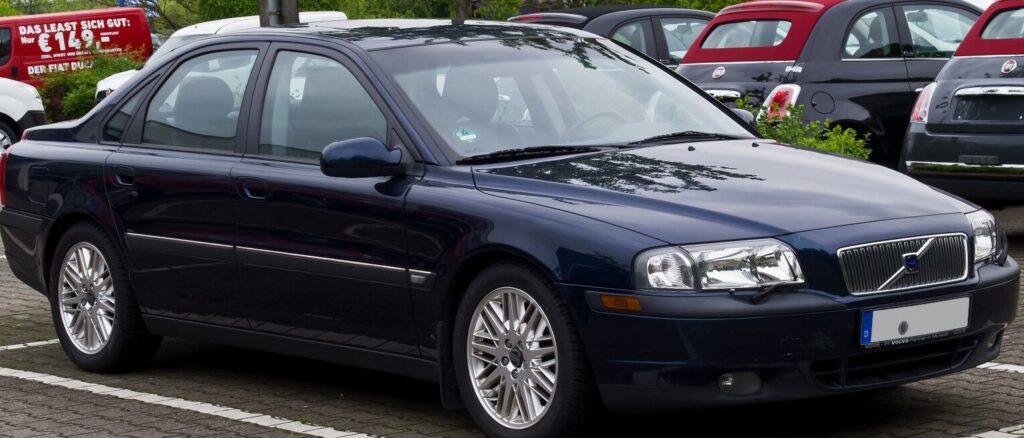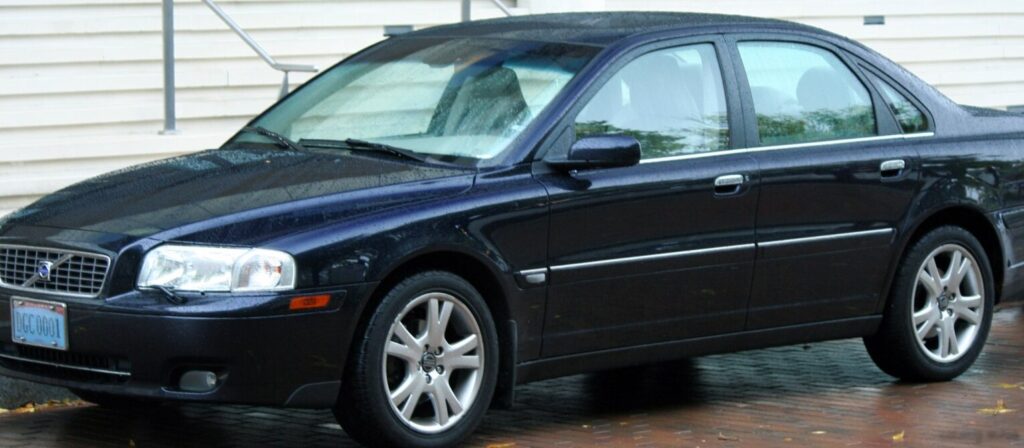
The Volvo S80 2.4 20V Automatic, produced from 2003 to 2006, represents a significant iteration of Volvo’s flagship sedan. This version, part of the second-generation S80 (codenamed P2), arrived with the facelift introduced in 2003, bringing revised styling and updated features. Positioned as a mid-range offering within the S80 lineup, the 2.4-liter engine paired with a five-speed automatic transmission aimed to provide a balance of performance, comfort, and fuel efficiency for the North American and European markets. It served as a popular alternative to the more powerful T6 models and the fuel-efficient, though slower, 2.0-liter variants.
Technical Specifications
| Brand | Volvo |
| Model | S80 |
| Generation | S80 (facelift 2003) |
| Type (Engine) | 2.4 20V (170 Hp) Automatic |
| Start of production | 2003 |
| End of production | 2006 |
| Powertrain Architecture | Internal Combustion engine |
| Body type | Sedan |
| Seats | 5 |
| Doors | 4 |
| Fuel consumption (urban) | 13.9 l/100 km (16.9 US mpg, 20.3 UK mpg, 7.2 km/l) |
| Fuel consumption (extra urban) | 7.4 l/100 km (31.8 US mpg, 38.2 UK mpg, 13.5 km/l) |
| Fuel consumption (combined) | 9.8 l/100 km (24 US mpg, 28.8 UK mpg, 10.2 km/l) |
| CO2 emissions | 235 g/km |
| Fuel Type | Petrol (Gasoline) |
| Acceleration 0 – 100 km/h | 9.9 sec |
| Acceleration 0 – 62 mph | 9.9 sec |
| Acceleration 0 – 60 mph | 9.4 sec |
| Maximum speed | 215 km/h (133.59 mph) |
| Emission standard | Euro 4 |
| Weight-to-power ratio | 8.9 kg/Hp, 111.8 Hp/tonne |
| Weight-to-torque ratio | 6.8 kg/Nm, 147.9 Nm/tonne |
| Power | 170 Hp @ 6000 rpm |
| Power per litre | 69.8 Hp/l |
| Torque | 225 Nm @ 4500 rpm (165.95 lb.-ft. @ 4500 rpm) |
| Engine layout | Front, Transverse |
| Engine Model/Code | B5244S |
| Engine displacement | 2435 cm3 (148.59 cu. in.) |
| Number of cylinders | 5 |
| Engine configuration | Inline |
| Cylinder Bore | 83 mm (3.27 in.) |
| Piston Stroke | 90 mm (3.54 in.) |
| Compression ratio | 10.3:1 |
| Number of valves per cylinder | 4 |
| Fuel injection system | Multi-port manifold injection |
| Engine aspiration | Naturally aspirated engine |
| Valvetrain | DOHC |
| Engine oil capacity | 5.5 l (5.81 US qt | 4.84 UK qt) |
| Coolant | 8 l (8.45 US qt | 7.04 UK qt) |
| Kerb Weight | 1521 kg (3353.23 lbs.) |
| Max. weight | 2020 kg (4453.34 lbs.) |
| Max load | 499 kg (1100.11 lbs.) |
| Trunk (boot) space – minimum | 460 l (16.24 cu. ft.) |
| Trunk (boot) space – maximum | 1126 l (39.76 cu. ft.) |
| Fuel tank capacity | 70 l (18.49 US gal | 15.4 UK gal) |
| Max. roof load | 100 kg (220.46 lbs.) |
| Permitted trailer load with brakes (12%) | 1800 kg (3968.32 lbs.) |
| Permitted trailer load without brakes | 750 kg (1653.47 lbs.) |
| Permitted towbar download | 75 kg (165.35 lbs.) |
| Length | 4822 mm (189.84 in.) |
| Width | 1832 mm (72.13 in.) |
| Height | 1452 mm (57.17 in.) |
| Wheelbase | 2791 mm (109.88 in.) |
| Front track | 1570 mm (61.81 in.) |
| Rear (Back) track | 1548 mm (60.94 in.) |
| Front overhang | 964 mm (37.95 in.) |
| Rear overhang | 1067 mm (42.01 in.) |
| Drag coefficient (Cd) | 0.28 |
| Minimum turning circle (turning diameter) | 11.6 m (38.06 ft.) |
| Drivetrain Architecture | The Internal combustion engine (ICE) drives the front wheels of the vehicle. |
| Drive wheel | Front wheel drive |
| Number of gears and type of gearbox | 5 gears, automatic transmission |
| Front suspension | Independent type McPherson |
| Rear suspension | Independent multi-link suspension |
| Front brakes | Ventilated discs, 288 mm |
| Rear brakes | Disc, 288 mm |
| Assisting systems | ABS (Anti-lock braking system) |
| Steering type | Steering rack and pinion |
| Power steering | Hydraulic Steering |
| Tires size | 215/55 R16; 225/50 R17 |
| Wheel rims size | 7J x 16; 7J x 17 |
INTRODUCTION
The 2003-2006 Volvo S80 2.4 20V Automatic represented a key offering in Volvo’s mid-size luxury sedan range. Built on the P2 platform, shared with the first-generation Volvo XC90, the S80 aimed to blend Scandinavian design with a focus on safety and comfort. The 2.4-liter engine, a mainstay of Volvo’s lineup for years, provided adequate power for most drivers, while the automatic transmission offered a smooth and convenient driving experience. This variant was particularly popular in markets where manual transmissions were less common, such as North America and parts of Europe.
Powertrain & Engine Architecture
At the heart of the S80 2.4 was the B5244S engine, a 2.4-liter inline-five cylinder powerplant. This engine featured a cast iron block and an aluminum cylinder head, incorporating Volvo’s variable valve timing system on the intake side. Fuel delivery was handled by a multi-port fuel injection system. The 20 valves (four per cylinder, plus one) contributed to good breathing and a relatively flat torque curve. The engine produced 170 horsepower at 6000 rpm and 225 Nm (165.95 lb-ft) of torque at 4500 rpm. The five-speed automatic transmission, typically an Aisin-Warner unit, was chosen for its smoothness and reliability. It featured adaptive shift logic, adjusting shift points based on driving style and conditions. While not a performance-oriented transmission, it provided comfortable and predictable gear changes.
Driving Characteristics
The S80 2.4 Automatic offered a comfortable and refined driving experience. Acceleration from 0-60 mph took around 9.4 seconds, which was adequate for everyday driving but not particularly sporty. The automatic transmission, while smooth, did contribute to some power loss compared to the available manual transmission. Gear ratios were tuned for fuel efficiency and comfort rather than outright performance. The engine provided sufficient torque for passing maneuvers, but required downshifting for quicker responses. The steering was light and precise, and the suspension, tuned for comfort, absorbed bumps and imperfections in the road well. Overall, the driving experience was geared towards relaxed cruising and long-distance comfort.
Equipment & Trim Levels
The S80 2.4 Automatic typically came well-equipped, reflecting Volvo’s commitment to safety and luxury. Standard features included leather upholstery, power-adjustable front seats, a premium audio system, automatic climate control, and alloy wheels. Safety features were comprehensive, including ABS brakes, traction control, and a suite of airbags. Optional extras included a sunroof, navigation system, and upgraded audio options. Trim levels varied by market, but generally offered increasing levels of luxury and convenience features. The S80 2.4 often served as a stepping stone to the higher-trim T6 models, offering a good balance of features and price.
Chassis & Braking
The S80 2.4 utilized an independent suspension system at all four wheels. The front suspension employed a McPherson strut design, while the rear featured a multi-link setup. This configuration provided a comfortable ride and good handling characteristics. Brakes consisted of ventilated discs at the front and solid discs at the rear. ABS (Anti-lock Braking System) was standard, enhancing braking performance and stability. The chassis was designed with safety in mind, incorporating reinforced structures to protect occupants in the event of a collision. Stabilizer bars were fitted front and rear to reduce body roll during cornering.
Market Reception & Comparison
The S80 2.4 Automatic was generally well-received by critics, who praised its comfortable ride, spacious interior, and comprehensive safety features. However, some reviewers noted that the engine lacked the punch of the T6 models, and the automatic transmission could feel somewhat sluggish. Compared to the 2.0-liter S80, the 2.4 offered a noticeable improvement in performance. Against competitors like the BMW 5 Series and Mercedes-Benz E-Class, the S80 2.4 offered a compelling value proposition, with a strong emphasis on safety and comfort. Fuel economy was reasonable for its class, averaging around 24 mpg in combined driving.
Legacy
The Volvo S80 2.4 Automatic has proven to be a relatively reliable vehicle, with many examples still on the road today. The B5244S engine is known for its durability, and the Aisin-Warner automatic transmission is generally considered robust. Common maintenance items include timing belt replacement (typically every 80,000-100,000 miles) and regular fluid changes. While not a particularly collectible model, the S80 2.4 remains a popular choice for buyers seeking a comfortable, safe, and affordable used luxury sedan. Its blend of Scandinavian design, practicality, and reliability has ensured its continued presence in the used car market.