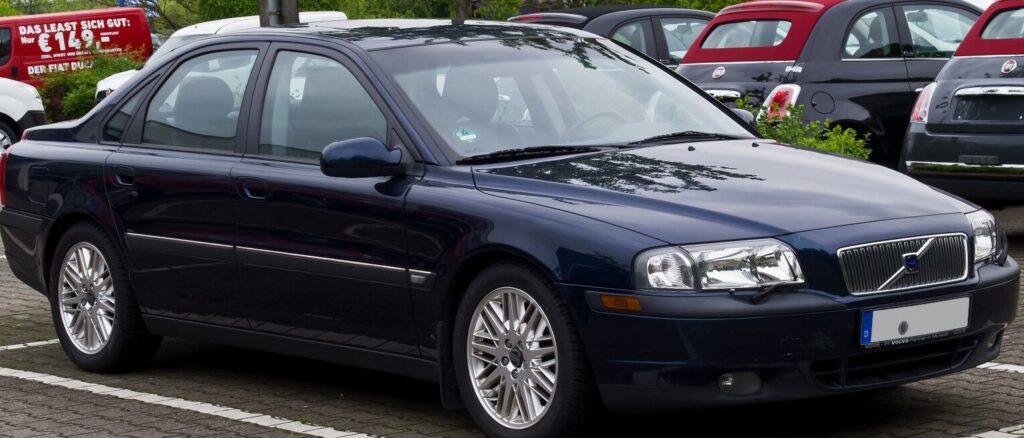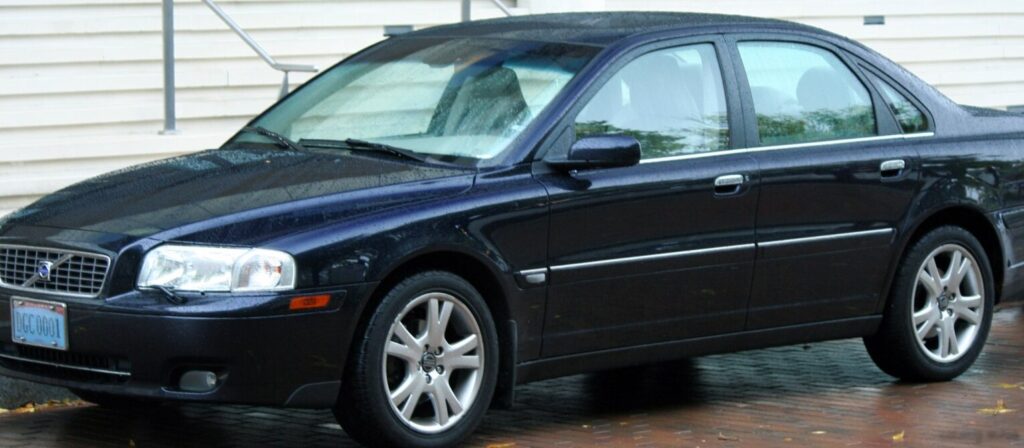
The Volvo S80 2.4 D5 (163 hp) represents a significant iteration of Volvo’s flagship sedan, produced from 2003 to 2006 as part of the second-generation S80 (facelift). This variant, powered by a five-cylinder turbodiesel engine, was primarily aimed at the European market, where diesel engines held a substantial share of the executive car segment. It offered a blend of fuel efficiency, respectable performance, and Volvo’s renowned safety features. Within the S80 lineup, the 2.4 D5 positioned itself as a mid-range offering, bridging the gap between the entry-level petrol engines and the more powerful, higher-trim models.
Technical Specifications
| Brand | Volvo |
| Model | S80 |
| Generation | S80 (facelift 2003) |
| Type (Engine) | 2.4 D5 (163 Hp) |
| Start of production | 2003 |
| End of production | 2006 |
| Powertrain Architecture | Internal Combustion engine |
| Body type | Sedan |
| Seats | 5 |
| Doors | 4 |
| Fuel consumption (urban) | 9 l/100 km (26.1 US mpg, 31.4 UK mpg, 11.1 km/l) |
| Fuel consumption (extra urban) | 5.1 l/100 km (46.1 US mpg, 55.4 UK mpg, 19.6 km/l) |
| Fuel consumption (combined) | 6.5 l/100 km (36.2 US mpg, 43.5 UK mpg, 15.4 km/l) |
| CO2 emissions | 172 g/km |
| Fuel Type | Diesel |
| Acceleration 0 – 100 km/h | 9.8 sec |
| Acceleration 0 – 62 mph | 9.8 sec |
| Acceleration 0 – 60 mph | 9.3 sec |
| Maximum speed | 210 km/h (130.49 mph) |
| Emission standard | Euro 3 |
| Weight-to-power ratio | 9.7 kg/Hp, 103.2 Hp/tonne |
| Weight-to-torque ratio | 4.6 kg/Nm, 215.2 Nm/tonne |
| Power | 163 Hp @ 4000 rpm |
| Power per litre | 67.9 Hp/l |
| Torque | 340 Nm @ 1750-3000 rpm (250.77 lb.-ft. @ 1750-3000 rpm) |
| Engine layout | Front, Transverse |
| Engine Model/Code | D5244T |
| Engine displacement | 2401 cm3 (146.52 cu. in.) |
| Number of cylinders | 5 |
| Engine configuration | Inline |
| Cylinder Bore | 81 mm (3.19 in.) |
| Piston Stroke | 93.2 mm (3.67 in.) |
| Compression ratio | 18:1 |
| Number of valves per cylinder | 4 |
| Fuel injection system | Diesel Commonrail |
| Engine aspiration | Turbocharger, Intercooler |
| Valvetrain | DOHC |
| Engine oil capacity | 6.5 l (6.87 US qt | 5.72 UK qt) |
| Coolant | 12.5 l (13.21 US qt | 11 UK qt) |
| Kerb Weight | 1580 kg (3483.3 lbs.) |
| Max. weight | 2080 kg (4585.62 lbs.) |
| Max load | 500 kg (1102.31 lbs.) |
| Trunk (boot) space – minimum | 460 l (16.24 cu. ft.) |
| Trunk (boot) space – maximum | 1126 l (39.76 cu. ft.) |
| Fuel tank capacity | 70 l (18.49 US gal | 15.4 UK gal) |
| Max. roof load | 100 kg (220.46 lbs.) |
| Permitted trailer load with brakes (12%) | 1800 kg (3968.32 lbs.) |
| Permitted trailer load without brakes | 750 kg (1653.47 lbs.) |
| Permitted towbar download | 75 kg (165.35 lbs.) |
| Length | 4822 mm (189.84 in.) |
| Width | 1832 mm (72.13 in.) |
| Height | 1452 mm (57.17 in.) |
| Wheelbase | 2791 mm (109.88 in.) |
| Front track | 1570 mm (61.81 in.) |
| Rear (Back) track | 1548 mm (60.94 in.) |
| Front overhang | 964 mm (37.95 in.) |
| Rear overhang | 1067 mm (42.01 in.) |
| Drag coefficient (Cd) | 0.28 |
| Minimum turning circle (turning diameter) | 11.6 m (38.06 ft.) |
| Drivetrain Architecture | The Internal combustion engine (ICE) drives the front wheels of the vehicle. |
| Drive wheel | Front wheel drive |
| Number of gears and type of gearbox | 5 gears, manual transmission |
| Front suspension | Independent type McPherson |
| Rear suspension | Independent multi-link suspension |
| Front brakes | Ventilated discs, 288 mm |
| Rear brakes | Disc, 288 mm |
| Assisting systems | ABS (Anti-lock braking system) |
| Steering type | Steering rack and pinion |
| Power steering | Hydraulic Steering |
| Tires size | 215/55 R16; 225/50 R17 |
| Wheel rims size | 7J x 16; 7J x 17 |
INTRODUCTION
The Volvo S80 2.4 D5 (163 hp), produced between 2003 and 2006, was a key variant within the second-generation S80 lineup (designated internally as the P2 platform, with the 2003 facelift often referred to as the Mk II). This model represented Volvo’s attempt to cater to the growing European demand for efficient and refined diesel-powered executive cars. The facelift brought subtle styling changes, including a revised grille, headlights, and interior trim, enhancing the S80’s overall appeal. The 2.4 D5 engine, a mainstay of Volvo’s diesel offerings, provided a balance between performance and fuel economy, making it a popular choice for long-distance drivers and company car fleets.
Powertrain & Engine Architecture
The heart of the S80 2.4 D5 is the D5244T engine, a 2.4-liter inline-five cylinder diesel. This engine utilizes a common rail direct injection system, delivering fuel at extremely high pressure for optimized combustion. The D5244T is equipped with a variable geometry turbocharger (VGT) and an intercooler, boosting power and torque while minimizing turbo lag. The engine’s DOHC (Double Overhead Camshaft) valvetrain, with four valves per cylinder, further enhances its breathing and efficiency. The 2.4 D5 was typically paired with a five-speed automatic transmission, although a six-speed manual was also available. The automatic transmission was designed for smooth shifts and efficient power delivery, prioritizing comfort over outright performance.
Driving Characteristics
The S80 2.4 D5 with the automatic transmission offered a comfortable and relaxed driving experience. While not particularly sporty, the engine’s 340 Nm (250.77 lb-ft) of torque, available from 1750-3000 rpm, provided ample pulling power for everyday driving and overtaking maneuvers. Acceleration from 0-60 mph took around 9.3 seconds, and the car could reach a top speed of 210 km/h (130.49 mph). Compared to the higher-output petrol versions of the S80, the D5 felt less eager to rev, but its superior torque made it more effortless in real-world conditions. The automatic transmission, while smooth, could sometimes feel hesitant during quick downshifts. The manual transmission offered a more engaging driving experience, but the automatic was favored by many buyers for its convenience.
Equipment & Trim Levels
The S80 2.4 D5 typically came equipped with a generous level of standard features. These included climate control, power windows and mirrors, a CD stereo system, and alloy wheels. Safety was a key focus for Volvo, and the S80 2.4 D5 included features such as ABS brakes, traction control, and multiple airbags. Higher trim levels offered options such as leather upholstery, a sunroof, a premium audio system, and parking sensors. The interior design was typically Scandinavian in style, emphasizing simplicity, functionality, and comfort. The dashboard layout was clean and intuitive, with logically placed controls.
Chassis & Braking
The S80 2.4 D5 featured an independent suspension system, with McPherson struts at the front and a multi-link setup at the rear. This provided a comfortable ride quality, absorbing bumps and imperfections in the road effectively. The car’s weight (approximately 1580 kg or 3483.3 lbs) was relatively high, which contributed to its stable handling. The braking system consisted of ventilated discs at the front and solid discs at the rear, providing adequate stopping power. ABS (Anti-lock Braking System) was standard, enhancing safety during emergency braking situations.
Market Reception & Comparison
The Volvo S80 2.4 D5 was generally well-received by automotive critics. It was praised for its fuel efficiency, comfortable ride, and strong safety credentials. However, some reviewers noted that the engine could be somewhat noisy compared to some of its rivals, and the automatic transmission wasn’t always the most responsive. Compared to the petrol-powered S80 variants, the D5 offered significantly better fuel economy, making it a more cost-effective option for high-mileage drivers. Compared to other diesel-powered executive cars, such as the BMW 5 Series and Audi A6, the S80 D5 offered a compelling combination of value, comfort, and safety.
Legacy
The D5244T engine, found in the S80 2.4 D5, proved to be a robust and reliable unit when properly maintained. While diesel engines are inherently more complex than their petrol counterparts, the D5244T has a reputation for longevity. Common issues include turbocharger wear and potential problems with the fuel injection system, but these are typically addressed with regular servicing. Today, the S80 2.4 D5 can be found on the used car market at relatively affordable prices. It remains a viable option for buyers seeking a comfortable, safe, and fuel-efficient executive car, particularly those who prioritize long-distance cruising.