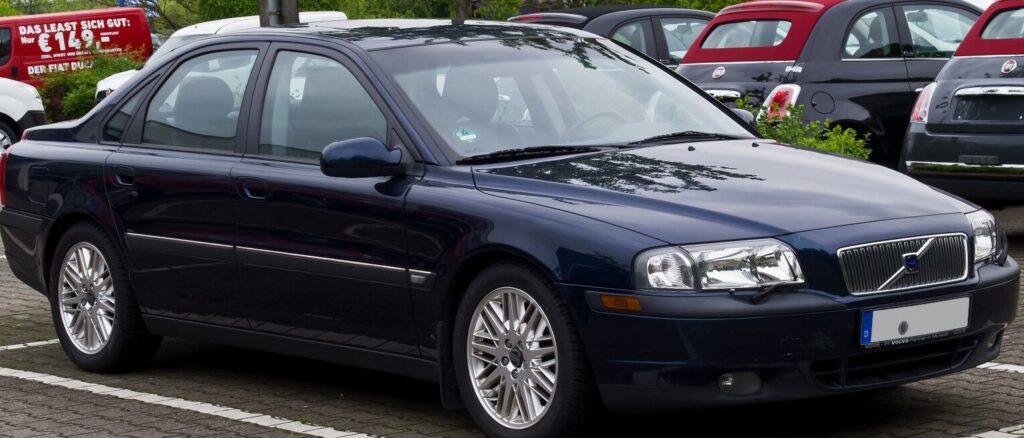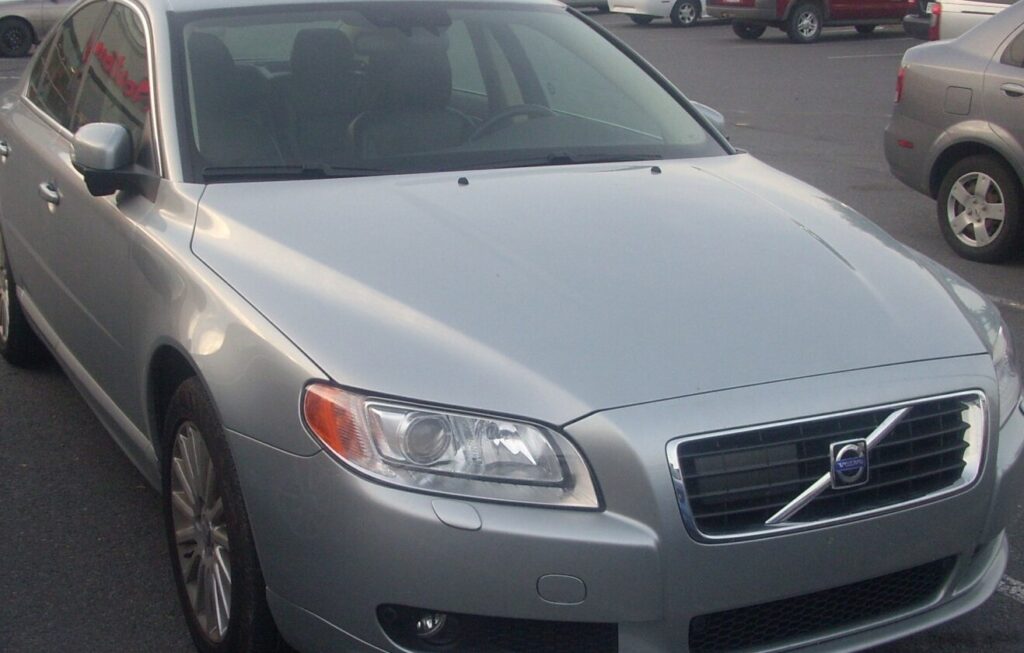
The Volvo S80 II 2.5 FT (200 hp) Ethanol Geartronic was a variant of the second-generation Volvo S80, produced for a limited time between 2008 and 2009. This model was specifically tailored for markets, particularly in Europe, embracing flex-fuel capability alongside traditional gasoline operation. It occupied a mid-range position within the S80 lineup, offering a balance between performance, fuel efficiency, and environmental considerations. The “FT” designation signifies its flexible-fuel capability, allowing it to run on gasoline, E85 ethanol, or any blend thereof. This variant was built on the Volvo P2 platform, also known as the Y20 platform, shared with other Volvo models of the era.
Technical Specifications
| Brand | Volvo |
| Model | S80 |
| Generation | S80 II |
| Type (Engine) | 2.5 FT (200 Hp) Ethanol Geartronic |
| Start of production | 2008 |
| End of production | 2009 |
| Powertrain Architecture | Internal Combustion engine |
| Body type | Sedan |
| Seats | 5 |
| Doors | 4 |
| Fuel consumption (economy) – urban (NEDC) | 15 l/100 km (15.7 US mpg, 18.8 UK mpg, 6.7 km/l) |
| Fuel consumption (economy) – extra urban (NEDC) | 7.3 l/100 km (32.2 US mpg, 38.7 UK mpg, 13.7 km/l) |
| Fuel consumption (economy) – combined (NEDC) | 10.1 l/100 km (23.3 US mpg, 28 UK mpg, 9.9 km/l) |
| CO2 emissions (NEDC) | 241 g/km |
| Fuel Type | Petrol / Ethanol – E85 |
| Acceleration 0 – 100 km/h | 8 sec |
| Acceleration 0 – 62 mph | 8 sec |
| Acceleration 0 – 60 mph | 7.6 sec |
| Maximum speed | 230 km/h (142.92 mph) |
| Weight-to-power ratio | 7.7 kg/Hp, 129.9 Hp/tonne |
| Weight-to-torque ratio | 5.1 kg/Nm, 194.8 Nm/tonne |
| Power | 200 Hp @ 4800 rpm |
| Power per litre | 79.3 Hp/l |
| Torque | 300 Nm @ 1500-4500 rpm (221.27 lb.-ft. @ 1500-4500 rpm) |
| Engine layout | Front, Transverse |
| Engine Model/Code | B5254T8 |
| Engine displacement | 2521 cm3 (153.84 cu. in.) |
| Number of cylinders | 5 |
| Engine configuration | Inline |
| Cylinder Bore | 83 mm (3.27 in.) |
| Piston Stroke | 93.2 mm (3.67 in.) |
| Compression ratio | 9:1 |
| Number of valves per cylinder | 4 |
| Fuel injection system | Multi-port manifold injection |
| Engine aspiration | Turbocharger, Intercooler |
| Valvetrain | DOHC |
| Engine oil capacity | 5.5 l (5.81 US qt | 4.84 UK qt) |
| Coolant | 9 l (9.51 US qt | 7.92 UK qt) |
| Kerb Weight | 1540 kg (3395.12 lbs.) |
| Trunk (boot) space – minimum | 480 l (16.95 cu. ft.) |
| Fuel tank capacity | 70 l (18.49 US gal | 15.4 UK gal) |
| Max. roof load | 75 kg (165.35 lbs.) |
| Permitted trailer load with brakes (12%) | 1800 kg (3968.32 lbs.) |
| Permitted trailer load without brakes | 750 kg (1653.47 lbs.) |
| Length | 4851 mm (190.98 in.) |
| Width | 1861 mm (73.27 in.) |
| Width including mirrors | 2106 mm (82.91 in.) |
| Height | 1493 mm (58.78 in.) |
| Wheelbase | 2835 mm (111.61 in.) |
| Front track | 1588 mm (62.52 in.) |
| Rear (Back) track | 1585 mm (62.4 in.) |
| Front overhang | 978 mm (38.5 in.) |
| Rear overhang | 1038 mm (40.87 in.) |
| Ride height (ground clearance) | 148 mm (5.83 in.) |
| Drag coefficient (Cd) | 0.29 |
| Minimum turning circle (turning diameter) | 11.7 m (38.39 ft.) |
| Drivetrain Architecture | The Internal combustion engine (ICE) drives the front wheels of the vehicle. |
| Drive wheel | Front wheel drive |
| Number of gears and type of gearbox | 6 gears, automatic transmission |
| Front suspension | Spring Strut |
| Rear suspension | Coil spring |
| Front brakes | Ventilated discs |
| Rear brakes | Ventilated discs |
| Assisting systems | ABS (Anti-lock braking system) |
| Steering type | Steering rack and pinion |
| Power steering | Electric Steering |
| Tires size | 225/55 R16 |
| Wheel rims size | 16 |
Powertrain & Engine Architecture
The heart of the S80 II 2.5 FT was the B5254T8 engine, a 2.5-liter inline-five cylinder turbocharged gasoline engine. This engine was designed to operate efficiently on both gasoline and E85 ethanol, thanks to its flex-fuel capability. The B5254T8 featured multi-port fuel injection and a double overhead camshaft (DOHC) valvetrain. The turbocharger, coupled with an intercooler, boosted power output to 200 horsepower at 4800 rpm and 300 Nm (221 lb-ft) of torque available from 1500 to 4500 rpm. The engine’s ability to run on E85 allowed for a higher compression ratio (9:1) without detonation, contributing to its power output. The engine was transversely mounted in the front of the vehicle. The Geartronic automatic transmission, a 6-speed unit, was specifically calibrated to work with the engine’s torque curve, providing smooth and responsive shifts.
Driving Characteristics
The 200 hp and 300 Nm of torque provided by the 2.5 FT engine delivered adequate performance for everyday driving. Acceleration from 0 to 60 mph took approximately 7.6 seconds, and the car had a top speed of 230 km/h (143 mph). Compared to the higher-output S80 variants, such as those with the 3.2-liter inline-six engine, the 2.5 FT offered less outright acceleration. However, it provided a more relaxed and fuel-efficient driving experience. The automatic transmission, while smooth, wasn’t as engaging as the available manual gearbox. The gear ratios were optimized for fuel economy and comfortable cruising, rather than sporty performance. The flex-fuel capability meant that performance could vary slightly depending on the ethanol content of the fuel used.
Equipment & Trim Levels
The S80 II 2.5 FT typically came with a respectable level of standard equipment. This included features like automatic climate control, power windows and mirrors, a CD stereo system, and alloy wheels. Safety was a key focus for Volvo, and the S80 II included features like ABS brakes, traction control, and multiple airbags. Optional extras included leather upholstery, a sunroof, a premium sound system, and navigation. The interior trim was generally comfortable and well-appointed, reflecting Volvo’s reputation for Scandinavian design. The dashboard layout was clean and functional, with intuitive controls.
Chassis & Braking
The S80 II featured a MacPherson strut front suspension and a multi-link rear suspension, providing a comfortable ride quality. The suspension was tuned for a balance between comfort and handling. The car was equipped with ventilated disc brakes on all four wheels, providing adequate stopping power. ABS (Anti-lock Braking System) was standard, enhancing safety during emergency braking situations. The steering was power-assisted, making it easy to maneuver at low speeds. The chassis was designed to provide good stability and handling characteristics, although it wasn’t as sporty as some of its competitors.
Market Reception & Comparison
The S80 II 2.5 FT was generally well-received by critics as a practical and fuel-efficient option within the luxury sedan segment. Its flex-fuel capability was seen as a positive attribute, appealing to environmentally conscious buyers. However, some reviewers noted that its performance wasn’t as exciting as some of its rivals. Compared to other S80 trims, the 2.5 FT offered a more affordable entry point into the model range. Fuel economy was a key selling point, with combined fuel consumption figures around 10.1 l/100 km (23.3 US mpg). Reliability was generally good, although some owners reported minor issues with the electronic systems.
Legacy
The Volvo S80 II 2.5 FT, while a relatively short-lived variant, represents an interesting chapter in Volvo’s history. Its flex-fuel capability demonstrated Volvo’s commitment to alternative fuels and environmental sustainability. Today, these cars can be found on the used car market at relatively affordable prices. The B5254T8 engine is known for its durability, but regular maintenance is essential to ensure long-term reliability. The automatic transmission is generally reliable, but it’s important to check for smooth shifting and proper operation. Overall, the S80 II 2.5 FT remains a comfortable, practical, and reasonably efficient luxury sedan.