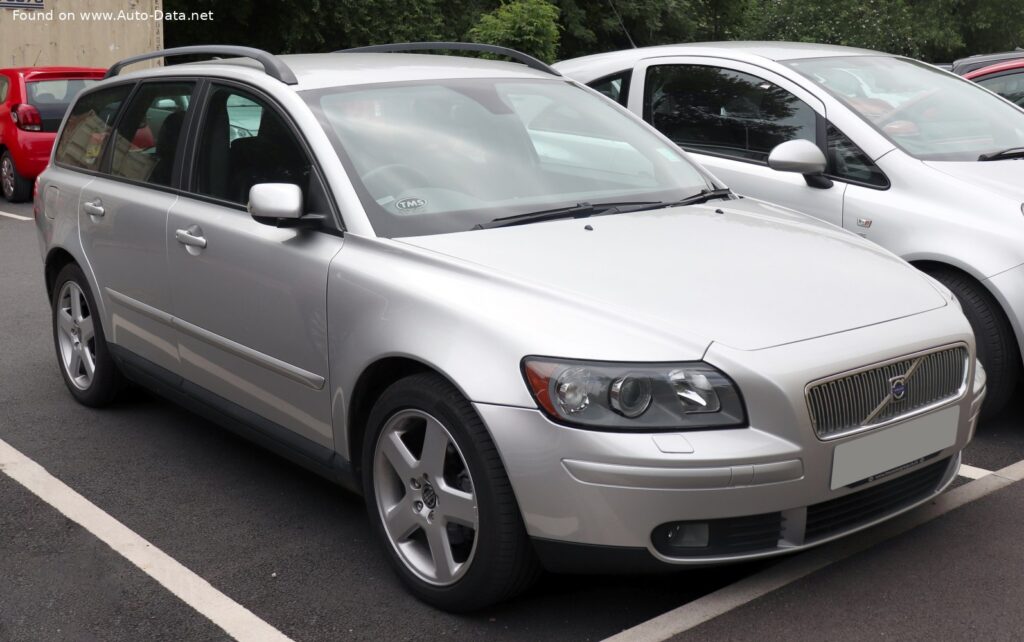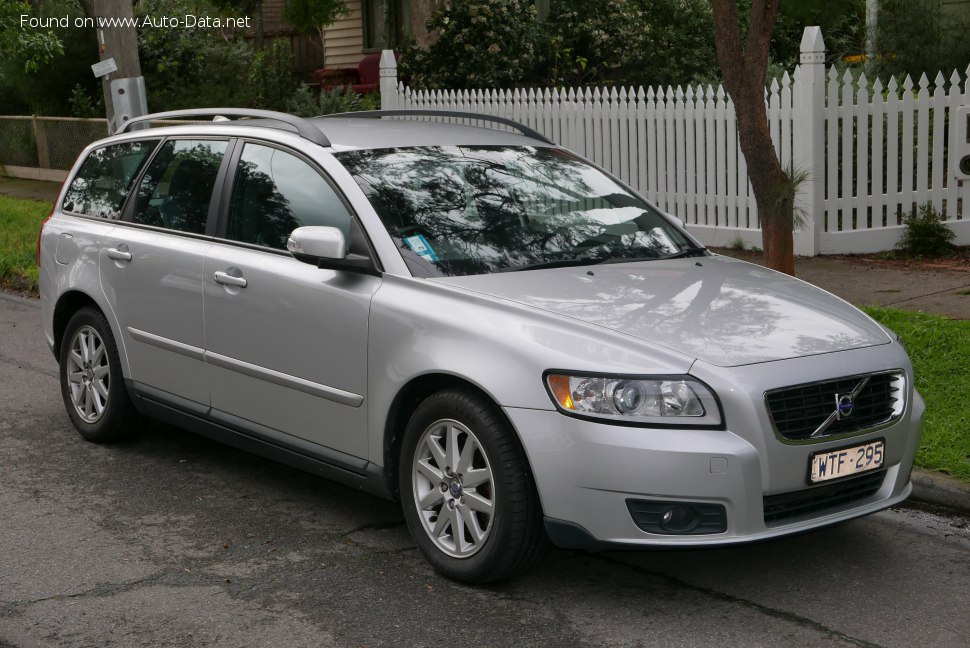
The Volvo V50, a compact executive car produced by the Swedish automaker Volvo Cars, represented a significant entry in the European premium compact segment. Introduced in 2004, the V50 was the station wagon counterpart to the S40 sedan, both built on Volvo’s P1 platform, which was shared with the Ford C1 platform (Ford Focus and Mazda 3). The model under review, the Volvo V50 (facelift 2007) 1.6 (100 Hp), received a mid-cycle refresh that brought subtle yet impactful updates, enhancing its aesthetic appeal and refining its features. Positioned as a practical and safe family vehicle, the V50 aimed to combine Volvo’s renowned safety credentials with a more dynamic driving experience and a compact footprint, catering primarily to the European market where smaller, efficient station wagons are highly valued.
Volvo V50 (Facelift 2007) 1.6: Entry-Level Premium
This particular variant, equipped with a 1.6-liter gasoline engine producing 100 horsepower, served as an entry-level offering, focusing on fuel efficiency and everyday usability rather than outright performance. While the V50 was available in North America with larger engine options, this specific 1.6-liter petrol model was a staple in European markets, appealing to buyers seeking a balance of Volvo’s premium feel, practicality, and economical running costs. The facelifted V50, produced from 2007 to 2012, continued Volvo’s tradition of understated design and robust engineering in a segment increasingly populated by competitive offerings from German and Japanese manufacturers.
Powertrain & Engine Architecture
At the heart of this Volvo V50 (facelift 2007) 1.6 (100 Hp) variant is a naturally aspirated 1.6-liter (1596 cm³) inline four-cylinder petrol engine, designated as the B4164S3. This powertrain architecture, with its front, transverse layout, delivers 100 horsepower at 6000 rpm and a peak torque of 150 Nm (110.63 lb-ft) at a modest 4000 rpm. The B4164S3 engine utilizes a multi-port fuel injection system, providing a reliable and relatively simple method of fuel delivery. The engine features a DOHC (Dual Overhead Camshaft) valvetrain with four valves per cylinder and a compression ratio of 11:1. This configuration is known for its reliability and smooth power delivery, characteristic of Volvo’s engineering philosophy.
The engine is typically paired with a 5-speed manual transmission, although a 4-speed automatic transmission (specifically the AW55-50SN) was also available. The automatic transmission, while offering convenience, is known to be less efficient than the manual counterpart and may exhibit slightly slower response times. The automatic transmission features electronically controlled hydraulic actuation and adaptive shift logic, aiming to optimize gear selection based on driving conditions. Power is sent to the front wheels, offering a direct and engaging driving experience typical of European compacts.
Driving Characteristics
The 1.6-liter, 100 hp V50 Automatic offers a driving experience geared towards practicality and fuel economy rather than spirited performance. Acceleration from 0 to 60 mph takes approximately 11.4 seconds, and the top speed is around 115 mph. Compared to the more powerful 2.0-liter or T5 turbocharged variants, the 1.6-liter feels noticeably less responsive, particularly during overtaking maneuvers. The automatic transmission, while smooth, can sometimes feel hesitant, especially when downshifting. The gear ratios are optimized for fuel efficiency, resulting in a relatively high cruising speed at lower engine revolutions. However, this can also mean that the engine feels strained when climbing hills or carrying a full load.
The manual transmission version of the 1.6L offers a more engaging driving experience, allowing the driver to better control the engine’s power band. However, even with the manual, the 1.6L is not a performance-oriented engine. The V50’s suspension provides a comfortable ride, absorbing bumps and imperfections in the road effectively. Steering is precise and well-weighted, providing good feedback to the driver.
Equipment & Trim Levels
The Volvo V50 (facelift 2007) 1.6 (100 Hp) typically came equipped with a reasonable level of standard features, reflecting its position as an entry-level premium vehicle. Standard equipment generally included air conditioning, power windows and mirrors, a CD stereo system, and ABS brakes. Safety features were, as with all Volvos, comprehensive, including front and side airbags, and a robust body structure designed to protect occupants in the event of a collision. Interior upholstery was typically cloth, with a dark color scheme. The dashboard featured a clean and functional design, with easy-to-read gauges and controls.
Optional extras available for this trim included alloy wheels, a sunroof, leather upholstery, a premium audio system, and parking sensors. Higher trim levels, such as the SE or Executive, added more features as standard, such as automatic climate control, rain-sensing wipers, and upgraded interior trim. The V50 also offered a range of optional safety features, such as Whiplash Protection System (WHIPS) and Dynamic Stability and Traction Control (DSTC).
Chassis & Braking
The Volvo V50 (facelift 2007) 1.6 (100 Hp) utilizes an independent McPherson strut suspension at the front and an independent multi-link suspension at the rear. This suspension setup provides a good balance of ride comfort and handling. The front suspension incorporates a stabilizer bar to reduce body roll during cornering. The rear suspension is designed to minimize noise and vibration, contributing to a refined driving experience. The steering system is an electric power steering (EPS) system, which provides precise and responsive steering feel while also improving fuel efficiency.
Braking duties are handled by ventilated disc brakes at the front and solid disc brakes at the rear. ABS (Anti-lock Braking System) is standard, preventing wheel lockup during hard braking. The braking system is generally considered to be effective and reliable, providing ample stopping power for everyday driving conditions.
Market Reception & Comparison
Critics generally viewed the Volvo V50 (facelift 2007) 1.6 (100 Hp) as a sensible and practical choice for buyers seeking a safe and reliable compact station wagon. The 1.6-liter engine was praised for its fuel efficiency, but some reviewers noted its lack of outright performance. Compared to the more powerful V50 variants, the 1.6-liter offered a more affordable entry point into the Volvo brand, but at the expense of driving excitement. Fuel economy was a strong point, with the 1.6-liter achieving around 32.7 US mpg on the combined cycle. Reliability was generally good, although some owners reported minor issues with the automatic transmission.
Compared to rivals such as the BMW 3 Series Touring and Audi A4 Avant, the V50 offered a more understated and practical design, with a greater emphasis on safety and comfort. However, it lacked the brand prestige and driving dynamics of its German competitors. The Volkswagen Golf Variant and Ford Focus Estate offered similar levels of practicality and fuel efficiency at a lower price point, but lacked the premium feel and safety features of the V50.
Technical Specifications
| Category | Specification |
| General Information | |
| Brand | Volvo |
| Model | V50 |
| Generation | V50 (facelift 2007) |
| Type (Engine) | 1.6 (100 Hp) |
| Start of production | 2007 year |
| End of production | 2012 year |
| Powertrain Architecture | Internal Combustion engine |
| Body type | Station wagon (estate) |
| Seats | 5 |
| Doors | 5 |
| Performance Specs | |
| Fuel consumption (economy) – urban (NEDC) | 9.2 l/100 km (25.6 US mpg) |
| Fuel consumption (economy) – extra urban (NEDC) | 5.8 l/100 km (40.6 US mpg) |
| Fuel consumption (economy) – combined (NEDC) | 7.2 l/100 km (32.7 US mpg) |
| CO2 emissions (NEDC) | 169 g/km |
| Fuel Type | Petrol (Gasoline) |
| Acceleration 0 – 100 km/h | 12 sec |
| Acceleration 0 – 60 mph | 11.4 sec |
| Maximum speed | 185 km/h (114.95 mph) |
| Emission standard | Euro 4 |
| Engine Specs | |
| Power | 100 Hp @ 6000 rpm |
| Torque | 150 Nm @ 4000 rpm (110.63 lb.-ft. @ 4000 rpm) |
| Engine layout | Front, Transverse |
| Engine Model/Code | B4164S3 |
| Engine displacement | 1596 cm³ (97.39 cu. in.) |
| Number of cylinders | 4 |
| Compression ratio | 11:1 |
Legacy
The Volvo V50, and specifically the 1.6-liter variant, has proven to be a reliable and durable vehicle in the used car market. The B4164S3 engine is known for its longevity, and with regular maintenance, can provide many years of trouble-free service. The automatic transmission, while not as refined as some modern units, is generally reliable, although some owners have reported issues with solenoid failure. The V50’s robust construction and comprehensive safety features continue to appeal to buyers seeking a practical and safe family vehicle. Today, the V50 (facelift 2007) 1.6 (100 Hp) represents a good value proposition for those seeking an affordable and well-equipped compact station wagon with a proven track record of reliability.