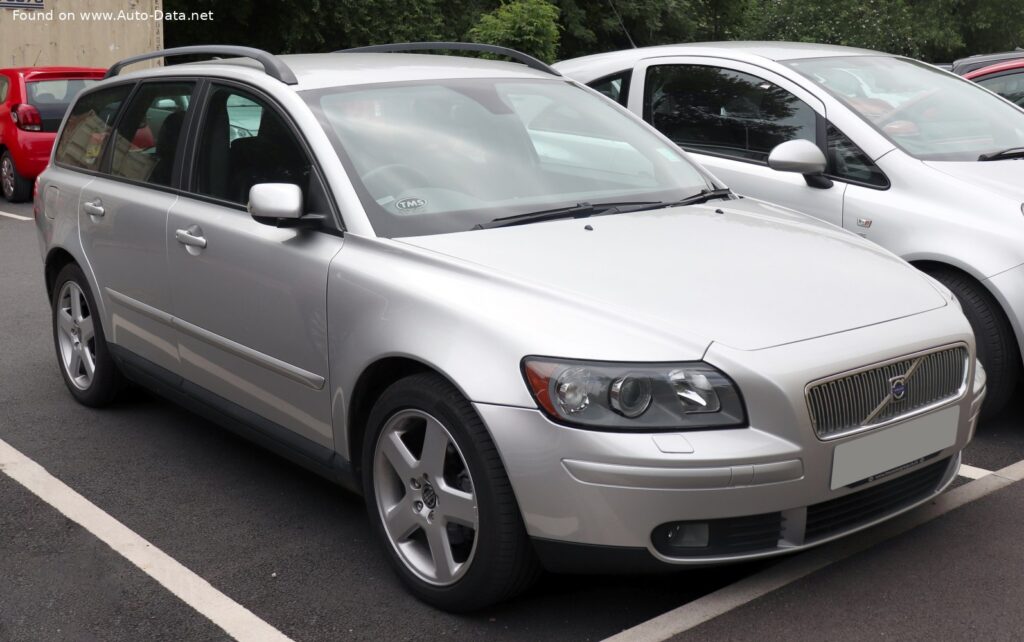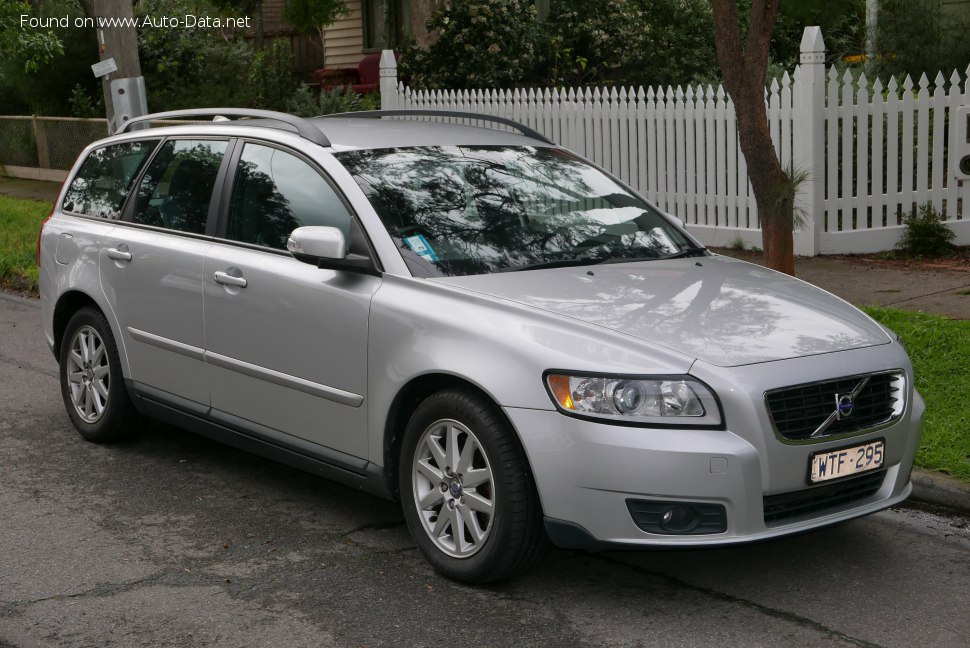
The Volvo V50, a compact executive car produced by the Swedish automaker Volvo Cars, represented a pivotal model in the company’s lineup, particularly within the competitive European market. Introduced in 2004, the V50 was the station wagon variant of the S40 sedan, both sharing the Ford C1 platform with the Ford Focus and Mazda 3. This platform collaboration allowed Volvo to leverage shared engineering while maintaining its distinct brand identity centered on safety, practicality, and sophisticated Scandinavian design. The focus of this article is on the Volvo V50 (facelift 2007) 1.6 D DRIVe (109 Hp) start/stop, a highly efficient diesel variant that emerged from the model’s mid-cycle refresh.
The 2007 facelift brought subtle yet effective updates to the V50, enhancing its aesthetic appeal and refining its technological offerings. While the V50 was available with various powertrains globally, including gasoline engines that were popular in North America, the 1.6 D DRIVe variant was specifically engineered for the European market, where diesel engines and fuel economy were paramount considerations for consumers and fleet operators alike. This particular model, produced from 2007 to 2010, embodied Volvo’s commitment to environmental responsibility through its innovative DRIVe initiative, featuring a start/stop system to significantly reduce fuel consumption and CO2 emissions.
Engine and Performance of the Volvo V50 (facelift 2007) 1.6 D DRIVe (109 Hp) start/stop
At the heart of the Volvo V50 (facelift 2007) 1.6 D DRIVe (109 Hp) start/stop lies a highly optimized 1.6-liter (1560 cm3) inline-four turbo-diesel engine, designated D4164T. This powerplant, a result of a collaboration between Ford and PSA Peugeot Citroën, was renowned for its balance of efficiency and usable torque. It delivers 109 horsepower at 4000 rpm and a robust 177 lb.-ft. of torque at a low 1750 rpm. This low-end torque characteristic made the V50 1.6 D DRIVe particularly well-suited for everyday driving, offering responsive acceleration in urban environments and relaxed cruising on highways, despite its modest horsepower figure.
The engine’s sophisticated design includes a DOHC (Double Overhead Camshaft) valvetrain with 4 valves per cylinder, a common-rail direct fuel injection system, and a turbocharger with an intercooler. These technologies work in concert to ensure efficient combustion and optimal power delivery. With a compression ratio of 18.3:1, it was designed for maximum diesel efficiency. The vehicle’s performance figures reflect its emphasis on economy rather than outright speed, achieving 0-60 mph in a respectable 10.9 seconds and a top speed of 118 mph. Power is delivered to the front wheels via a smooth-shifting 5-speed manual transmission, a common choice for maximizing fuel efficiency in this segment.
The “DRIVe” designation signifies Volvo’s dedication to reducing environmental impact. This particular V50 variant was a pioneer in integrating a start/stop system, which automatically shuts off the engine when the vehicle is stationary and restarts it instantly when the driver presses the clutch. This feature, combined with other aerodynamic and efficiency enhancements, allowed the 1.6 D DRIVe to achieve remarkable fuel economy figures: an impressive 48 US mpg in urban driving, 69.2 US mpg on the extra-urban cycle, and a combined 60.3 US mpg. Its CO2 emissions of just 104 g/km were class-leading at the time, helping it meet the stringent Euro 4 emission standard and offering significant tax advantages in many European countries.
Powertrain & Engine Architecture
The D4164T engine is a testament to collaborative engineering. The engine block is cast iron, providing durability, while the cylinder head is aluminum alloy, contributing to weight reduction. The common-rail direct injection system utilizes piezo injectors, allowing for precise fuel metering and multiple injection events per combustion cycle. This optimizes combustion efficiency and reduces particulate emissions. The turbocharger is a variable geometry turbo (VGT), which adjusts the turbine vanes to optimize boost pressure across the engine’s operating range, improving both low-end torque and high-end power. The engine also features an exhaust gas recirculation (EGR) system to further reduce NOx emissions.
The 5-speed manual transmission used in the V50 1.6 D DRIVe is a robust unit designed to handle the engine’s torque output. Gear ratios are optimized for fuel efficiency, with a relatively tall fifth gear for highway cruising. The transmission’s shift linkage is cable-operated, providing a precise and direct feel. The clutch is a single-plate dry clutch, typical for this class of vehicle. The transmission does not feature any electronic assistance or automated shifting capabilities.
Driving Characteristics
The V50 1.6 D DRIVe offers a driving experience focused on efficiency and comfort rather than outright performance. The 109 hp engine provides adequate power for everyday driving, but acceleration is not brisk. The strong low-end torque makes it easy to navigate city streets and maintain highway speeds. The 5-speed manual transmission requires frequent shifting when accelerating or climbing hills. Compared to the higher-output 2.0D or gasoline-powered V50 models, the 1.6 D DRIVe feels noticeably slower. However, the trade-off is significantly improved fuel economy.
The start/stop system operates seamlessly, restarting the engine quickly and smoothly when the clutch is depressed. The system can feel slightly intrusive in stop-and-go traffic, but the fuel savings are substantial. The V50’s suspension provides a comfortable ride, absorbing bumps and imperfections in the road surface effectively. Steering is light and precise, making it easy to maneuver in tight spaces. Overall, the driving experience is refined and predictable, prioritizing comfort and efficiency over sporty handling.
Equipment & Trim Levels
The 1.6 D DRIVe trim level was generally positioned as the entry-level or near-entry-level offering in the V50 range, focusing on fuel efficiency and affordability. Standard equipment typically included air conditioning, power windows and mirrors, a CD stereo system, and ABS brakes. Safety features were comprehensive, including driver and passenger airbags, side airbags, and curtain airbags. The interior upholstery was typically cloth, with a durable and practical finish.
Optional extras available for the 1.6 D DRIVe included alloy wheels, a sunroof, leather upholstery, a premium audio system, and parking sensors. Higher trim levels offered additional features such as automatic climate control, rain-sensing wipers, and a trip computer. The overall interior design was minimalist and functional, reflecting Volvo’s Scandinavian design philosophy. The “floating” center console, a signature Volvo design element, provided storage space and a unique aesthetic.
Chassis & Braking
The V50 1.6 D DRIVe utilizes a MacPherson strut front suspension with a stabilizer bar, providing a comfortable and controlled ride. The rear suspension is a multi-link independent suspension, which further enhances ride quality and handling. The chassis is relatively lightweight, contributing to the vehicle’s fuel efficiency.
The braking system consists of ventilated disc brakes at the front and drum brakes at the rear. ABS (Anti-lock Braking System) is standard, providing enhanced braking performance in emergency situations. The brake calipers are single-piston units. The braking system is adequate for the vehicle’s weight and performance, providing sufficient stopping power in most driving conditions. The steering system is a power-assisted rack-and-pinion system, offering precise and responsive steering feel.
Market Reception & Comparison
The Volvo V50 1.6 D DRIVe was generally well-received by critics for its exceptional fuel economy and low emissions. It was praised for its comfortable ride, practical interior, and comprehensive safety features. However, some critics noted that the engine lacked power, particularly when fully loaded or driving uphill. Compared to other trims in the V50 lineup, the 1.6 D DRIVe offered the best fuel economy but the lowest performance.
Compared to competitors such as the Ford Focus Estate, Volkswagen Golf Estate, and Opel Astra Sports Tourer, the V50 1.6 D DRIVe stood out for its Scandinavian design, strong safety credentials, and refined driving experience. Its fuel economy was competitive with other diesel-powered estates in its class. Reliability was generally good, although some owners reported issues with the diesel particulate filter (DPF) and the start/stop system.
Technical Specifications
| Brand | Volvo |
| Model | V50 |
| Generation | V50 (facelift 2007) |
| Type (Engine) | 1.6 D DRIVe (109 Hp) start/stop |
| Production Start | 2007 year |
| Production End | 2010 year |
| Powertrain Architecture | Internal Combustion engine |
| Body Type | Station wagon (estate) |
| Seats | 5 |
| Doors | 5 |
| Performance Specs | |
| Fuel Economy – Urban (NEDC) | 4.9 l/100 km (48 US mpg) |
| Fuel Economy – Extra Urban (NEDC) | 3.4 l/100 km (69.2 US mpg) |
| Fuel Economy – Combined (NEDC) | 3.9 l/100 km (60.3 US mpg) |
| CO2 Emissions (NEDC) | 104 g/km |
| Fuel Type | Diesel |
| Acceleration 0 – 60 mph | 10.9 sec |
| Maximum Speed | 118.06 mph (190 km/h) |
| Emission Standard | Euro 4 |
| Weight-to-Power Ratio | 12.1 kg/Hp (82.6 Hp/tonne) |
| Engine Specs | |
| Power | 109 Hp @ 4000 rpm |
| Power per Liter | 69.9 Hp/l |
| Torque | 177.01 lb.-ft. (240 Nm) @ 1750 rpm |
| Engine Layout | Front, Transverse |
| Engine Model/Code | D4164T |
| Engine Displacement | 1.6 l (1560 cm3 / 95.2 cu. in.) |
| Number of Cylinders | 4, Inline |
| Cylinder Bore | 2.95 in. (75 mm) |
| Piston Stroke | 3.48 in. (88.3 mm) |
| Compression Ratio | 18.3:1 |
| Valves per Cylinder | 4 |
| Fuel Injection System | Diesel Commonrail |
| Engine Aspiration | Turbocharger, Intercooler |
Legacy
The Volvo V50 1.6 D DRIVe powertrain has proven to be relatively reliable, although, as with any diesel engine, the diesel particulate filter (DPF) can be prone to clogging if the vehicle is primarily used for short trips. The start/stop system has also been known to experience occasional issues, such as battery drain or failure of the starter motor. However, these issues are not widespread and can often be addressed with proper maintenance.
In the used car market today, the V50 1.6 D DRIVe remains a popular choice for buyers seeking a fuel-efficient and practical estate car. Its low running costs and comfortable ride make it an attractive option for commuters and families. While it may not offer the performance of higher-powered V50 models, its exceptional fuel economy and environmental credentials continue to appeal to a wide range of buyers. The V50 1.6 D DRIVe represents a significant step forward in Volvo’s commitment to sustainable mobility.