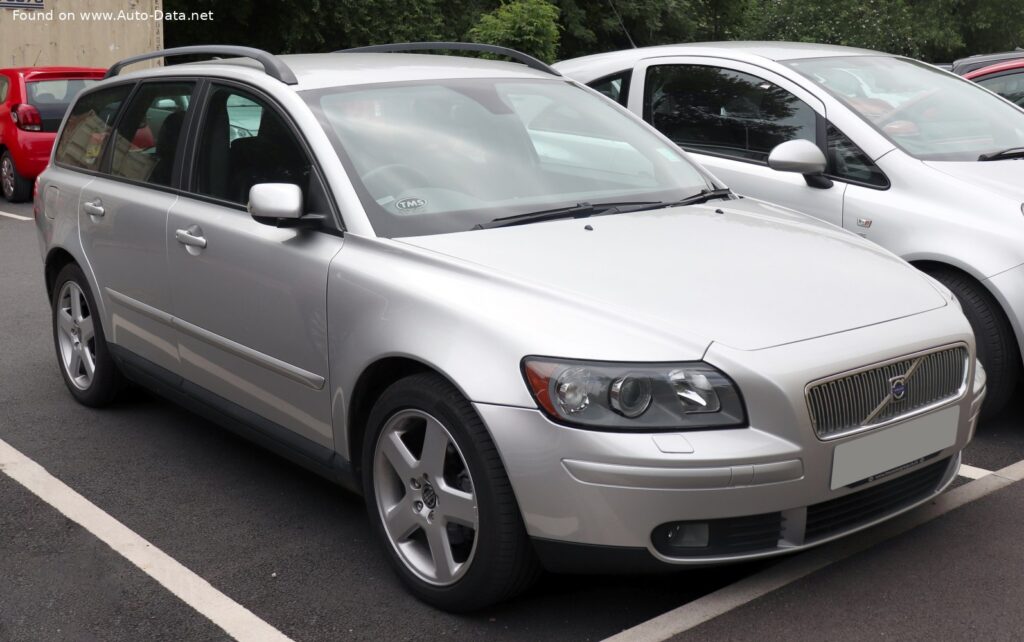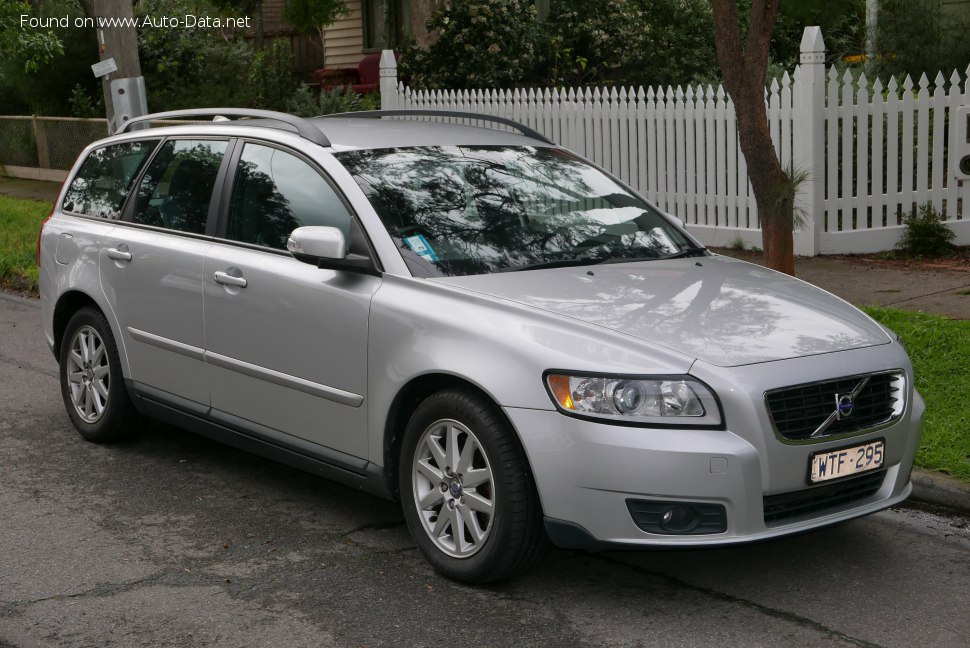
The Volvo V50 (facelift 2007) represents a significant evolution of Volvo’s compact premium station wagon, first introduced in 2004. As part of the P1 platform family, shared with the Ford C1 and Mazda 3, the V50 was designed to offer Volvo’s renowned safety and practicality in a more compact, dynamically capable package. The 2007 facelift brought a series of aesthetic and functional enhancements, solidifying its position in the competitive compact executive segment. This particular variant, equipped with the 2.4i (170 Hp) engine and a 5-speed automatic transmission, provided a balanced blend of performance and everyday usability, appealing to buyers seeking a versatile and sophisticated vehicle with a distinctive Swedish character. Though primarily a strong contender in the European market, the V50 also carved out a niche in North America, catering to those who appreciated its understated elegance and wagon utility in an SUV-dominated landscape.
The 2.4i Automatic V50: Positioning and Target Audience
The 2.4i automatic variant of the Volvo V50 (facelift 2007) occupied a mid-range position within the V50 lineup. It sat above the base 1.8L models, offering a noticeable performance upgrade, and below the more powerful 2.5T turbocharged versions. This positioning made it an attractive option for buyers who desired more power than the entry-level engine but didn’t require or want to pay for the added complexity and running costs of the turbocharger. The target audience was typically families or individuals who prioritized comfort, safety, and practicality, and who needed a versatile vehicle for both daily commuting and longer journeys. The automatic transmission further broadened its appeal to those who preferred the convenience of a two-pedal setup, particularly in urban driving conditions.
Powertrain & Engine Architecture
At the heart of the Volvo V50 (facelift 2007) 2.4i automatic lies Volvo’s venerable B5244S4 engine, a naturally aspirated 2.4-liter (2435 cm3 or 148.59 cu. in.) inline-five cylinder unit. This engine configuration is a hallmark of Volvo engineering, known for its distinctive sound, smooth power delivery, and inherent balance. It features a DOHC (Double Overhead Camshaft) valvetrain with four valves per cylinder, optimizing airflow for efficiency and performance. The multi-port manifold injection system ensures precise fuel delivery, contributing to both responsiveness and fuel economy.
The 2.4i engine produces a robust 170 horsepower at 6000 rpm, coupled with 169.64 lb.-ft. of torque peaking at a relatively accessible 4400 rpm. This power is channeled through a 5-speed automatic transmission, specifically the AW55-50SN unit, a commonly used gearbox known for its smooth shifting and reliability. This transmission features electronic control and adaptive shift logic, adjusting shift points based on driving conditions and driver input. The torque converter provides smooth launch characteristics and enhances low-speed drivability. The automatic transmission lacks a manual shift mode, focusing on providing a comfortable and effortless driving experience.
Driving Characteristics
The 2.4i automatic V50 delivers a comfortable and refined driving experience. While not as overtly sporty as the manual transmission or turbocharged variants, it offers sufficient power for everyday driving and highway cruising. The automatic transmission prioritizes smooth shifts and fuel efficiency, resulting in a more relaxed driving style. Acceleration from 0 to 60 mph takes approximately 8.5-9.0 seconds, slightly slower than the manual version due to the transmission’s inherent power loss. The gear ratios are optimized for fuel economy and comfortable cruising, with a relatively tall final drive. The engine provides adequate torque for overtaking maneuvers, but requires a downshift for quicker acceleration. Compared to the 1.8L automatic, the 2.4i offers a noticeable improvement in performance, particularly when fully loaded or driving uphill. The automatic transmission contributes to a more forgiving driving experience, especially in stop-and-go traffic.
Equipment & Trim Levels
The 2.4i automatic V50 typically came standard with a generous array of features, reflecting Volvo’s commitment to safety and comfort. Standard equipment included climate control, power windows and locks, a CD stereo system, alloy wheels, and ABS brakes. Safety features were comprehensive, including SIPS (Side Impact Protection System), WHIPS (Whiplash Protection System), and a full complement of airbags. Higher trim levels, such as the SE or Executive, added features like leather upholstery, a sunroof, premium audio system, and parking sensors. Optional extras included navigation system, heated front seats, and automatic headlights. Interior upholstery was typically cloth on the base models, with leather available as an upgrade. The dashboard layout was clean and functional, with logically placed controls and clear instrumentation. The “floating” center console, a signature Volvo design element, provided storage space and a unique aesthetic.
Chassis & Braking
The V50’s chassis was designed to provide a balance between comfort and handling. It featured an independent MacPherson strut suspension at the front and an independent multi-link suspension at the rear, both with coil springs and stabilizer bars. This configuration delivered a comfortable ride quality while maintaining good body control. The steering was power-assisted, providing precise feedback and effortless maneuverability. The braking system utilized ventilated discs at the front and solid discs at the rear, ensuring strong and consistent stopping power. ABS (Anti-lock Braking System) was standard, enhancing safety in emergency braking situations. The V50’s suspension was tuned to prioritize comfort over outright sportiness, resulting in a more forgiving ride compared to some of its German rivals. Stabilizer bar thickness was moderate, providing adequate roll control without compromising ride comfort.
Market Reception & Comparison
Critics generally praised the Volvo V50 2.4i automatic for its comfortable ride, spacious interior, and comprehensive safety features. The engine was considered adequate for most driving situations, although some reviewers noted that it lacked the punch of the turbocharged models. The automatic transmission was appreciated for its smooth shifting and ease of use. Fuel economy was considered respectable for a vehicle of its class, averaging around 25-28 mpg in real-world driving. Compared to the 1.8L automatic, the 2.4i offered a noticeable performance improvement, making it a more enjoyable vehicle to drive. However, it was more expensive to purchase and operate. Compared to the 2.5T models, the 2.4i offered a more affordable entry point into the V50 range, but lacked the added performance and prestige of the turbocharged engine. Reliability was generally good, with the B5244S4 engine and AW55-50SN transmission proving to be durable and long-lasting.
Technical Specifications
| Category | Specification |
| Brand | Volvo |
| Model | V50 (facelift 2007) |
| Type (Engine) | 2.4i (170 Hp) Automatic |
| Production Start | 2007 |
| Production End | 2009 |
| Body Type | Station wagon (estate) |
| Seats | 5 |
| Doors | 5 |
| Fuel Consumption (Urban) | 19 US mpg (12.4 l/100 km) |
| Fuel Consumption (Extra Urban) | 35.6 US mpg (6.6 l/100 km) |
| Fuel Consumption (Combined) | 27.7 US mpg (8.5 l/100 km) |
| CO2 Emissions (NEDC) | 203 g/km |
| Fuel Type | Petrol (Gasoline) |
| Acceleration 0-60 mph | 8.5-9.0 sec |
| Maximum Speed | 136.7 mph (220 km/h) |
| Emission Standard | Euro 4 |
| Engine Model/Code | B5244S4 |
| Engine Displacement | 2.4 liters (2435 cm3 / 148.59 cu. in.) |
| Number of Cylinders | 5 |
| Engine Configuration | Inline |
| Power | 170 Hp @ 6000 rpm |
| Torque | 169.64 lb.-ft. (230 Nm) @ 4400 rpm |
| Transmission | 5-speed Automatic (AW55-50SN) |
Legacy
The Volvo V50 2.4i automatic has proven to be a reliable and durable vehicle in the used car market. The B5244S4 engine is known for its longevity, and the AW55-50SN transmission is generally considered to be robust. Common maintenance items include regular oil changes, timing belt replacement (typically every 80,000-100,000 miles), and inspection of the cooling system. While not without its quirks, the V50 2.4i automatic remains a popular choice for buyers seeking a safe, practical, and comfortable wagon. Its understated elegance and distinctive Swedish character continue to appeal to a loyal following. Today, well-maintained examples can be found for reasonable prices, making it an attractive option for those who appreciate a classic Volvo wagon.