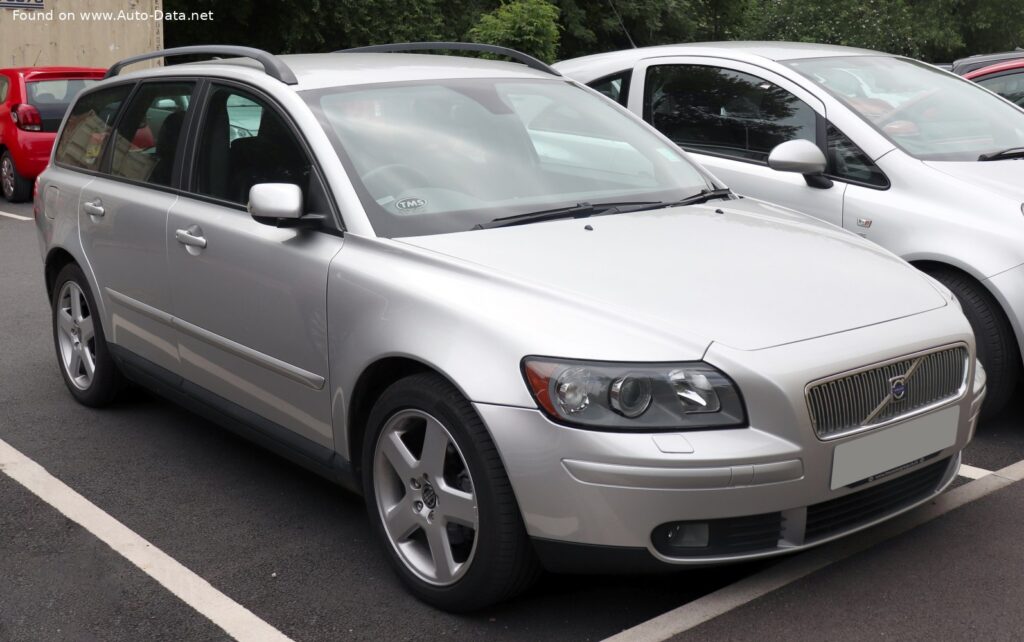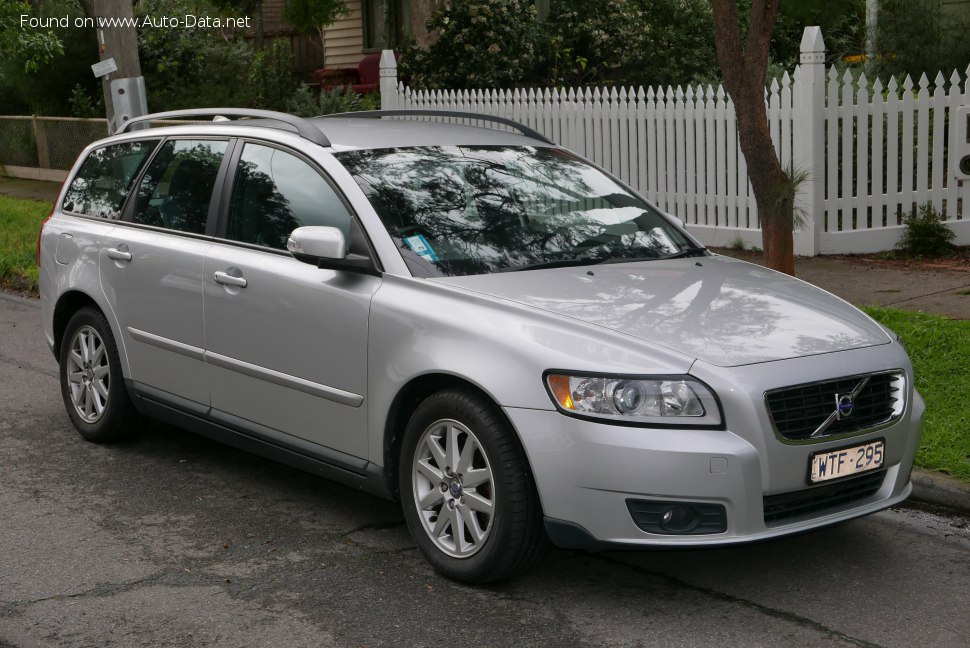
The Volvo V50 (facelift 2007) 2.5 T5 represents a significant refresh of Volvo’s compact premium station wagon, first introduced for the 2004 model year. Sharing its platform with the Ford C1 architecture (also underpinning the Ford Focus and Mazda3), the V50 was Volvo’s offering in the competitive compact executive segment, aiming to blend Scandinavian design, robust safety, and surprising performance in a practical package. The 2007 facelift brought a series of aesthetic and technical enhancements, solidifying its appeal, particularly in its primary European market, while also being available in North America. This particular variant, powered by the potent 2.5-liter T5 turbocharged five-cylinder engine, stood out as the performance flagship of the V50 lineup, offering a compelling blend of speed and utility.
Powertrain & Engine Architecture
At the core of the performance-oriented Volvo V50 (facelift 2007) 2.5 T5 was Volvo’s renowned B5254T7 engine, a transversely mounted 2.5-liter (2521 cm3 or 153.84 cu. in.) inline five-cylinder unit. This powerplant was a hallmark of Volvo engineering, celebrated for its distinctive thrum and robust power delivery. Equipped with a turbocharger and intercooler, along with a DOHC (Double Overhead Camshaft) valvetrain and multi-port manifold injection, it produced a healthy 230 horsepower at 5000 rpm. Its impressive power-per-liter figure of 91.2 Hp/l underscored its efficiency and tuning.
The B5254T7 engine utilized a cast iron block with an aluminum cylinder head. The fuel injection system was a sequential multi-port fuel injection, providing precise fuel delivery for optimal combustion. The DOHC valvetrain featured four valves per cylinder, enhancing volumetric efficiency and contributing to the engine’s strong performance across the rev range. The turbocharger, a Mitsubishi TD04HL-13C, provided significant boost, contributing to the engine’s high output. The engine was paired with an Aisin Warner TF-80SC automatic transmission, a 6-speed unit known for its smooth shifting and durability. This transmission featured adaptive shift logic, adjusting shift points based on driving style and conditions.
Driving Characteristics
The Volvo V50 (facelift 2007) 2.5 T5 with the automatic transmission delivered a refined and capable driving experience. While not as overtly sporty as the 6-speed manual version, the automatic provided smooth and effortless acceleration. The broad torque curve of the 2.5-liter engine, peaking at 320 Nm (236.02 lb.-ft.) between 1500 and 5000 rpm, meant that strong pulling power was readily available at all times. The automatic transmission’s gear ratios were optimized for both fuel efficiency and performance. First gear was relatively short for quick off-the-line acceleration, while higher gears were geared for comfortable highway cruising.
Compared to the lower-powered 1.8L and 2.0L variants, the T5 offered a substantial performance advantage. The 1.8L models, for example, produced around 120 hp and felt noticeably slower, particularly when fully loaded. The T5’s acceleration from 0 to 60 mph in 6.6 seconds was significantly quicker than the 9-10 seconds required by the base models. While the manual transmission offered a more engaging driving experience, the automatic provided a more relaxed and convenient option for everyday driving. The automatic transmission did introduce a slight power loss compared to the manual, but the difference was minimal in real-world driving conditions.
Equipment & Trim Levels
The 2.5 T5 variant of the Volvo V50 (facelift 2007) typically represented the highest trim level available. Standard equipment included leather upholstery, automatic climate control, a premium audio system (often with a CD changer), alloy wheels (typically 17-inch), and a host of safety features. The interior featured Volvo’s signature floating center console design, providing a clean and modern aesthetic. The seats were designed for comfort and support, even on long journeys.
Optional extras included a sunroof, navigation system, parking assist sensors, and upgraded audio options. Many T5 models were also equipped with the optional Dynamic Stability and Traction Control (DSTC) system, enhancing stability and control in challenging driving conditions. The exterior styling could be further customized with optional body kits and different wheel designs. The T5 trim was positioned as the premium offering, appealing to buyers who wanted a combination of performance, luxury, and practicality.
Chassis & Braking
The Volvo V50 (facelift 2007) featured an independent suspension system designed to provide a comfortable yet controlled ride. The front suspension utilized McPherson struts with coil springs and an anti-roll bar, while the rear suspension employed a multi-link setup, also with coil springs and an anti-roll bar. This configuration helped to minimize body roll and provide precise handling. The T5 variant typically featured slightly stiffer suspension components compared to the lower-powered models, enhancing its dynamic capabilities.
The braking system consisted of ventilated disc brakes at the front and solid disc brakes at the rear. ABS (Anti-lock Braking System) was standard, along with Electronic Brake-force Distribution (EBD). The braking performance was adequate for the vehicle’s weight and power, providing confident stopping power in both normal and emergency situations. The steering system was an electric power steering (EPS) system, offering precise control and a relatively tight turning circle.
Market Reception & Comparison
Critics generally praised the Volvo V50 (facelift 2007) 2.5 T5 for its blend of performance, safety, and practicality. The 2.5-liter T5 engine was widely regarded as a strong performer, offering ample power and torque for everyday driving and occasional spirited runs. The automatic transmission was appreciated for its smoothness and convenience. Fuel economy, rated at 8.7 liters per 100 km (27 US mpg) combined, was considered competitive for a vehicle of its class and performance level.
Compared to other trims in the V50 lineup, the T5 offered a significant performance upgrade. The 1.8L and 2.0L models were more fuel-efficient but lacked the T5’s punch. In terms of reliability, the B5254T7 engine was generally considered to be robust and durable, although regular maintenance was essential. The Aisin Warner automatic transmission was also known for its reliability. Compared to rivals like the BMW 3 Series Touring and Audi A4 Avant, the V50 T5 offered a unique Scandinavian aesthetic and a strong emphasis on safety.
Technical Specifications
| Category | Specification |
| General Information | Brand: Volvo |
| Model: V50 | |
| Generation: V50 (facelift 2007) | |
| Type (Engine): 2.5 T5 (230 Hp) | |
| Start of production: 2007 year | |
| End of production: 2012 year | |
| Powertrain Architecture: Internal Combustion engine | |
| Body type: Station wagon (estate) | |
| Seats: 5 | |
| Doors: 5 | |
| Performance Specs | Fuel consumption (economy) – urban: 12.6 l/100 km (18.7 US mpg) |
| Fuel consumption (economy) – extra urban: 6.4 l/100 km (36.8 US mpg) | |
| Fuel consumption (economy) – combined: 8.7 l/100 km (27 US mpg) | |
| CO2 emissions: 208 g/km | |
| Fuel Type: Petrol (Gasoline) | |
| Acceleration 0 – 60 mph: 6.6 sec | |
| Acceleration 0 – 100 km/h: 6.9 sec | |
| Maximum speed: 240 km/h (149.13 mph) | |
| Weight-to-power ratio: 6.1 kg/Hp, 163.6 Hp/tonne | |
| Weight-to-torque ratio: 4.4 kg/Nm, 227.6 Nm/tonne | |
| Engine Specs | Power: 230 Hp @ 5000 rpm |
| Power per liter: 91.2 Hp/l | |
| Torque: 320 Nm @ 1500-5000 rpm (236.02 lb.-ft.) | |
| Engine layout: Front, Transverse | |
| Engine Model/Code: B5254T7 | |
| Engine displacement: 2521 cm3 (153.84 cu. in.) | |
| Number of cylinders: 5 | |
| Engine configuration: Inline | |
| Cylinder Bore: 83 mm (3.27 in.) | |
| Piston Stroke: 93.2 mm (3.67 in.) | |
| Compression ratio: 9:1 | |
| Number of valves per cylinder: 4 | |
| Fuel injection system: Multi-port manifold injection | |
| Engine aspiration: Turbocharger, Intercooler | |
| Valvetrain: DOHC | |
| Engine oil capacity: 5.8 l (6.13 US qt) | |
| Coolant: 9.5 l (10.04 US qt) | |
| Space, Volume and Weights | Kerb Weight: 1406 kg (3099.7 lbs.) |
| Max. weight: 2000 kg (4409.25 lbs.) | |
| Max load: 594 kg (1309.55 lbs.) | |
| Trunk (boot) space – minimum: 417 l (14.73 cu. ft.) | |
| Trunk (boot) space – maximum: 1307 l (46.16 cu. ft.) | |
| Fuel tank capacity: 62 l (16.38 US gal) | |
| Max. roof load: 75 kg (165.35 lbs.) | |
| Permitted trailer load with brakes (12%): 1500 kg (3306.93 lbs.) | |
| Permitted trailer load without brakes: 700 kg (1543.24 lbs.) | |
| Permitted towbar download: 75 kg (165.35 lbs.) | |
| Dimensions | Length: 4522 mm (178.03 in.) |
| Width: 1770 mm (69.69 in.) | |
| Width including mirrors: 2022 mm (79.61 in.) | |
| Height: 1457 mm (57.36 in.) | |
| Wheelbase: 2640 mm (103.94 in.) | |
| Front track: 1535 mm (60.43 in.) | |
| Rear (Back) track: 1531 mm (60.28 in.) | |
| Minimum turning circle (turning diameter): 10.6 m (34.78 ft.) | |
| Drivetrain, Brakes and Suspension Specs | Drivetrain Architecture: The Internal combustion engine (ICE) drives the front wheels of the vehicle. |
| Drive wheel: Front wheel drive | |
| Number of gears and type of gearbox: 6 gears, manual transmission | |
| Front suspension: Independent, type McPherson with coil spring and anti-roll bar | |
| Rear suspension: Independent multi-link spring suspension with stabilizer | |
| Front brakes: Ventilated discs | |
| Rear brakes: Disc | |
| Assisting systems: ABS (Anti-lock braking system) | |
| Steering type: Steering rack and pinion | |
| Power steering: Electric Steering | |
| Tires size: 205/55 R16; 205/50 R17; 215/45 R18 | |
| Wheel rims size: 6.5J x 16; 7J x 17; 7.5J x 18 |
Legacy
The Volvo V50 (facelift 2007) 2.5 T5 carved out a unique niche in the global automotive market, particularly in Europe where compact wagons are highly valued. While the V50 was sold in the United States, the T5 engine variant was often presented as a more premium, performance-oriented choice, competing against established rivals such as the BMW 3 Series Touring, Audi A4 Avant, and Mercedes-Benz C-Class Wagon. In Asia, it offered a distinct European alternative to models like the Subaru Legacy Wagon or Mazda Atenza (Mazda6) Wagon.
Its reputation stemmed from its ability to offer a compelling blend of Volvo’s traditional strengths – safety, robust build quality, and practical design – with an unexpected dose of performance. The 2.5-liter five-cylinder turbo engine was widely praised for its character, power, and durability, making the V50 T5 a “sleeper” performance car for those who needed utility without sacrificing driving enjoyment. The facelifted model, produced from 2007 to 2012, maintained its appeal throughout its production run, benefiting from the refreshed styling and ongoing refinement. On the used car market today, well-maintained examples of the V50 T5 continue to command reasonable prices, appealing to buyers seeking a practical, safe, and relatively quick wagon. The B5254T7 engine, when properly maintained, is known for its longevity, making these vehicles a potentially reliable choice for those seeking a European-engineered vehicle with a bit of character.