
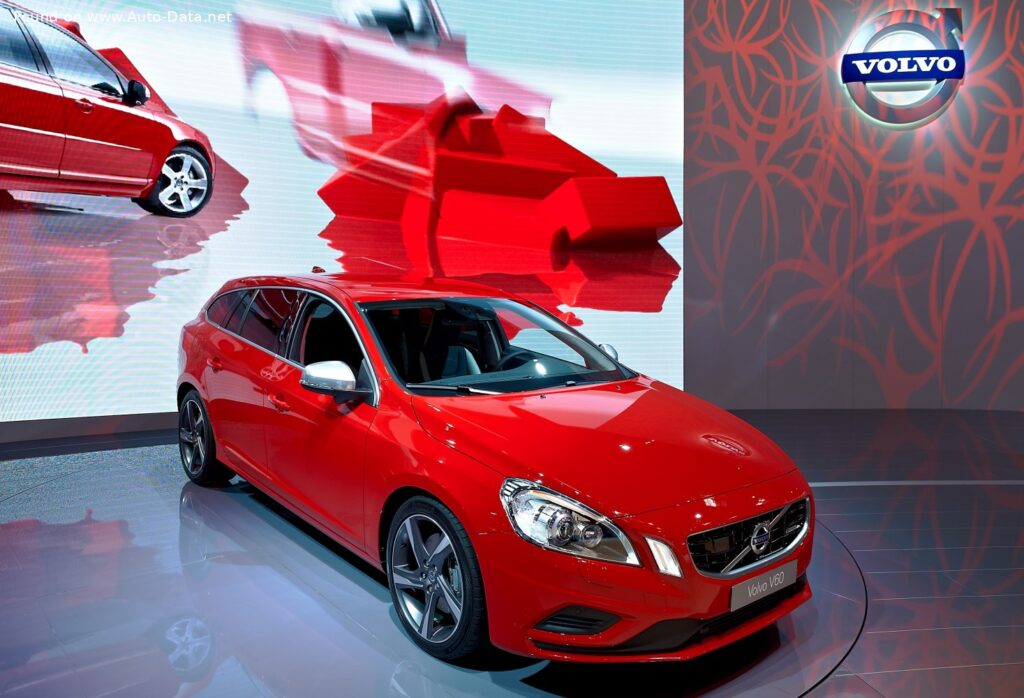
The Volvo V60 I 1.6 T3 (150 Hp) represents the first generation of Volvo’s compact executive wagon, launched in 2011. It quickly gained recognition as a stylish and practical vehicle within the competitive European premium segment. Designed to combine the functionality of a traditional station wagon with the aesthetics of a sports sedan, the V60 I offered a unique alternative to its German competitors. This particular variant, the 1.6 T3 (150 Hp), was a key offering in markets prioritizing efficiency and affordability, particularly across Europe. Produced until 2015, this iteration of the V60 showcased Volvo’s commitment to modern design, advanced safety features, and efficient powertrain technology, all packaged in a practical five-door, five-seat station wagon.
Engine & Performance of the Volvo V60 I 1.6 T3 (150 Hp)
The Volvo V60 I 1.6 T3 (150 Hp) is powered by Volvo’s B4164T3 engine, a 1.6-liter (1596 cm³) inline four-cylinder gasoline unit. This powertrain is front, transverse-mounted, driving the front wheels – a common and efficient configuration for vehicles in this class. The engine incorporates advanced technologies such as direct fuel injection and a turbocharger with an intercooler, maximizing performance from its relatively small displacement.
The T3 engine delivers 150 horsepower at 5700 rpm, resulting in a power-per-liter output of 94 Hp/l. More importantly, it produces 240 Nm (177.01 lb.-ft.) of torque across a broad rev range, from 1600 to 4000 rpm. This wide torque band contributes to the car’s drivability, providing ample pulling power at low engine speeds and a responsive feel in everyday driving. The power-to-weight ratio is 10.2 kg/Hp, or 97.6 Hp/tonne, indicating a well-balanced performance for its class.
Paired with a 6-speed manual transmission, the V60 I 1.6 T3 accelerates from 0 to 60 mph in 9.1 seconds (0-100 km/h in 9.6 seconds). While not a high-performance vehicle, these figures demonstrate a capable and confident pace for a family wagon. Fuel efficiency was a major selling point in Europe, with a combined fuel consumption of 6 liters per 100 km (39.2 US mpg). Urban consumption is rated at 7.5 l/100 km (31.4 US mpg), and extra-urban driving achieves 5.1 l/100 km (46.1 US mpg). CO2 emissions of 156 g/km allowed the V60 I 1.6 T3 to meet the Euro 5 emission standard. The engine has a coolant capacity of 9.2 liters and requires 4.1 liters of engine oil, reflecting its engineering for thermal efficiency and longevity.
Design & Features
The Volvo V60 I represented a departure from Volvo’s traditionally boxy wagon designs, adopting a more dynamic and coupe-like silhouette. Classified as a station wagon (estate), its sleek lines and tapering roofline provided a sporty aesthetic appealing to buyers seeking practicality without sacrificing style. The five-door body offered easy access to both front and rear cabins, while the five-seat configuration ensured comfortable accommodation for a family.
The V60 I measures 4628 mm (182.2 inches) in length, 1865 mm (73.43 inches) in width, and 1484 mm (58.43 inches) in height. Its 2776 mm (109.29 inches) wheelbase contributed to a stable ride and a spacious interior, particularly for rear passengers. The minimum turning circle of 11.5 meters (37.73 feet) made it adequately maneuverable in urban environments.
Inside, the V60 I showcased Volvo’s commitment to ergonomic design and high-quality materials. The interior typically featured a driver-centric cockpit, comfortable seating, and a floating center console – a signature Volvo design element of the time. Safety, a core Volvo value, was paramount. Standard features included ABS (Anti-lock Braking System), and the V60 I generation was known for pioneering advanced active and passive safety systems, such as City Safety (automatic braking at low speeds), pedestrian detection, and a comprehensive suite of airbags. Despite its sporty profile, the V60 I maintained a good degree of practicality. The trunk (boot) space offered a minimum of 692 liters (24.44 cu. ft.), expandable by folding down the rear seats. The 67.5-liter (17.83 US gallons) fuel tank ensured a decent cruising range, especially with the efficient T3 engine. Its kerb weight is 1537 kg (3388.5 lbs.), and it can handle a maximum load of 563 kg (1241.2 lbs.), bringing its maximum weight to 2100 kg (4629.71 lbs.).
Technical Specifications
| Category | Specification |
| General Information | |
| Brand | Volvo |
| Model | V60 |
| Generation | V60 I |
| Type (Engine) | 1.6 T3 (150 Hp) |
| Start of Production | 2011 |
| End of Production | 2015 |
| Powertrain Architecture | Internal Combustion engine |
| Body type | Station wagon (estate) |
| Seats | 5 |
| Doors | 5 |
| Performance Specs | |
| Fuel consumption (economy) – urban | 7.5 l/100 km (31.4 US mpg) |
| Fuel consumption (economy) – extra urban | 5.1 l/100 km (46.1 US mpg) |
| Fuel consumption (economy) – combined | 6 l/100 km (39.2 US mpg) |
| CO2 emissions | 156 g/km |
| Fuel Type | Petrol (Gasoline) |
| Acceleration 0 – 60 mph | 9.1 sec |
| Acceleration 0 – 100 km/h | 9.6 sec |
| Emission standard | Euro 5 |
| Weight-to-power ratio | 10.2 kg/Hp (97.6 Hp/tonne) |
| Weight-to-torque ratio | 6.4 kg/Nm (156.1 Nm/tonne) |
| Engine Specs | |
| Power | 150 Hp @ 5700 rpm |
| Power per liter | 94 Hp/l |
| Torque | 240 Nm @ 1600-4000 rpm (177.01 lb.-ft.) |
| Engine layout | Front, Transverse |
| Engine Model/Code | B4164T3 |
| Engine displacement | 1596 cm³ (1.6 l / 97.39 cu. in.) |
| Number of cylinders | 4 |
| Engine configuration | Inline |
| Cylinder Bore | 79 mm (3.11 in.) |
| Piston Stroke | 81.4 mm (3.2 in.) |
| Fuel injection system | Direct injection |
| Engine aspiration | Turbocharger, Intercooler |
| Engine oil capacity | 4.1 l (4.33 US qt) |
| Coolant | 9.2 l (9.72 US qt) |
| Space, Volume and Weights | |
| Kerb Weight | 1537 kg (3388.5 lbs.) |
| Max. weight | 2100 kg (4629.71 lbs.) |
| Max load | 563 kg (1241.2 lbs.) |
| Trunk (boot) space – minimum | 692 l (24.44 cu. ft.) |
| Fuel tank capacity | 67.5 l (17.83 US gal) |
| Dimensions | |
| Length | 4628 mm (182.2 in.) |
| Width | 1865 mm (73.43 in.) |
| Height | 1484 mm (58.43 in.) |
| Wheelbase | 2776 mm (109.29 in.) |
| Front track | 1588 mm (62.52 in.) |
| Rear (Back) track | 1585 mm (62.4 in.) |
| Minimum turning circle (turning diameter) | 11.5 m (37.73 ft.) |
| Drivetrain, Brakes and Suspension Specs | |
| Drivetrain Architecture | The Internal combustion engine (ICE) drives the front wheels of the vehicle. |
| Drive wheel | Front wheel drive |
| Number of gears and type of gearbox | 6 gears, manual transmission |
| Assisting systems | ABS (Anti-lock braking system) |
Legacy and Market Impact
The Volvo V60 I, particularly in its 1.6 T3 (150 Hp) configuration, played a significant role in Volvo’s strategy to reposition itself as a provider of stylish, dynamic, and technologically advanced premium vehicles. Its sleek design, a departure from Volvo’s more traditional wagon designs, helped attract a new demographic of buyers who desired both practicality and aesthetic appeal. In the European market, this specific engine variant was crucial, as European consumers often prioritize fuel efficiency and lower emissions due to higher taxes. The T3 provided a compelling blend of performance, fuel economy, and reduced emissions, translating to lower running costs.
The V60 I competed against established rivals such as the BMW 3 Series Touring, Audi A4 Avant, Mercedes-Benz C-Class Estate, Volkswagen Passat Variant, and Ford Mondeo Estate. The V60 I carved out its niche by emphasizing its distinctive Scandinavian design, renowned safety reputation, and refined driving experience. While the 1.6 T3 engine might have been less powerful than some competitors, its efficiency and smooth power delivery made it a smart choice for many European families and fleet operators.
Historically, the V60 I represented a pivotal moment for Volvo, demonstrating the brand’s ability to evolve its design language while retaining its core values of safety, quality, and practicality. The adoption of modern turbocharged engines, even at the entry level, showcased Volvo’s commitment to powertrain efficiency and environmental responsibility. The success of the V60 I laid the groundwork for subsequent generations and solidified Volvo’s position as a desirable premium brand globally, particularly for those who value understated luxury, advanced safety, and thoughtful engineering. The Volvo V60 I 1.6 T3 (150 Hp) remains a testament to this era, embodying the balance of performance, efficiency, and timeless design that characterized Volvo’s resurgence in the 21st century.
