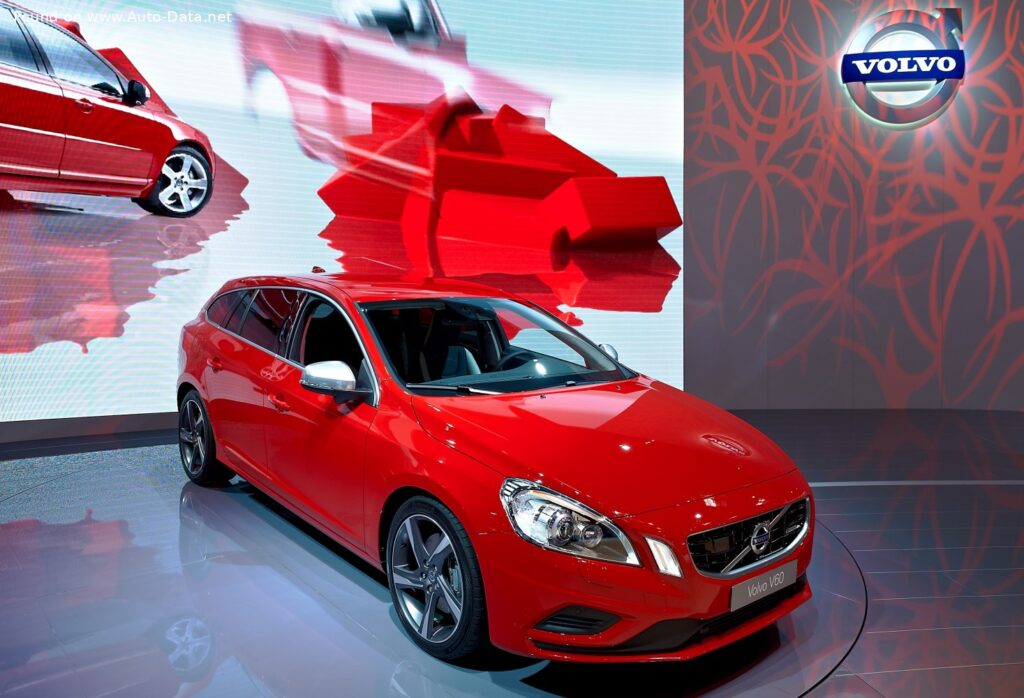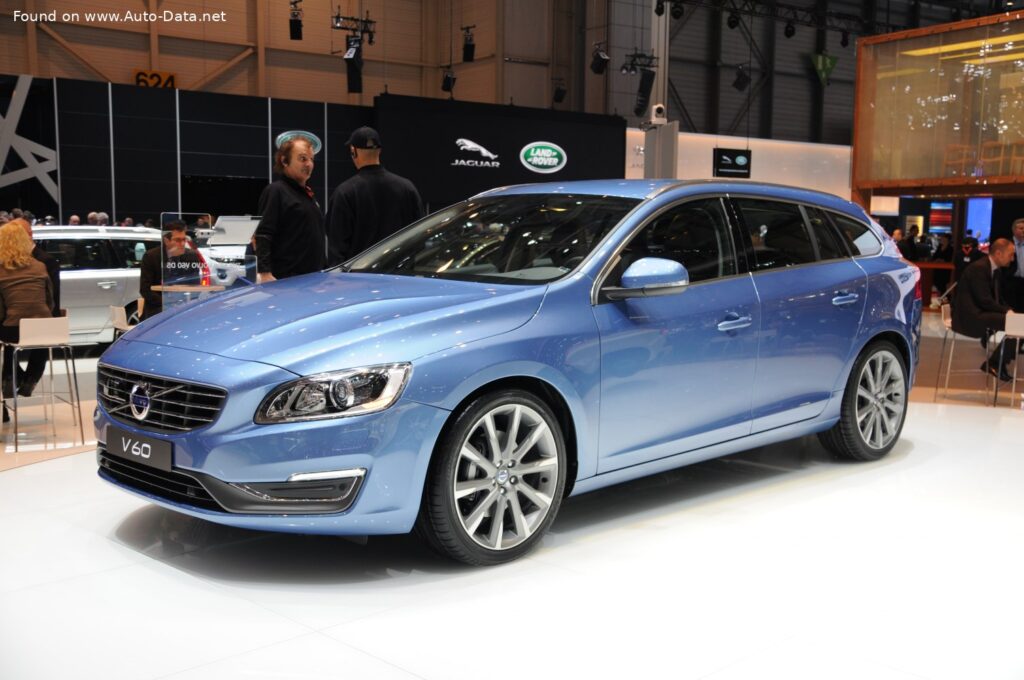
The Volvo V60, first introduced in 2010, represented Volvo’s contemporary vision for a premium compact executive wagon. Positioned primarily within the European market, where the estate car body style retains significant popularity and prestige, the V60 was designed to combine the brand’s long-standing reputation for safety and practicality with a dynamic driving experience and a more sculpted, modern aesthetic. The specific iteration under review, the Volvo V60 I (2013 facelift) 1.6 T4 (180 Hp) Automatic, showcases the mid-cycle refresh that brought subtle yet significant enhancements to its design, technology, and powertrain offerings.
This first-generation V60, particularly after its 2013 facelift, aimed to compete directly with established German rivals in the highly competitive D-segment. While not as widely available in the United States as its larger V70 and V90 siblings, the V60 carved out a niche for itself as a stylish and sophisticated alternative, emphasizing Scandinavian design principles, advanced safety features, and efficient powertrain options tailored to European regulations and consumer preferences. The 1.6-liter T4 engine variant, coupled with an automatic transmission, was a popular choice, offering a compelling blend of performance and fuel economy for everyday driving.
The Volvo V60 I (2013 facelift) 1.6 T4 (180 Hp) Automatic: Powertrain and Performance
At the heart of this particular Volvo V60 lies the 1.6-liter T4 engine, a sophisticated four-cylinder gasoline (petrol) unit designated with the internal code B4164T. This engine is a prime example of Volvo’s commitment to “right-sizing,” delivering robust performance from a relatively small displacement thanks to advanced technology. It features an inline configuration, direct fuel injection, and is boosted by a turbocharger with an intercooler. This setup allows the engine to produce a healthy 180 horsepower at 5700 rpm, translating to an impressive power-per-liter output of 112.8 Hp/l.
More critically for real-world driving, the 1.6 T4 engine generates a substantial 177.01 lb.-ft. of torque, available across a wide and accessible rev range from 1600 to 5000 rpm. This broad torque band ensures strong pulling power from low engine speeds, making the vehicle feel responsive and capable in various driving conditions, whether navigating urban traffic or cruising on the highway. Power is seamlessly delivered to the front wheels via a 6-speed automatic transmission, which is tuned to balance smooth shifts with efficient power transfer.
In terms of acceleration, the Volvo V60 I (2013 facelift) 1.6 T4 (180 Hp) Automatic can sprint from 0 to 60 mph in a respectable 8.7 seconds. This performance is commendable for a family wagon of its size and power, offering enough urgency for confident overtakes and merging onto fast-moving traffic. Despite its performance capabilities, Volvo also focused on efficiency. The combined fuel economy for this model is rated at 32.7 US mpg, with extra-urban driving achieving an even more impressive 40.6 US mpg. It adheres to the Euro 5 emission standard, with CO2 emissions of 167 g/km, reflecting a balance between driving dynamics and environmental consciousness for its era. The powertrain architecture, with the internal combustion engine driving the front wheels, contributes to both efficiency and predictable handling characteristics.
Design & Features of the V60 I (2013 facelift)
The 2013 facelift brought a refreshed aesthetic to the V60, refining its already sleek and sporty station wagon (estate) profile. Volvo designers focused on creating a more unified and contemporary look, particularly at the front. Key changes included a wider grille, new headlights that integrated into the design more fluidly, and revised front and rear bumpers. These updates gave the V60 a more sophisticated and purposeful stance, aligning it with Volvo’s evolving design language of the time. The body type remained a practical 5-door station wagon, offering seating for five occupants and easy access through its five doors.
Inside, the V60 maintained Volvo’s characteristic Scandinavian interior design – clean, ergonomic, and focused on user-friendliness. The “floating” center console, a Volvo hallmark, remained a prominent feature, housing controls for the infotainment and climate systems. While specific luxury features vary by trim, the V60 typically offered high-quality materials, comfortable seating, and a strong emphasis on safety, which is synonymous with the Volvo brand. Standard safety features included ABS (Anti-lock Braking System), and depending on the market and trim, a host of advanced driver-assistance systems (ADAS) that were pioneering for the segment.
Practicality was a core tenet of the V60’s design. With a minimum trunk (boot) space of 15.19 cubic feet (430 liters), it offered sufficient cargo capacity for daily needs and family trips, expandable by folding down the rear seats. Its dimensions – a length of 182.48 inches, a width of 71.85 inches, and a height of 58.43 inches – made it a maneuverable yet spacious vehicle. The wheelbase of 109.29 inches contributed to a stable ride, while a minimum turning circle of 37.07 feet aided urban maneuverability. The steering system, a rack and pinion type, provided precise and responsive handling, characteristic of a premium European sedan or wagon.
Safety Innovations
Volvo has long been synonymous with safety, and the V60 I (2013 facelift) continued this tradition. Beyond the standard ABS, available safety systems included City Safety, an autonomous braking system designed to mitigate or avoid low-speed collisions. Other available features included lane departure warning, blind spot information system (BLIS), and adaptive cruise control, representing a significant step forward in driver assistance technology for the time.
Technical Specifications
| Category | Specification |
| General Information | |
| Brand | Volvo |
| Model | V60 |
| Generation | V60 I (2013 facelift) |
| Type (Engine) | 1.6 T4 (180 Hp) Automatic |
| Start of Production | 2013 year |
| End of Production | 2015 year |
| Powertrain Architecture | Internal Combustion engine |
| Body type | Station wagon (estate) |
| Seats | 5 |
| Doors | 5 |
| Performance Specs | |
| Fuel consumption (economy) – urban | 9.9 l/100 km (23.8 US mpg) |
| Fuel consumption (economy) – extra urban | 5.8 l/100 km (40.6 US mpg) |
| Fuel consumption (economy) – combined | 7.2 l/100 km (32.7 US mpg) |
| CO2 emissions | 167 g/km |
| Fuel Type | Petrol (Gasoline) |
| Acceleration 0 – 60 mph | 8.7 sec |
| Emission standard | Euro 5 |
| Weight-to-power ratio | 9.2 kg/Hp (108.3 Hp/tonne) |
| Weight-to-torque ratio | 6.9 kg/Nm (144.4 Nm/tonne) |
| Engine Specs | |
| Power | 180 Hp @ 5700 rpm |
| Power per liter | 112.8 Hp/l |
| Torque | 240 Nm (177.01 lb.-ft.) @ 1600-5000 rpm |
| Engine layout | Front, Transverse |
| Engine Model/Code | B4164T |
| Engine displacement | 1596 cm3 (97.39 cu. in.) |
| Number of cylinders | 4 |
| Engine configuration | Inline |
| Cylinder Bore | 79 mm (3.11 in.) |
| Piston Stroke | 81.4 mm (3.2 in.) |
| Fuel injection system | Direct injection |
| Engine aspiration | Turbocharger, Intercooler |
| Engine oil capacity | 4.1 l (4.33 US qt) |
| Engine oil specification | Not specified |
| Coolant | 9.2 l (9.72 US qt) |
| Space, Volume and Weights | |
| Kerb Weight | 1662 kg (3664.08 lbs.) |
| Max. weight | 2100 kg (4629.71 lbs.) |
| Max load | 438 kg (965.62 lbs.) |
| Trunk (boot) space – minimum | 430 l (15.19 cu. ft.) |
| Fuel tank capacity | 67.5 l (17.83 US gal) |
| Dimensions | |
| Length | 4635 mm (182.48 in.) |
| Width | 1825 mm (71.85 in.) |
| Height | 1484 mm (58.43 in.) |
| Wheelbase | 2776 mm (109.29 in.) |
| Front track | 1588 mm (62.52 in.) |
| Rear (Back) track | 1585 mm (62.4 in.) |
| Minimum turning circle (turning diameter) | 11.3 m (37.07 ft.) |
| Drivetrain, Brakes and Suspension Specs | |
| Drivetrain Architecture | The Internal combustion engine (ICE) drives the front wheels of the vehicle. |
| Drive wheel | Front wheel drive |
| Number of gears and type of gearbox | 6 gears, automatic transmission |
| Assisting systems | ABS (Anti-lock braking system) |
| Steering type | Steering rack and pinion |
Legacy & Market Impact
The Volvo V60 I (2013 facelift) with the 1.6 T4 engine played a crucial role in Volvo’s strategy to rejuvenate its image and expand its market share in the premium compact executive segment. In its primary European markets, the V60 was celebrated for its compelling blend of elegant styling, robust safety credentials, and practical wagon utility. It offered a distinctive alternative to its often more overtly sporty German rivals like the BMW 3 Series Touring, Audi A4 Avant, and Mercedes-Benz C-Class Estate, by emphasizing a unique Scandinavian luxury experience.
The V60’s reputation was built on its solid build quality, comfortable ride, and, particularly with the facelifted model, a more engaging driving dynamic than previous Volvo wagons. The 1.6 T4 engine, in particular, showcased Volvo’s engineering prowess in downsized turbocharged engines, providing ample power and torque without sacrificing fuel efficiency. This made it an attractive option for buyers concerned with running costs and environmental impact, especially in regions with strict emissions regulations.
Historically, the V60 represented a pivot point for Volvo, moving away from more boxy, utilitarian designs towards a sleeker, more emotionally appealing aesthetic, while still retaining the core values of safety and practicality. Its success helped pave the way for subsequent generations of Volvo vehicles that further refined this design philosophy and technological advancement. While the wagon segment has faced increasing pressure from the rise of SUVs globally, models like the V60 continued to demonstrate the enduring appeal of a well-executed estate car, offering superior driving dynamics and often better fuel economy than comparable SUVs. The Volvo V60 I (2013 facelift) 1.6 T4 (180 Hp) Automatic, therefore, stands as a testament to Volvo’s ability to innovate and compete effectively within a challenging, yet rewarding, automotive landscape. Its legacy is one of balancing performance, efficiency, safety, and sophisticated design, contributing significantly to Volvo’s modern identity as a premium automaker.