The Volvo V60 I (2013 facelift) represents a significant chapter in Volvo’s modern history, embodying the brand’s commitment to sophisticated design, advanced safety, and efficient powertrains within the premium compact executive wagon segment. Introduced as a facelift to the first-generation V60, which originally debuted in 2010, this iteration refined an already compelling package. The specific variant under examination, the 2.0 T3 with 152 horsepower, was produced from 2016 to 2018, serving as an accessible yet capable entry point into the V60 lineup, primarily for the European and Asian markets.
While never officially sold in the United States in this exact T3 configuration, the V60 I (2013 facelift) played a crucial role in strengthening Volvo’s presence in its primary markets. It continued the Swedish automaker’s tradition of offering practical, stylish, and safe station wagons (known as estates in Europe), providing a distinct alternative to the burgeoning SUV market. This model, with its front-wheel-drive architecture and a refined internal combustion engine, showcased Volvo’s engineering prowess and commitment to its core values before the brand’s full transition to its new Scalable Product Architecture (SPA) platform and electrified powertrains. The V60 I (2013 facelift) 2.0 T3 (152 Hp) was a testament to Volvo’s ability to blend everyday usability with a premium driving experience.
Engine & Performance: The Drive-E 2.0 T3 (152 Hp)
At the heart of the Volvo V60 I (2013 facelift) 2.0 T3 (152 Hp) lies a modern and efficient 2.0-liter, four-cylinder inline engine, part of Volvo’s innovative Drive-E powertrain family. Coded as B4204T37, this unit was engineered for a balance of performance and fuel economy, a hallmark of Volvo’s strategy during this period. The engine features direct fuel injection, a single turbocharger, and an intercooler, allowing it to produce a respectable 152 horsepower at 5000 rpm. This power output, combined with a power per liter rating of 77.2 Hp/l, demonstrates efficient energy extraction from its 120.16 cubic inch (1969 cm³) displacement.
Perhaps more impressive than the peak horsepower is the engine’s torque delivery. It generates a robust 250 Nm, or 184.39 lb.-ft., of torque, available across a broad rev range from a low 1300 rpm up to 4000 rpm. This wide torque band is crucial for real-world drivability, providing strong acceleration from a standstill and flexible in-gear response, making the car feel more potent than its horsepower figure might suggest, especially in urban environments and when overtaking. The engine’s configuration includes 4 valves per cylinder and a Double Overhead Camshaft (DOHC) valvetrain, ensuring optimal airflow and combustion efficiency. With an 11.3:1 compression ratio, it’s designed to maximize the benefits of direct injection and turbocharging.
Power is channeled to the front wheels via a precise 6-speed manual transmission, offering an engaging driving experience for those who prefer to row their own gears. This drivetrain architecture, combined with the efficient engine, results in commendable performance figures for a family wagon. The V60 T3 can accelerate from 0 to 60 mph in a brisk 8.3 seconds (0-100 km/h in 8.7 seconds) and reach a maximum speed of 127.38 mph (205 km/h).
Fuel efficiency was a key consideration, with the V60 I (2013 facelift) 2.0 T3 achieving a combined fuel consumption of 40.6 US mpg (5.8 l/100 km). This efficiency is paired with relatively low CO2 emissions of 135 g/km, reflecting Volvo’s commitment to environmental responsibility. The engine oil capacity is 6.23 US quarts (5.9 liters), and the cooling system holds 8.77 US quarts (8.3 liters) of coolant, ensuring reliable operation under various conditions.
Design & Features of the Volvo V60 I (2013 facelift)
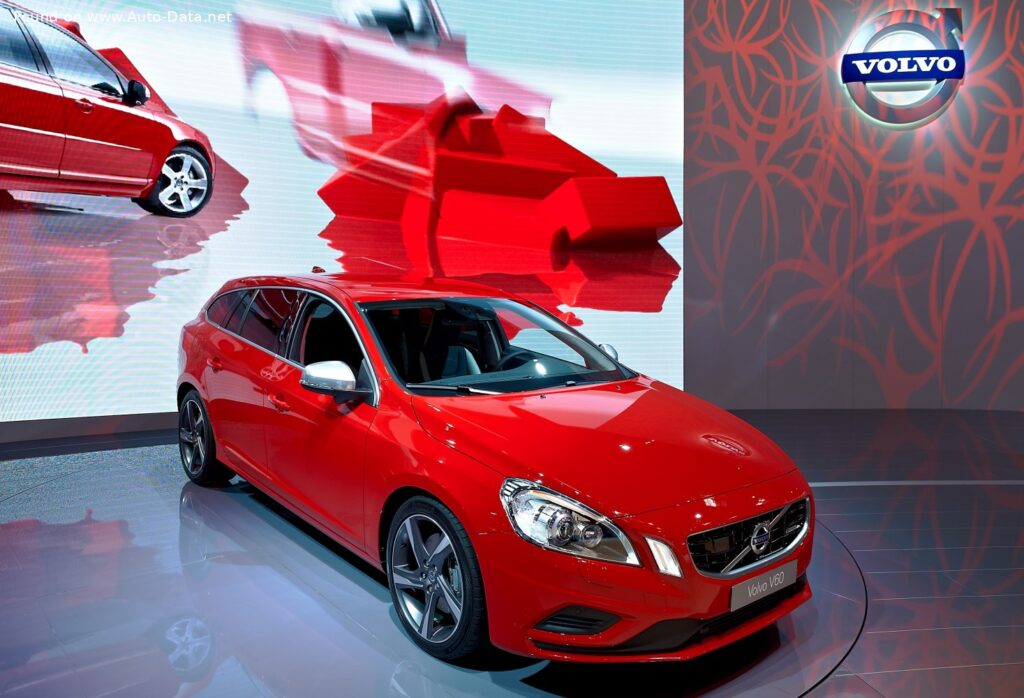
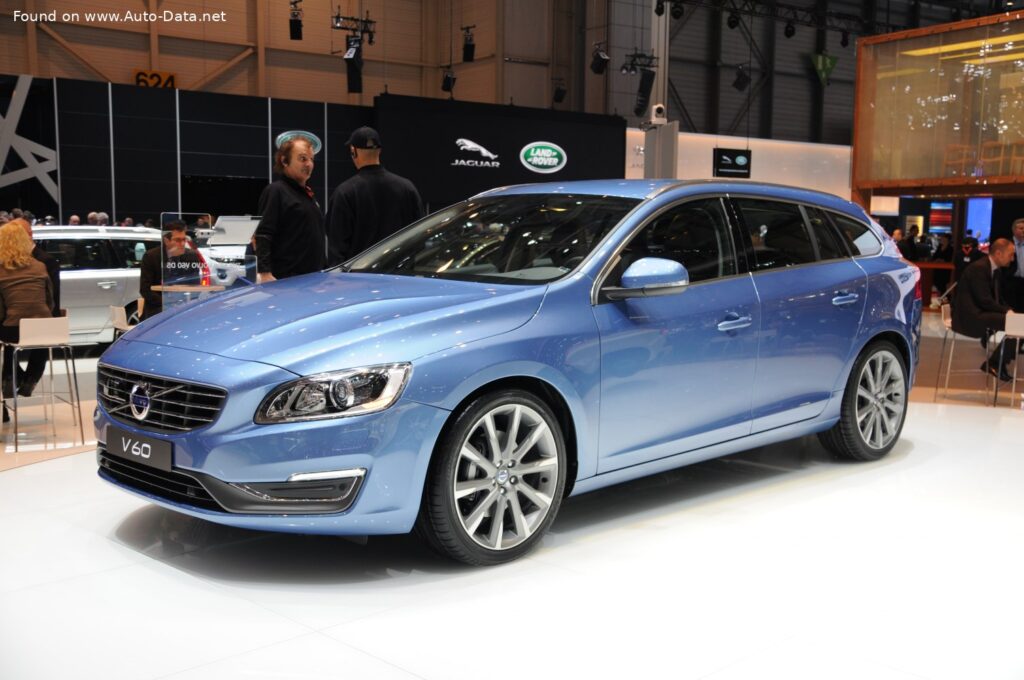
The Volvo V60 I (2013 facelift) maintained its distinctive station wagon (estate) body type, a design that perfectly blends sporty aesthetics with practical utility. The facelift introduced several key visual updates that brought the V60’s styling in line with Volvo’s evolving design language. These included a wider, lower grille, revised headlights that became a single unit (replacing the previous two-piece design), and updated front and rear bumpers. These changes gave the V60 a more assertive and contemporary look, enhancing its road presence. The sleek profile, characterized by its coupé-like roofline, disguises its wagon practicality, appealing to buyers who desired functionality without compromising on style.
Measuring 182.48 inches (4635 mm) in length, 71.85 inches (1825 mm) in width (82.56 inches or 2097 mm including mirrors), and 58.43 inches (1484 mm) in height, the V60 possessed compact yet substantial dimensions for its class. The 109.29-inch (2776 mm) wheelbase contributed to both stable handling and a comfortable ride. Its aerodynamic efficiency was notable, with a drag coefficient (Cd) of 0.29, aiding in fuel economy and reducing wind noise at higher speeds. The practical aspects are underscored by a minimum trunk space of 15.19 cubic feet (430 liters), making it a capable companion for families and active lifestyles. Furthermore, it boasts a maximum roof load of 165.35 lbs (75 kg) and impressive towing capabilities, with a permitted trailer load of 3968.32 lbs (1800 kg) with brakes (8% gradient). The fuel tank capacity of 17.83 US gallons (67.5 liters) ensures a good cruising range.
Interior Comfort and Technology
Inside, the V60 I (2013 facelift) offered a quintessential Volvo experience: a cabin designed with ergonomic excellence, high-quality materials, and a focus on occupant well-being. The five-seat configuration provided ample space for passengers, particularly in the front, with comfortable and supportive seating. The “floating” center console, a Volvo signature at the time, housed intuitive controls for climate and audio, contributing to a clean and uncluttered dashboard layout. While not explicitly detailed in the provided data, this generation of V60 typically featured Volvo’s Sensus infotainment system, offering navigation, connectivity, and entertainment options, all designed for ease of use. The attention to detail, from the tactile quality of the switchgear to the choice of interior trim, underscored its premium aspirations.
Safety Innovations
Safety has always been synonymous with Volvo, and the V60 I (2013 facelift) was no exception. While the technical data specifically mentions ABS (Anti-lock Braking System), the V60 was equipped with a comprehensive suite of active and passive safety features typical of Volvo during this era. This would have included multiple airbags, traction control, stability control, and Volvo’s pioneering City Safety system, which automatically applies the brakes to mitigate or avoid low-speed collisions. The robust body structure, combined with advanced restraint systems, aimed to provide exceptional occupant protection. The braking system itself featured ventilated discs at the front and disc brakes at the rear, ensuring strong and consistent stopping power. The independent front suspension (McPherson with coil spring and anti-roll bar) and independent rear coil spring suspension, along with a precise rack and pinion steering system, contributed to stable handling and a confident driving feel, further enhancing active safety.
Technical Specifications: Volvo V60 I (2013 facelift) 2.0 T3 (152 Hp)
| Category | Specification |
| General Information | BrandVolvo |
| Model | V60 |
| Generation | V60 I (2013 facelift) |
| Engine Type | 2.0 T3 (152 Hp) |
| Start of Production | 2016 year |
| End of Production | 2018 year |
| Powertrain Architecture | Internal Combustion engine |
| Body Type | Station wagon (estate) |
| Seats | 5 |
| Doors | 5 |
| Performance Specifications | Fuel Consumption (Combined) |
| 40.6 US mpg (5.8 l/100 km) | |
| CO2 Emissions | 135 g/km |
| Fuel Type | Petrol (Gasoline) |
| Acceleration 0 – 60 mph | 8.3 sec |
| Acceleration 0 – 62 mph (0-100 km/h) | 8.7 sec |
| Maximum Speed | 127.38 mph (205 km/h) |
| Engine Specifications | Power |
| 152 Hp @ 5000 rpm | |
| Power per liter | 77.2 Hp/l |
| Torque | 184.39 lb.-ft. @ 1300-4000 rpm (250 Nm) |
| Engine Layout | Front, Transverse |
| Engine Model/Code | B4204T37 |
| Engine Displacement | 120.16 cu. in. (1969 cm³) |
| Number of Cylinders | 4 |
| Engine Configuration | Inline |
| Cylinder Bore | 3.23 in. (82 mm) |
| Piston Stroke | 3.67 in. (93.2 mm) |
| Compression Ratio | 11.3:1 |
| Valves per Cylinder | 4 |
| Fuel Injection System | Direct injection |
| Engine Aspiration | Turbocharger, Intercooler |
| Valvetrain | DOHC |
| Engine Oil Capacity | 6.23 US qt (5.9 l) |
| Coolant Capacity | 8.77 US qt (8.3 l) |
| Space, Volume and Weights | Trunk (boot) Space – Minimum |
| 15.19 cu. ft. (430 l) | |
| Fuel Tank Capacity | 17.83 US gal (67.5 l) |
| Max. Roof Load | 165.35 lbs (75 kg) |
| Permitted Trailer Load with Brakes (8%) | 3968.32 lbs (1800 kg) |
| Permitted Trailer Load with Brakes (12%) | 3306.93 lbs (1500 kg) |
| Dimensions | Length |
| 182.48 in. (4635 mm) | |
| Width | 71.85 in. (1825 mm) |
| Width with Mirrors Folded | 74.76 in. (1899 mm) |
| Width Including Mirrors | 82.56 in. (2097 mm) |
| Height | 58.43 in. (1484 mm) |
| Wheelbase | 109.29 in. (2776 mm) |
| Front Track | 62.52 – 62.13 in. (1588-1578 mm) |
| Rear (Back) Track | 62.4 – 62.01 in. (1585-1575 mm) |
| Ride Height (Ground Clearance) | 5.35 in. (136 mm) |
| Drag Coefficient (Cd) | 0.29 |
| Minimum Turning Circle (Turning Diameter) | 37.73 – 40.68 ft. (11.5 – 12.4 m) |
| Drivetrain, Brakes and Suspension Specs | Drivetrain Architecture |
| Front-wheel drive (ICE drives front wheels) | |
| Drive Wheel | Front wheel drive |
| Number of Gears and Type of Gearbox | 6 gears, manual transmission |
| Front Suspension | Independent, type McPherson with coil spring and anti-roll bar |
| Rear Suspension | Independent coil spring |
| Front Brakes | Ventilated discs |
| Rear Brakes | Disc |
| Assisting Systems | ABS (Anti-lock braking system) |
| Steering Type | Steering rack and pinion |
Legacy and Market Impact of the Volvo V60 I (2013 facelift)
The Volvo V60 I (2013 facelift), particularly in its 2.0 T3 (152 Hp) guise, carved out a distinct niche in the highly competitive European premium compact executive segment. While it was not offered with this specific engine in the North American market, its role in Europe was significant. It catered to buyers seeking an alternative to the dominant German trio – the BMW 3 Series Touring, Audi A4 Avant, and Mercedes-Benz C-Class Estate – by offering a unique blend of Scandinavian design, robust safety credentials, and practical utility. Its primary appeal was to families and professionals who valued understated luxury, comfort, and the renowned safety that Volvo represented.
In its home market and across Europe, the V60 was positioned as a stylish, dynamic, and family-friendly option that avoided the larger footprint and higher running costs of SUVs. The T3 engine, being an entry-level powertrain, made the premium V60 accessible to a broader audience while still delivering adequate performance and excellent fuel economy for daily commuting and longer journeys. Its front-wheel-drive configuration and manual transmission appealed to those who appreciated a more direct and engaging driving experience, a segment of the market that remained strong in Europe.
The V60 I (2013 facelift) represents a pivotal moment for Volvo, showcasing the brand’s ability to refresh an existing model with new aesthetics and, crucially, its new generation of Drive-E powertrains. These engines were a significant step forward in terms of efficiency and performance, laying the groundwork for Volvo’s future success. The 2.0 T3 engine, despite its relatively modest horsepower, was a testament to the effectiveness of turbocharging and direct injection in delivering a satisfying driving experience with responsible fuel consumption.
Its legacy is one of a well-executed premium wagon that stayed true to Volvo’s heritage while embracing modern technology and design. It underscored Volvo’s commitment to the station wagon body style, even as many manufacturers shifted focus to SUVs. The V60 I (2013 facelift) continued to build on Volvo’s reputation for durability and comfort, making it a popular choice in the used car market for those seeking a reliable and safe family vehicle with a touch of Scandinavian sophistication. It successfully bridged the gap between the older Volvo designs and the revolutionary SPA-based models that would follow, ensuring Volvo remained a strong contender in the premium segment globally.