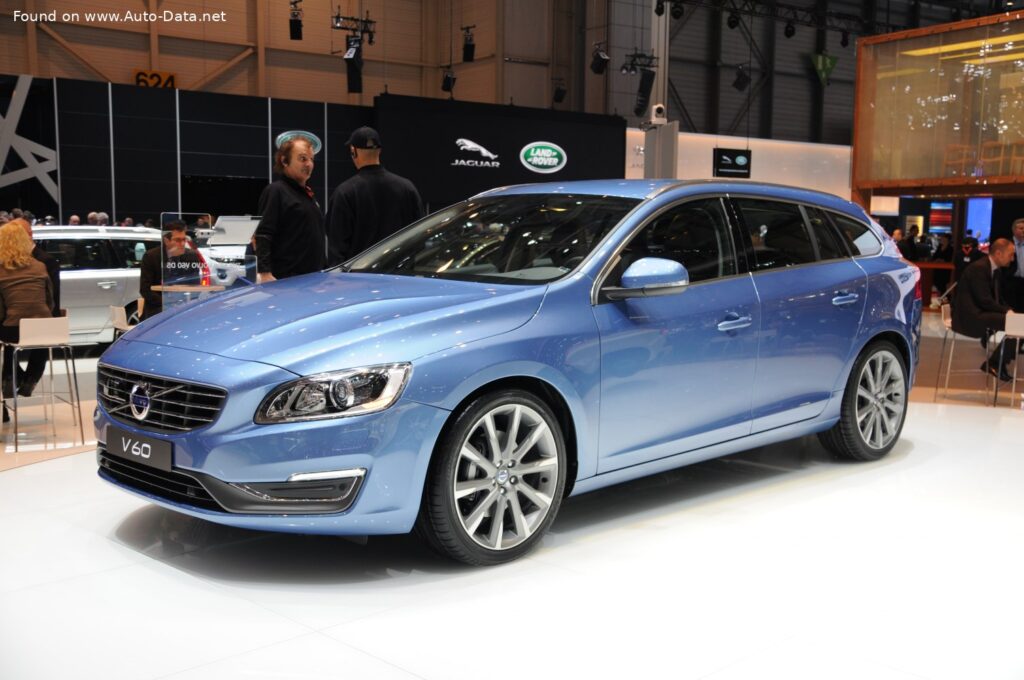
The Volvo V60 I (2013 facelift) 2.0 T4 (190 Hp) Automatic represents a significant refresh in the first generation of Volvo’s premium compact executive wagon. Introduced in 2015 and produced until 2018, this particular iteration showcased Volvo’s commitment to refining its successful V60 platform, offering a compelling blend of elegant Scandinavian design, advanced safety features, and a dynamic yet efficient powertrain. While the V60 was a global model, this specific 2.0 T4 engine variant, with its emphasis on balanced performance and fuel economy, found a particularly strong footing in European markets, where it competed fiercely in the highly contested premium wagon segment. The facelift brought subtle but impactful changes to the exterior styling, interior ergonomics, and—critically—powertrain options, solidifying the V60’s reputation as a sophisticated and practical choice for discerning buyers.
Volvo V60 I (2013 Facelift) 2.0 T4: A Scandinavian Refinement
The Volvo V60, launched initially in 2010, aimed to bring a distinctive Scandinavian aesthetic and a focus on practicality to the premium compact wagon segment. The 2013 facelift, and specifically the 2.0 T4 variant produced from 2015-2018, represented a mid-cycle update designed to enhance the model’s appeal and competitiveness. This version of the V60 was particularly well-received in Europe, where wagons maintain a strong market presence and fuel efficiency is a key purchasing factor. It offered a compelling alternative to the more established German competitors, emphasizing a different set of values – understated elegance, robust safety, and a comfortable driving experience.
Engine & Performance
The heart of the Volvo V60 I (2013 facelift) 2.0 T4 Automatic is Volvo’s Drive-E powertrain, a family of modular engines designed for efficiency and performance. This configuration utilizes a 2.0-liter (120.16 cubic inches) inline four-cylinder gasoline engine, internally designated as B4204T19. The engine employs a single turbocharger with an intercooler, direct fuel injection, and a double overhead camshaft (DOHC) valvetrain. This combination allows the engine to produce 190 horsepower at 4700 rpm, achieving a power density of 96.5 horsepower per liter – a testament to its modern design and forced induction.
However, the engine’s strength lies in its torque output. The 2.0 T4 generates 221.27 lb.-ft. (300 Nm) of torque, readily available from a low 1300 rpm and sustained through 4000 rpm. This broad torque curve provides strong acceleration from a standstill and excellent responsiveness during highway overtaking. Power is delivered to the front wheels via a smooth-shifting 6-speed automatic transmission. This powertrain combination enables the V60 T4 to accelerate from 0 to 60 mph in 6.9 seconds (0-100 km/h in 7.3 seconds), with a top speed of 139.81 mph (225 km/h). Despite its performance capabilities, the V60 2.0 T4 achieves a combined fuel consumption of 40.6 US mpg (5.8 liters per 100 km) and CO2 emissions of 136 g/km, demonstrating Volvo’s commitment to fuel efficiency. The engine is mounted transversely in the front of the vehicle, optimizing space and weight distribution. It features a compression ratio of 11.3:1 and 4 valves per cylinder for enhanced combustion efficiency.
Design & Features
The Volvo V60 I (2013 facelift) maintains the sleek and dynamic profile of the original model, while incorporating subtle design updates. As a five-door station wagon (estate), it successfully combines the practicality of a family vehicle with the aesthetic appeal of a sport sedan. The facelift included revised front and rear fascias, updated headlight designs, and refreshed interior trim options. The vehicle’s dimensions – 182.48 inches in length, 74.76 inches in width, and 58.43 inches in height – provide a substantial presence without feeling unwieldy, supported by a 109.29-inch wheelbase.
The interior embodies the Scandinavian design philosophy, characterized by minimalism, high-quality materials, and ergonomic comfort. The five-seat configuration offers ample space for passengers, with supportive seats designed for long journeys. Practicality is further enhanced by 15.19 cubic feet (430 liters) of trunk space, expandable by folding the rear seats. Safety is a core Volvo value, and the V60 I (2013 facelift) is equipped with a comprehensive suite of active and passive safety systems, including ABS, multiple airbags, and Volvo’s City Safety system, which automatically applies the brakes to mitigate or avoid low-speed collisions. Optional packages included advanced driver-assistance systems like pedestrian detection, adaptive cruise control, and lane-keeping assist. The ride quality is balanced, prioritizing comfort and stability, thanks to the independent front suspension (McPherson struts with coil springs and an anti-roll bar) and independent coil spring rear suspension. Ventilated front disc brakes and rear disc brakes provide strong stopping power, while the rack and pinion steering offers precise control and feedback.
Technical Specifications: Volvo V60 I (2013 facelift) 2.0 T4 (190 Hp) Automatic
| Category | Specification |
| General Information | |
| Brand | Volvo |
| Model | V60 |
| Generation | V60 I (2013 facelift) |
| Type (Engine) | 2.0 T4 (190 Hp) Automatic |
| Start of Production | 2015 |
| End of Production | 2018 |
| Powertrain Architecture | Internal Combustion engine |
| Body type | Station wagon (estate) – 5 Doors, 5 Seats |
| Performance Specs | |
| Fuel consumption (combined) | 5.8 l/100 km (40.6 US mpg) |
| CO2 emissions | 136 g/km |
| Fuel Type | Petrol (Gasoline) |
| Acceleration 0 – 60 mph | 6.9 sec |
| Acceleration 0 – 100 km/h | 7.3 sec |
| Maximum speed | 225 km/h (139.81 mph) |
| Engine Specs | |
| Power | 190 Hp @ 4700 rpm |
| Power per liter | 96.5 Hp/l |
| Torque | 300 Nm @ 1300-4000 rpm (221.27 lb.-ft. @ 1300-4000 rpm) |
| Engine layout | Front, Transverse |
| Engine Model/Code | B4204T19 |
| Engine displacement | 1969 cm3 (2.0 liters / 120.16 cu. in.) |
| Number of cylinders | 4 (Inline configuration) |
| Cylinder Bore | 82 mm (3.23 in.) |
| Piston Stroke | 93.2 mm (3.67 in.) |
| Compression ratio | 11.3:1 |
| Number of valves per cylinder | 4 |
| Fuel injection system | Direct injection |
| Engine aspiration | Turbocharger, Intercooler |
| Valvetrain | DOHC |
| Engine oil capacity | 5.9 l (6.23 US qt) |
| Coolant capacity | 8.3 l (8.77 US qt) |
| Space, Volume and Weights | |
| Trunk (boot) space – minimum | 430 l (15.19 cu. ft.) |
| Fuel tank capacity | 67.5 l (17.83 US gal) |
| Dimensions | |
| Length | 4635 mm (182.48 in.) |
| Width | 1899 mm (74.76 in.) |
| Height | 1484 mm (58.43 in.) |
| Wheelbase | 2776 mm (109.29 in.) |
| Front track | 1588-1578 mm (62.52 – 62.13 in.) |
| Rear (Back) track | 1585-1575 mm (62.4 – 62.01 in.) |
| Ride height (ground clearance) | 136 mm (5.35 in.) |
| Minimum turning circle | 11.5 – 12.4 m (37.73 – 40.68 ft.) |
| Drivetrain, Brakes and Suspension Specs | |
| Drivetrain Architecture | Internal combustion engine (ICE) drives front wheels |
| Drive wheel | Front wheel drive |
| Number of gears and type of gearbox | 6 gears, automatic transmission |
| Front suspension | Independent, type McPherson with coil spring and anti-roll bar |
| Rear suspension | Independent coil spring |
| Front brakes | Ventilated discs |
| Rear brakes | Disc |
| Assisting systems | ABS (Anti-lock braking system) |
| Steering type | Steering rack and pinion |
Legacy and Market Impact
The Volvo V60 I (2013 facelift) 2.0 T4 Automatic played a vital role in Volvo’s strategy to expand its market share in the premium compact executive segment, particularly in Europe. While the V60 was available in the United States, often with more powerful T5 and T6 engine options, the T4 variant was specifically tailored for markets where fuel efficiency and lower emissions were key considerations. Its balanced performance, combined with Volvo’s legendary safety reputation and elegant design, made it a strong contender against established rivals. The V60’s success paved the way for future Volvo models, reinforcing the brand’s commitment to safety, design, and sustainable mobility.