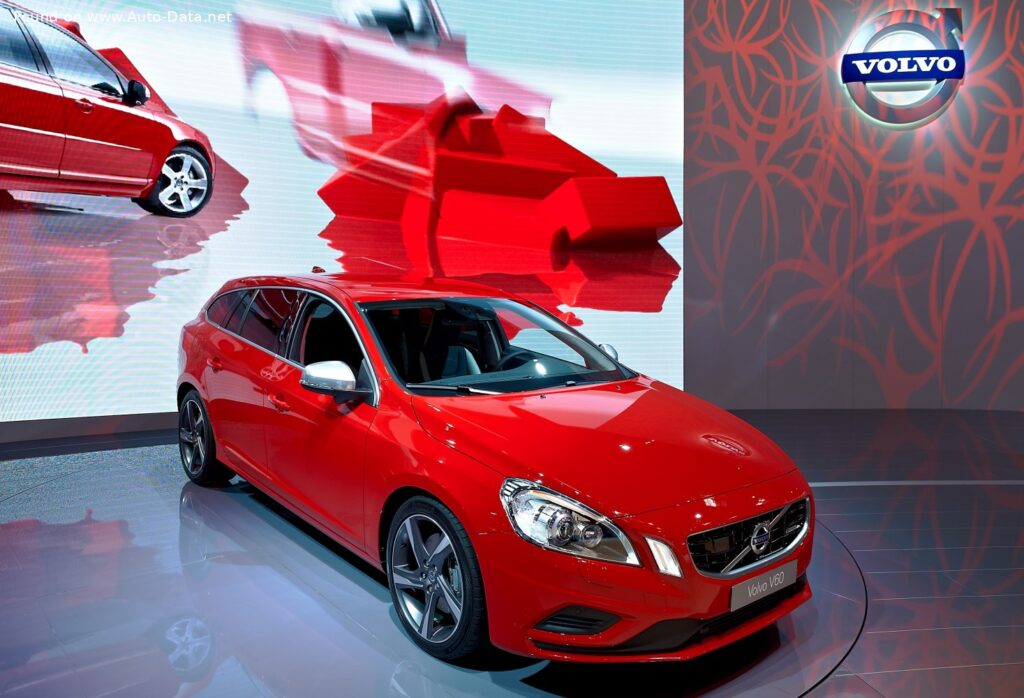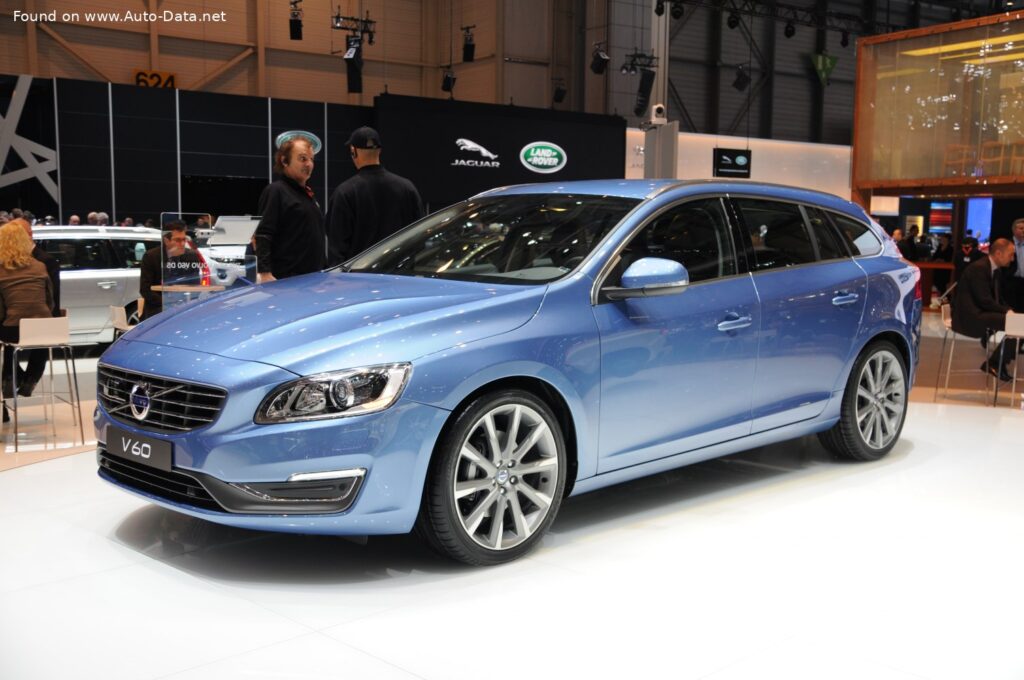
The Volvo V60 I (2013 facelift) 2.4 D6 Twin Engine (288 Hp) Plug-in Hybrid AWD Geartronic represents a significant milestone in automotive engineering, particularly within the European premium mid-size wagon segment. Introduced as part of the V60’s first-generation facelift, this specific powertrain variant, produced from April 2015 to 2018, was a pioneering effort by Volvo to combine diesel power with plug-in hybrid technology. While the V60 itself was a globally recognized model, this sophisticated diesel-electric configuration was primarily aimed at European markets, where diesel engines held a strong market share and the demand for high efficiency and lower emissions was growing. It showcased Volvo’s commitment to innovation and environmental responsibility, offering an intriguing blend of performance, luxury, and remarkable fuel economy for its class.
Positioned as a versatile five-door station wagon (often referred to as an estate in Europe), the Volvo V60 I (2013 facelift) 2.4 D6 Twin Engine provided seating for five occupants and embraced Volvo’s characteristic blend of Scandinavian design, advanced safety features, and practical utility. Its powertrain architecture, a Plug-in Hybrid Electric Vehicle (PHEV), allowed for substantial all-electric driving capability, further distinguishing it from conventional hybrids and internal combustion engine (ICE) vehicles of its time. This model was a testament to Volvo’s forward-thinking approach, laying groundwork for the brand’s future electrification strategies.
Engine & Performance of the Volvo V60 I (2013 facelift) 2.4 D6 Twin Engine
At the heart of the Volvo V60 I (2013 facelift) 2.4 D6 Twin Engine lies a highly innovative and complex powertrain system. The internal combustion engine is a robust 2.4-liter inline five-cylinder DOHC diesel unit, featuring twin-turbocharging and an intercooler. This engine alone generates 220 horsepower at 4000 rpm and a substantial 324.53 lb.-ft. (440 Nm) of torque, available between 1500 and 3000 rpm. Its common-rail fuel injection system and Euro 6 emission standard compliance underscore its modern diesel technology, which also includes a Start & Stop system and a particulate filter for reduced environmental impact.
Complementing the powerful diesel engine is an electric motor strategically placed on the rear axle. This motor contributes an additional 68 horsepower at 2387 rpm and an impressive 147.51 lb.-ft. (200 Nm) of torque, available from a low 320 rpm up to 1700 rpm. The combined output of this sophisticated twin-engine setup is a potent 288 horsepower. This integration allows for a unique all-wheel-drive (AWD) architecture where the diesel engine primarily drives the front wheels, and the electric motor powers the rear wheels. The vehicle is capable of running in full electric mode, solely on the internal combustion engine, or in a mixed hybrid mode, dynamically optimizing power delivery and efficiency.
Power is managed through a 6-speed Geartronic automatic transmission, providing smooth and responsive shifts. This powertrain enables the V60 D6 Twin Engine to achieve impressive performance figures for a wagon of its size and weight. Acceleration from 0 to 60 mph is accomplished in a swift 5.7 seconds, while the vehicle can reach a maximum speed of 142.92 mph (230 km/h). Despite this strong performance, the most remarkable aspect is its fuel economy. With a combined (NEDC) fuel consumption rating of 130.7 US mpg (1.8 l/100 km) and CO2 emissions of just 48 g/km, it set a benchmark for efficiency in its class. The plug-in hybrid system is supported by an 11.2 kWh gross (8 kWh net usable) Lithium-ion battery, providing an all-electric range of approximately 31.07 miles (50 km) and an electric-only top speed of 77.67 mph (125 km/h).
Design & Features
The Volvo V60 I (2013 facelift) retained the elegant and athletic design language that characterized the first-generation V60, updated with subtle yet effective enhancements. As a station wagon, it offered a practical five-door body type with comfortable seating for five adults. The facelift introduced a more cohesive front fascia, integrating the headlights and grille into a single, flowing design, giving it a wider and more planted appearance. The V60’s silhouette was distinctly Volvo, combining sleek lines with a functional cargo area, balancing style with utility.
Inside, the V60 D6 Twin Engine featured a typical Volvo interior – ergonomic, driver-focused, and built with high-quality materials. Volvo’s commitment to safety was paramount, and the V60 was equipped with a comprehensive suite of active and passive safety features, including ABS (Anti-lock braking system), multiple airbags, stability control, and potentially advanced driver-assistance systems (ADAS) depending on the trim level and market. The cabin design prioritized comfort and intuitive controls, reflecting Scandinavian minimalism and functionality.
Despite the integration of the plug-in hybrid battery pack inside the trunk, the V60 still offered reasonable cargo versatility. It provided a minimum trunk space of 10.77 cubic feet (305 liters), which could expand to 39.76 cubic feet (1126 liters) with the rear seats folded down. This configuration, while slightly compromising on ultimate cargo volume compared to non-hybrid V60 models, still maintained the essential practicality expected from a premium station wagon. The vehicle rode on 235/45 R17 tires mounted on 8J x 17-inch wheel rims, contributing to its stable handling and refined ride quality. The suspension setup featured independent McPherson struts at the front and a coil spring system with a transverse stabilizer at the rear, ensuring a comfortable yet controlled driving experience. Braking was handled by ventilated discs both front (336×28 mm) and rear (302×22 mm), providing ample stopping power.
Volvo V60 I (2013 facelift) 2.4 D6 Twin Engine: Technical Specifications
| Brand | Volvo |
| Model | V60 |
| Generation | V60 I (2013 facelift) |
| Type (Engine) | 2.4 D6 Twin Engine (288 Hp) Plug-in Hybrid AWD Geartronic |
| Start of production | April, 2015 |
| End of production | 2018 |
| Powertrain Architecture | PHEV (Plug-in Hybrid Electric Vehicle) |
| Body type | Station wagon (estate) |
| Seats | 5 |
| Doors | 5 |
| Fuel consumption (economy) – combined (NEDC) | 1.8 l/100 km (130.7 US mpg, 156.9 UK mpg, 55.6 km/l) |
| CO2 emissions (NEDC) | 48 g/km |
| Fuel Type | Diesel / electricity |
| Acceleration 0 – 60 mph | 5.7 sec |
| Acceleration 0 – 100 km/h (0 – 62 mph) | 6 sec |
| Maximum speed | 230 km/h (142.92 mph) |
| Emission standard | Euro 6 |
| Weight-to-power ratio | 6.9 kg/Hp, 146 Hp/tonne |
| Weight-to-torque ratio | 4.5 kg/Nm, 223 Nm/tonne |
| Gross battery capacity | 11.2 kWh |
| Net (usable) battery capacity | 8 kWh |
| Battery voltage | 400 V |
| Battery technology | Lithium-ion (Li-Ion) |
| Battery location | Inside the trunk |
| All-electric range (NEDC) | 50 km (31.07 mi) |
| Average Energy consumption (NEDC) | 13.3 kWh/100 km (21.4 kWh/100 mi, 157 MPGe, 7.5 km/kWh, 4.7 mi/kWh) |
| Max speed (electric) | 125 km/h (77.67 mph) |
| Electric motor power | 68 Hp @ 2387 rpm |
| Electric motor Torque | 200 Nm (147.51 lb.-ft.) @ 320-1700 rpm |
| Electric motor location | Rear axle, Transverse |
| System power | 288 Hp |
| Power | 220 Hp @ 4000 rpm |
| Power per liter | 91.7 Hp/l |
| Torque | 440 Nm (324.53 lb.-ft.) @ 1500-3000 rpm |
| Engine layout | Front, Transverse |
| Engine Model/Code | D97PHEV |
| Engine displacement | 2400 cm3 (146.46 cu. in.) |
| Number of cylinders | 5 |
| Engine configuration | Inline |
| Cylinder Bore | 81 mm (3.19 in.) |
| Piston Stroke | 93.15 mm (3.67 in.) |
| Compression ratio | 16.5:1 |
| Number of valves per cylinder | 4 |
| Fuel injection system | Diesel Commonrail |
| Engine aspiration | Twin-Turbo, Intercooler |
| Valvetrain | DOHC |
| Engine oil capacity | 5.9 l (6.23 US qt | 5.19 UK qt) |
| Coolant | 12.9 l (13.63 US qt | 11.35 UK qt) |
| Engine systems | Start & Stop System, Particulate filter |
| Kerb Weight | 1973 kg (4349.72 lbs.) |
| Max. weight | 2505 kg (5522.58 lbs.) |
| Max load | 532 kg (1172.86 lbs.) |
| Trunk (boot) space – minimum | 305 l (10.77 cu. ft.) |
| Trunk (boot) space – maximum | 1126 l (39.76 cu. ft.) |
| Fuel tank capacity | 45 l (11.89 US gal | 9.9 UK gal) |
| Max. roof load | 75 kg (165.35 lbs.) |
| Permitted trailer load with brakes (12%) | 1800 kg (3968.32 lbs.) |
| Permitted trailer load without brakes | 750 kg (1653.47 lbs.) |
| Permitted towbar download | 90 kg (198.42 lbs.) |
| Length | 4635 mm (182.48 in.) |
| Width | 1865 mm (73.43 in.) |
| Width with mirrors folded | 1899 mm (74.76 in.) |
| Width including mirrors | 2097 mm (82.56 in.) |
| Height | 1484 mm (58.43 in.) |
| Wheelbase | 2776 mm (109.29 in.) |
| Front track | 1578 mm (62.13 in.) |
| Rear (Back) track | 1575 mm (62.01 in.) |
| Front overhang | 943 mm (37.13 in.) |
| Rear overhang | 916 mm (36.06 in.) |
| Ride height (ground clearance) | 137 mm (5.39 in.) |
| Drag coefficient (Cd) | 0.29 |
| Minimum turning circle (turning diameter) | 12.4 m (40.68 ft.) |
| Drivetrain Architecture | The Internal combustion engine (ICE) permanently drives the front wheels of the vehicle, the electric motor drives the rear wheels of the vehicle, capable of running in full electric mode, only by the Internal combustion engine (ICE) or in mixed mode. |
| Drive wheel | All wheel drive (4×4) |
| Number of gears and type of gearbox | 6 gears, automatic transmission Geartronic |
| Front suspension | Independent type McPherson, Transverse stabilizer |
| Rear suspension | Transverse stabilizer, Coil spring |
| Front brakes | Ventilated discs, 336×28 mm |
| Rear brakes | Ventilated discs, 302×22 mm |
| Assisting systems | ABS (Anti-lock braking system) |
| Steering type | Steering rack and pinion |
| Power steering | Electric Steering |
| Tires size | 235/45 R17 |
| Wheel rims size | 8J x 17 |
Legacy and Market Impact
The Volvo V60 I (2013 facelift) 2.4 D6 Twin Engine stands as a testament to Volvo’s innovative spirit and its early foray into advanced electrification. While diesel-electric plug-in hybrids never gained significant traction in the North American market, this model was a groundbreaking product in Europe. It was one of the first premium vehicles to effectively combine the long-distance efficiency of a diesel engine with the urban zero-emission capability of a plug-in hybrid system. This unique proposition allowed it to appeal to European buyers seeking both low running costs and reduced environmental impact without compromising on performance or the practicality of a wagon.
Its primary competitors in the European market would have included other premium mid-size wagons like the Audi A4 Avant, BMW 3 Series Touring, and Mercedes-Benz C-Class Estate. However, none of these rivals offered a direct diesel-electric plug-in hybrid counterpart during the V60 D6 Twin Engine’s production run, making Volvo a leader in this niche. While some competitors offered gasoline plug-in hybrids or conventional diesel powertrains, Volvo’s specific combination offered a distinct advantage in markets where diesel fuel was prevalent and incentives for PHEVs were strong.
The V60 D6 Twin Engine’s remarkable fuel economy, low CO2 emissions, and useful all-electric range helped establish Volvo as a serious contender in the burgeoning electrified vehicle segment. It demonstrated that performance, luxury, and environmental responsibility could coexist in a practical family vehicle. This model paved the way for Volvo’s subsequent and more widespread adoption of electrification, including the development of gasoline plug-in hybrids and ultimately, full battery electric vehicles. Its legacy lies not just in its impressive technical specifications, but in its role as a pioneering vehicle that challenged conventional notions of powertrain design and helped shape Volvo’s future as a leader in sustainable mobility. It proved that a premium brand could successfully integrate complex hybrid technology into a beloved body style, delivering a compelling package for a discerning European audience.