
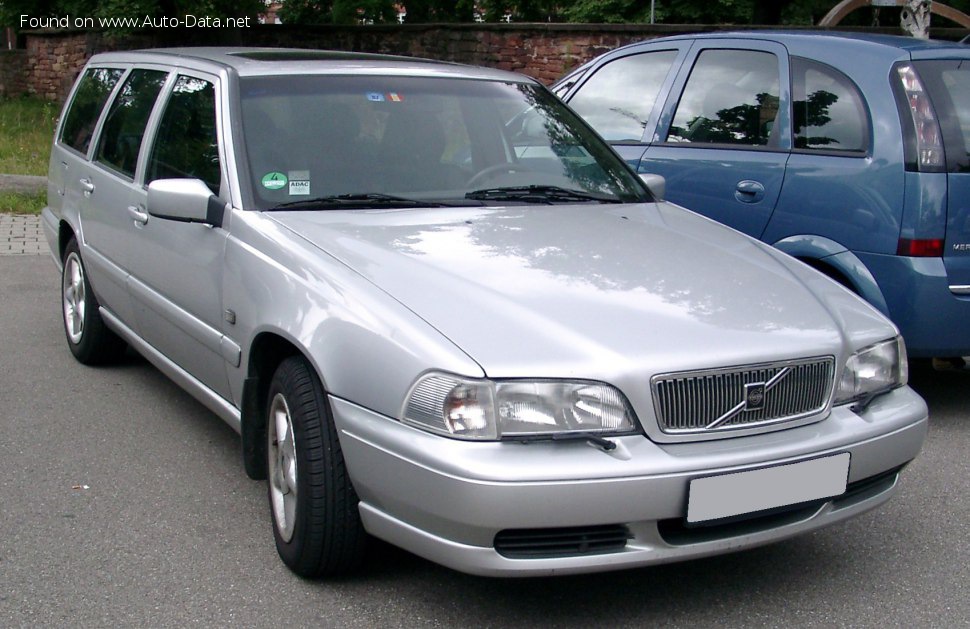
The Volvo V70 I 2.0 20V Turbo, produced between 1996 and 2000, represents Volvo’s initial foray into the premium, mid-size station wagon (estate) segment. Building upon Volvo’s established reputation for safety and practicality, the V70 I aimed to offer a more refined and dynamic driving experience compared to its predecessor, the 940 series. This first generation V70 was primarily marketed in Europe, where the station wagon body style enjoys significant popularity, and served as a key model in Volvo’s lineup, showcasing their engineering prowess and commitment to family-oriented vehicles. The 2.0 20V Turbo variant, equipped with a turbocharged four-cylinder engine and automatic transmission, provided a balance of performance and fuel efficiency for the era.
Volvo V70 I 2.0 20V Turbo: An Overview
The V70 I was a significant departure from previous Volvo estates, adopting a more contemporary and aerodynamic design. It shared its platform with the S70 sedan, offering a similar level of comfort and features. The 2.0 20V Turbo model specifically targeted buyers seeking a responsive and capable vehicle for both daily commuting and longer journeys. While not officially sold in the United States during its production run, the V70’s design principles and engineering advancements would later influence Volvo models offered in the North American market.
Engine & Performance
The heart of the V70 I 2.0 20V Turbo is its 1984 cc (121.07 cu. in.) inline five-cylinder engine, designated the B5204T3. This engine utilizes a multi-port fuel injection system and, crucially, a turbocharger to boost power output to 225 horsepower at 5700 rpm. Torque figures stand at 310 Nm (228.64 lb.-ft.) available from 2700 rpm, providing strong mid-range acceleration. The engine’s configuration – a 20-valve DOHC (Double Overhead Camshaft) setup – contributes to its responsiveness and efficiency. Power is delivered to the front wheels via a four-speed automatic transmission. Performance figures include a 0-100 km/h (0-62 mph) time of 8 seconds and a top speed of 230 km/h (142.92 mph). The weight-to-power ratio of 6.5 kg/Hp and weight-to-torque ratio of 4.7 kg/Nm demonstrate a respectable level of performance for a family wagon of this era.
Design & Features
The Volvo V70 I boasts a classic station wagon profile, characterized by its long roofline and generous cargo capacity. Its design emphasized practicality and functionality, while also incorporating Volvo’s signature Scandinavian aesthetic. The interior was designed with comfort and usability in mind, offering seating for five passengers. Key features included a spacious cabin, comfortable seats, and a well-appointed dashboard. Safety was, as always with Volvo, a paramount concern. The V70 I was equipped with ABS (Anti-lock Braking System) as standard, and its robust construction provided a high level of occupant protection. The vehicle’s trunk offered a minimum capacity of 420 liters (14.83 cu. ft.), expanding to a substantial 1580 liters (55.8 cu. ft.) with the rear seats folded down. The vehicle’s dimensions – 4730 mm (186.22 in.) in length, 1760 mm (69.29 in.) in width, and 1430 mm (56.3 in.) in height – positioned it as a sizable vehicle within its segment.
Technical Specifications
| Brand | Volvo |
| Model | V70 |
| Generation | V70 I |
| Type (Engine) | 2.0 20V Turbo (225 Hp) Automatic |
| Start of production | 1996 |
| End of production | 2000 |
| Powertrain Architecture | Internal Combustion engine |
| Body type | Station wagon (estate) |
| Seats | 5 |
| Doors | 5 |
| Fuel consumption (urban) | 16.8 l/100 km (14 US mpg / 16.8 UK mpg) |
| Fuel consumption (extra urban) | 8.5 l/100 km (27.7 US mpg / 33.2 UK mpg) |
| Fuel Type | Petrol (Gasoline) |
| Acceleration 0 – 100 km/h | 8 sec |
| Acceleration 0 – 62 mph | 8 sec |
| Acceleration 0 – 60 mph | 7.6 sec |
| Maximum speed | 230 km/h (142.92 mph) |
| Weight-to-power ratio | 6.5 kg/Hp |
| Weight-to-torque ratio | 4.7 kg/Nm |
| Power | 225 Hp @ 5700 rpm |
| Power per litre | 113.4 Hp/l |
| Torque | 310 Nm @ 2700 rpm (228.64 lb.-ft. @ 2700 rpm) |
| Engine layout | Front, Transverse |
| Engine Model/Code | B5204T3 |
| Engine displacement | 1984 cm3 (121.07 cu. in.) |
| Number of cylinders | 5 |
| Engine configuration | Inline |
| Cylinder Bore | 81 mm (3.19 in.) |
| Piston Stroke | 77 mm (3.03 in.) |
| Compression ratio | 8.4:1 |
| Number of valves per cylinder | 4 |
| Fuel injection system | Multi-port manifold injection |
| Engine aspiration | Turbocharger |
| Valvetrain | DOHC |
| Engine oil capacity | 5.8 l (6.13 US qt | 5.1 UK qt) |
| Coolant | 7 l (7.4 US qt | 6.16 UK qt) |
| Kerb Weight | 1470 kg (3240.8 lbs.) |
| Max. weight | 1970 kg (4343.11 lbs.) |
| Max load | 500 kg (1102.31 lbs.) |
| Trunk (boot) space – minimum | 420 l (14.83 cu. ft.) |
| Trunk (boot) space – maximum | 1580 l (55.8 cu. ft.) |
| Fuel tank capacity | 70 l (18.49 US gal | 15.4 UK gal) |
| Length | 4730 mm (186.22 in.) |
| Width | 1760 mm (69.29 in.) |
| Height | 1430 mm (56.3 in.) |
| Wheelbase | 2660 mm (104.72 in.) |
| Front track | 1520 mm (59.84 in.) |
| Rear (Back) track | 1470 mm (57.87 in.) |
| Drag coefficient (Cd) | 0.32 |
| Drivetrain Architecture | ICE, Front wheel drive |
| Drive wheel | Front wheel drive |
| Number of gears and type of gearbox | 4 gears, automatic transmission |
| Front suspension | Wishbone |
| Rear suspension | Coil spring |
| Front brakes | Ventilated discs |
| Rear brakes | Disc |
| Assisting systems | ABS (Anti-lock braking system) |
| Steering type | Steering rack and pinion |
| Power steering | Hydraulic Steering |
| Tires size | 205/50 R16 |
| Wheel rims size | 16 |
The Volvo V70 I 2.0 20V Turbo, while not a high-performance machine, offered a compelling package of practicality, comfort, and safety. It solidified Volvo’s position as a leader in the station wagon segment and laid the groundwork for future generations of the V70, which would eventually find their way to the North American market.
