
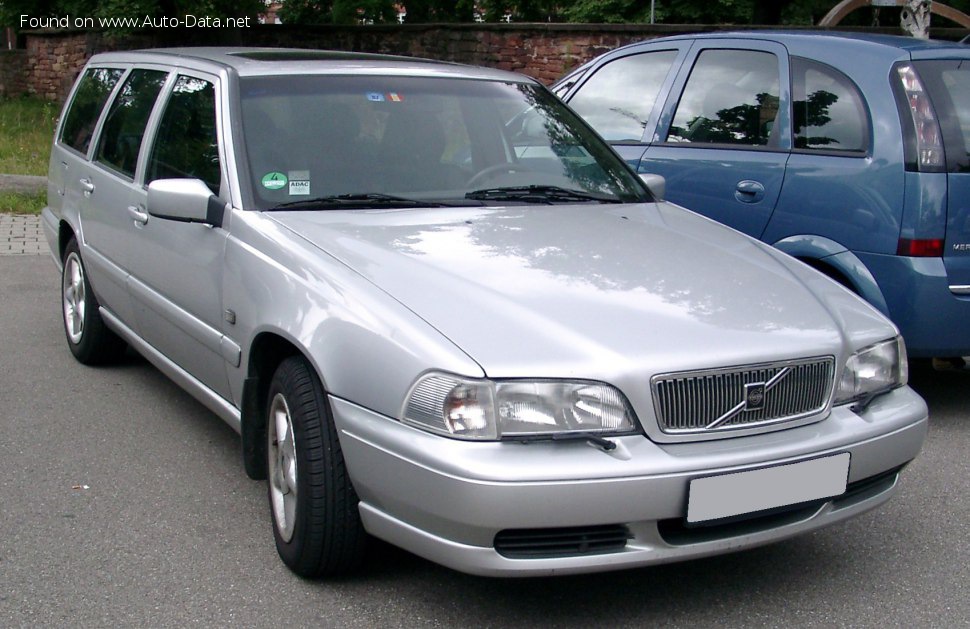
The Volvo V70 I 2.3 20V T-5, produced between 1996 and 2000, represents Volvo’s initial foray into the premium mid-size station wagon segment. Building upon the success of the 850 series, the V70 aimed to offer a more refined and spacious alternative to traditional sedans and smaller wagons. This first generation V70 was a key model for Volvo, solidifying their reputation for safety, practicality, and understated Scandinavian design. While not initially a high-volume seller in the United States, the V70 found a dedicated following among buyers seeking a versatile and durable vehicle. The “T-5” designation indicates the model’s turbocharged engine, providing a significant performance boost compared to naturally aspirated variants.
Volvo V70 I: A Detailed Overview
The V70 I (the “I” denoting the first generation) was designed to appeal to families and individuals needing a vehicle capable of carrying both passengers and substantial cargo. It distinguished itself from competitors with its focus on passenger comfort and a robust build quality. The V70’s design language was evolutionary, retaining the clean lines of the 850 but with a more integrated and modern aesthetic. It served as a practical and safe option in the European market, where station wagons remained a popular body style.
Engine & Performance
The heart of the V70 I 2.3 T-5 is its 2.3-liter inline five-cylinder turbocharged gasoline engine, designated the B5234S. This engine produced 240 horsepower at 5100 rpm and 330 Newton-meters (243.4 lb.-ft.) of torque at 2700 rpm. The turbocharger significantly enhanced performance, allowing for a 0 to 60 mph (0-97 km/h) acceleration time of approximately 7 seconds and a top speed of 235 km/h (146 mph). Power delivery was smooth and linear, making it suitable for both everyday driving and longer journeys. The engine’s specific output of 103.5 horsepower per liter was impressive for its time. Power is delivered to the front wheels via a four-speed automatic transmission. The weight-to-power ratio of 6.1 kg/Hp and weight-to-torque ratio of 4.5 kg/Nm contributed to the vehicle’s responsive feel.
Design & Features
The V70 I is a five-door, five-seat station wagon (estate). Its body style prioritized practicality and cargo space. The vehicle’s dimensions – 4730 mm (186.22 in) in length, 1760 mm (69.29 in) in width, and 1430 mm (56.3 in) in height – provided ample room for passengers and luggage. A key feature was its versatile cargo area, offering a minimum of 420 liters (14.83 cu. ft.) and expanding to a substantial 1580 liters (55.8 cu. ft.) with the rear seats folded down. Volvo placed a strong emphasis on safety, and the V70 I incorporated features such as Anti-lock Braking System (ABS) as standard equipment. The interior was designed with comfort in mind, featuring supportive seats and a functional dashboard layout. The vehicle’s drag coefficient of 0.32 contributed to reasonable aerodynamic efficiency. The suspension utilized a wishbone setup at the front and coil springs at the rear, providing a comfortable ride quality. Hydraulic power steering offered precise and responsive handling.
Technical Specifications
| Brand | Volvo |
| Model | V70 |
| Generation | V70 I |
| Type (Engine) | 2.3 20V T-5 (240 Hp) Automatic |
| Start of production | 1996 |
| End of production | 2000 |
| Powertrain Architecture | Internal Combustion engine |
| Body type | Station wagon (estate) |
| Seats | 5 |
| Doors | 5 |
| Fuel consumption (urban) | 16.8 l/100 km (14 US mpg / 16.8 UK mpg) |
| Fuel consumption (extra urban) | 8.5 l/100 km (27.7 US mpg / 33.2 UK mpg) |
| Fuel Type | Petrol (Gasoline) |
| Acceleration 0 – 100 km/h | 7.4 sec |
| Acceleration 0 – 62 mph | 7.4 sec |
| Acceleration 0 – 60 mph | 7 sec |
| Maximum speed | 235 km/h (146.02 mph) |
| Weight-to-power ratio | 6.1 kg/Hp |
| Weight-to-torque ratio | 4.5 kg/Nm |
| Power | 240 Hp @ 5100 rpm |
| Power per litre | 103.5 Hp/l |
| Torque | 330 Nm @ 2700 rpm (243.4 lb.-ft. @ 2700 rpm) |
| Engine layout | Front, Transverse |
| Engine Model/Code | B5234S |
| Engine displacement | 2319 cm3 (141.51 cu. in.) |
| Number of cylinders | 5 |
| Engine configuration | Inline |
| Cylinder Bore | 81 mm (3.19 in.) |
| Piston Stroke | 90 mm (3.54 in.) |
| Compression ratio | 8.5:1 |
| Number of valves per cylinder | 4 |
| Fuel injection system | Multi-port manifold injection |
| Engine aspiration | Turbocharger |
| Valvetrain | DOHC |
| Engine oil capacity | 5.8 l (6.13 US qt | 5.1 UK qt) |
| Coolant | 7 l (7.4 US qt | 6.16 UK qt) |
| Kerb Weight | 1470 kg (3240.8 lbs.) |
| Max. weight | 1970 kg (4343.11 lbs.) |
| Max load | 500 kg (1102.31 lbs.) |
| Trunk (boot) space – minimum | 420 l (14.83 cu. ft.) |
| Trunk (boot) space – maximum | 1580 l (55.8 cu. ft.) |
| Fuel tank capacity | 70 l (18.49 US gal | 15.4 UK gal) |
| Length | 4730 mm (186.22 in.) |
| Width | 1760 mm (69.29 in.) |
| Height | 1430 mm (56.3 in.) |
| Wheelbase | 2660 mm (104.72 in.) |
| Front track | 1520 mm (59.84 in.) |
| Rear (Back) track | 1470 mm (57.87 in.) |
| Drag coefficient (Cd) | 0.32 |
| Drivetrain Architecture | ICE, Front wheel drive |
| Drive wheel | Front wheel drive |
| Number of gears and type of gearbox | 4 gears, automatic transmission |
| Front suspension | Wishbone |
| Rear suspension | Coil spring |
| Front brakes | Ventilated discs |
| Rear brakes | Disc |
| Assisting systems | ABS (Anti-lock braking system) |
| Steering type | Steering rack and pinion |
| Power steering | Hydraulic Steering |
| Tires size | 205/45 R17 |
| Wheel rims size | 17 |
