
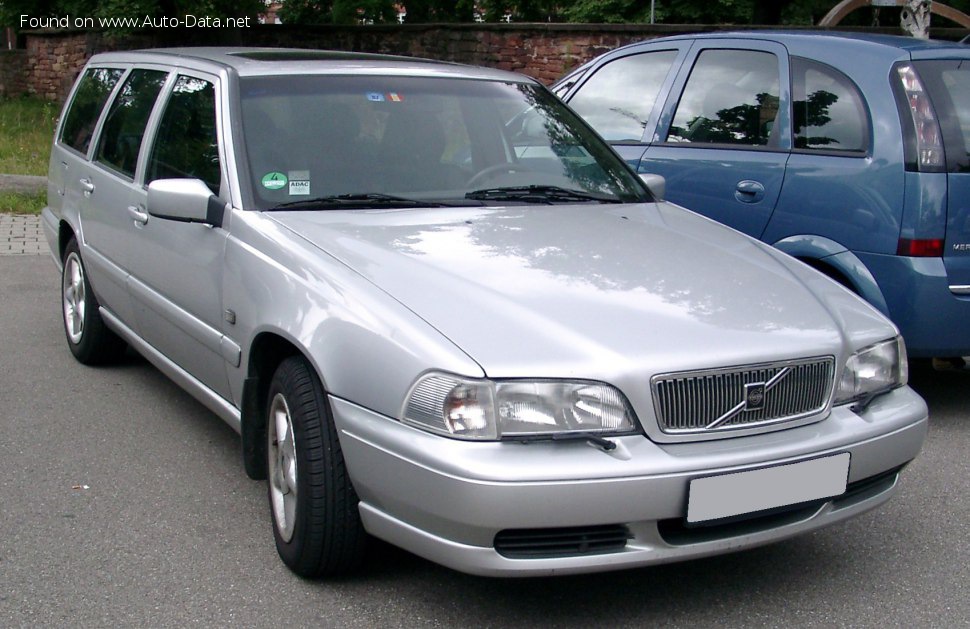
The Volvo V70 I 2.3 20V T-5 AWD, produced between 1996 and 2000, represents Volvo’s initial foray into the premium, mid-size wagon segment. Building upon the foundations laid by the 850 series, the V70 aimed to offer a more refined and sophisticated experience, blending practicality with Volvo’s renowned safety and durability. This first generation V70 was primarily marketed in Europe, where the station wagon body style enjoys significant popularity, and to a lesser extent in North America. It served as a direct competitor to vehicles like the Audi A6 Avant, BMW 5 Series Touring, and Mercedes-Benz E-Class Estate, offering a compelling alternative with its distinctive Scandinavian design and robust engineering.
Volvo V70 I: A Legacy of Practical Luxury
The V70 I distinguished itself through its spacious interior, versatile cargo capacity, and available all-wheel-drive system. Volvo positioned the V70 as a vehicle for active families and individuals who required a blend of comfort, performance, and all-weather capability. The “T-5” designation indicates the top-of-the-line engine option, a turbocharged 2.3-liter inline-five cylinder engine that delivered a substantial 240 horsepower. This engine, coupled with the available automatic transmission and all-wheel drive, provided brisk acceleration and confident handling in a variety of conditions. The V70 I laid the groundwork for the subsequent generations of V70 models, establishing a reputation for being a practical, safe, and well-engineered wagon.
Engine & Performance
At the heart of the V70 I 2.3 20V T-5 AWD lies the B5234S engine, a 2.3-liter inline-five cylinder powerplant. This engine is characterized by its robust construction and the addition of a turbocharger and intercooler, boosting output to 240 horsepower at 5400 rpm and 330 Nm (243.4 lb.-ft.) of torque at 2400 rpm. The turbocharger significantly enhances low-end responsiveness, providing strong acceleration from a standstill. The engine features multi-port fuel injection and a double overhead camshaft (DOHC) valvetrain with four valves per cylinder, optimizing airflow and combustion efficiency. Power is delivered to all four wheels via a four-speed automatic transmission, ensuring optimal traction and stability. Performance figures include a 0-100 km/h (0-62 mph) acceleration time of 8.1 seconds and a top speed of 225 km/h (139.81 mph). The weight-to-power ratio of 6.8 kg/Hp and weight-to-torque ratio of 4.9 kg/Nm contribute to a responsive and engaging driving experience.
Design & Features
The Volvo V70 I boasts a classic station wagon profile, characterized by its long roofline, generous cargo area, and understated elegance. The design emphasizes practicality and functionality, while still maintaining a distinctly Scandinavian aesthetic. The interior is spacious and well-appointed, offering comfortable seating for five passengers. Volvo prioritized safety in the V70 I, equipping it with features such as Anti-lock Braking System (ABS) as standard. The vehicle’s large trunk offers a minimum capacity of 420 liters (14.83 cu. ft.), expanding to a substantial 1580 liters (55.8 cu. ft.) with the rear seats folded down. The V70 I’s dimensions – a length of 4730 mm (186.22 in.), a width of 1760 mm (69.29 in.), and a height of 1430 mm (56.3 in.) – provide ample interior space without feeling overly cumbersome. The vehicle rides on a wheelbase of 2660 mm (104.72 in.), contributing to a stable and comfortable ride.
Technical Specifications
| Brand | Volvo |
| Model | V70 |
| Generation | V70 I |
| Type (Engine) | 2.3 20V T-5 (240 Hp) AWD |
| Start of production | 1996 |
| End of production | 2000 |
| Powertrain Architecture | Internal Combustion engine |
| Body type | Station wagon (estate) |
| Seats | 5 |
| Doors | 5 |
| Fuel consumption (urban) | 16.2 l/100 km (14.5 US mpg / 17.4 UK mpg / 6.2 km/l) |
| Fuel consumption (extra urban) | 8.7 l/100 km (27 US mpg / 32.5 UK mpg / 11.5 km/l) |
| Fuel Type | Petrol (Gasoline) |
| Acceleration 0 – 100 km/h | 8.1 sec |
| Acceleration 0 – 62 mph | 8.1 sec |
| Acceleration 0 – 60 mph | 7.7 sec |
| Maximum speed | 225 km/h (139.81 mph) |
| Weight-to-power ratio | 6.8 kg/Hp |
| Weight-to-torque ratio | 4.9 kg/Nm |
| Power | 240 Hp @ 5400 rpm |
| Power per litre | 103.5 Hp/l |
| Torque | 330 Nm @ 2400 rpm (243.4 lb.-ft. @ 2400 rpm) |
| Engine layout | Front, Transverse |
| Engine Model/Code | B5234S |
| Engine displacement | 2319 cm3 (141.51 cu. in.) |
| Number of cylinders | 5 |
| Engine configuration | Inline |
| Cylinder Bore | 81 mm (3.19 in.) |
| Piston Stroke | 90 mm (3.54 in.) |
| Compression ratio | 8.5:1 |
| Number of valves per cylinder | 4 |
| Fuel injection system | Multi-port manifold injection |
| Engine aspiration | Turbocharger |
| Valvetrain | DOHC |
| Engine oil capacity | 5.8 l (6.13 US qt | 5.1 UK qt) |
| Coolant | 7 l (7.4 US qt | 6.16 UK qt) |
| Kerb Weight | 1631 kg (3595.74 lbs.) |
| Max. weight | 2150 kg (4739.94 lbs.) |
| Max load | 519 kg (1144.2 lbs.) |
| Trunk (boot) space – minimum | 420 l (14.83 cu. ft.) |
| Trunk (boot) space – maximum | 1580 l (55.8 cu. ft.) |
| Fuel tank capacity | 70 l (18.49 US gal | 15.4 UK gal) |
| Length | 4730 mm (186.22 in.) |
| Width | 1760 mm (69.29 in.) |
| Height | 1430 mm (56.3 in.) |
| Wheelbase | 2660 mm (104.72 in.) |
| Front track | 1520 mm (59.84 in.) |
| Rear (Back) track | 1490 mm (58.66 in.) |
| Drag coefficient (Cd) | 0.32 |
| Drive wheel | All wheel drive (4×4) |
| Number of gears and type of gearbox | 4 gears, automatic transmission |
| Front suspension | Wishbone |
| Rear suspension | Coil spring |
| Front brakes | Ventilated discs |
| Rear brakes | Disc |
| Assisting systems | ABS (Anti-lock braking system) |
| Steering type | Steering rack and pinion |
| Power steering | Hydraulic Steering |
| Tires size | 205/45 R17 |
| Wheel rims size | 17 |
