
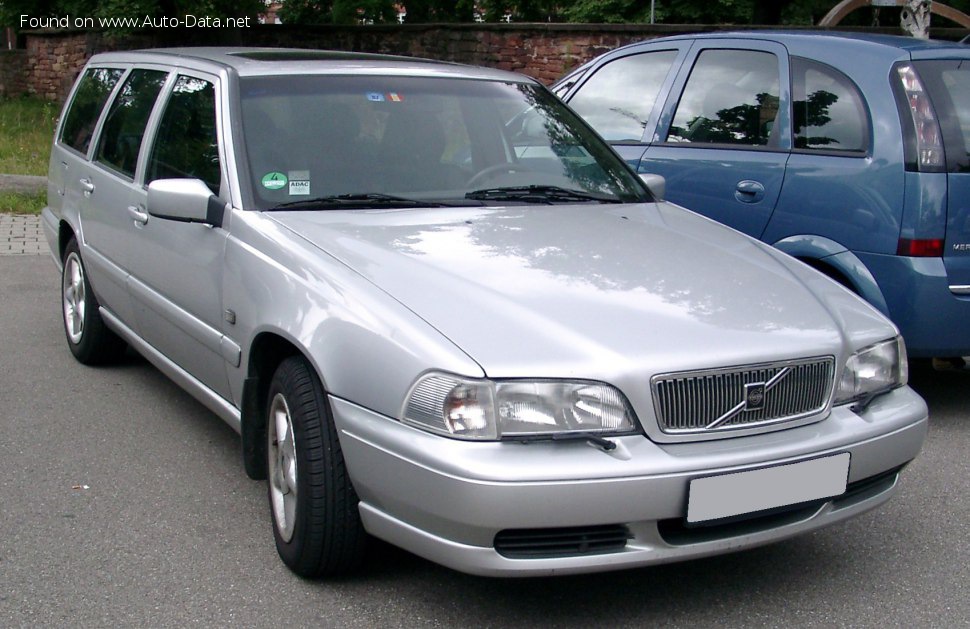
The Volvo V70 I 2.5, produced between 1996 and 2000, represents Volvo’s initial foray into the premium mid-size wagon segment. Building upon the success of the 850 series, the V70 aimed to offer a more refined and spacious alternative to traditional sedans and smaller estates. This first generation V70 was a key model for Volvo, solidifying their reputation for safety, practicality, and understated Scandinavian design. While primarily sold in Europe, the V70’s design and engineering influenced Volvo’s offerings in other markets, including North America, where wagons remained a popular choice among discerning buyers.
Volvo V70 I 2.5: A Detailed Overview
The V70 I, as the first iteration of the model is known, was designed to appeal to families and individuals needing a versatile vehicle capable of carrying both passengers and substantial cargo. It distinguished itself from competitors with its focus on comfort, build quality, and a commitment to safety features that were ahead of their time. The 2.5-liter engine variant, producing 144 horsepower, was a popular choice, offering a balance between performance and fuel efficiency for everyday driving.
Engine & Performance
Powering the Volvo V70 I 2.5 is a naturally aspirated, 2.435-liter (148.59 cubic inches) inline five-cylinder gasoline engine, designated the B5252S. This engine produces 144 horsepower at 5400 rpm and 206 Newton-meters (151.94 lb.-ft.) of torque at 3600 rpm. While not a performance powerhouse, the engine provides adequate power for comfortable cruising and everyday driving. The power-to-weight ratio stands at 98 horsepower per tonne, and the torque-to-weight ratio is 140.1 Nm per tonne. Acceleration from 0 to 100 km/h (0-62 mph) takes 10.4 seconds, while 0 to 60 mph is achieved in approximately 9.9 seconds. The V70 I 2.5 has a maximum speed of 205 km/h (127.38 mph). The engine features multi-port fuel injection and a double overhead camshaft (DOHC) valvetrain with two valves per cylinder. It’s a robust and reliable unit, typical of Volvo’s engineering philosophy of the era.
Design & Features
The Volvo V70 I is a five-door, five-seat station wagon (estate). Its design emphasizes practicality and functionality, with a long roofline maximizing cargo space. The exterior styling is characteristically Volvo – clean lines, a boxy silhouette, and a focus on aerodynamic efficiency, evidenced by a drag coefficient of 0.32. Inside, the V70 I offers a spacious and comfortable cabin. The rear seats can be folded down to create a large, flat cargo area, with a minimum capacity of 420 liters (14.83 cubic feet) expanding to a maximum of 1580 liters (55.8 cubic feet) with the seats folded. Safety was a paramount concern for Volvo, and the V70 I was equipped with features such as Anti-lock Braking System (ABS) as standard. Hydraulic power steering and a five-speed manual transmission were also standard equipment. The vehicle’s dimensions are 4730 mm (186.22 inches) in length, 1760 mm (69.29 inches) in width, and 1430 mm (56.3 inches) in height, with a wheelbase of 2660 mm (104.72 inches).
Technical Specifications
| Brand | Volvo |
| Model | V70 |
| Generation | V70 I |
| Type (Engine) | 2.5 (144 Hp) |
| Start of production | 1996 |
| End of production | 2000 |
| Powertrain Architecture | Internal Combustion engine |
| Body type | Station wagon (estate) |
| Seats | 5 |
| Doors | 5 |
| Fuel consumption (urban) | 13.4 l/100 km (17.6 US mpg, 21.1 UK mpg, 7.5 km/l) |
| Fuel consumption (extra urban) | 8 l/100 km (29.4 US mpg, 35.3 UK mpg, 12.5 km/l) |
| Fuel Type | Petrol (Gasoline) |
| Acceleration 0 – 100 km/h | 10.4 sec |
| Acceleration 0 – 62 mph | 10.4 sec |
| Acceleration 0 – 60 mph | 9.9 sec |
| Maximum speed | 205 km/h (127.38 mph) |
| Weight-to-power ratio | 10.2 kg/Hp |
| Weight-to-torque ratio | 7.1 kg/Nm |
| Power | 144 Hp @ 5400 rpm |
| Power per litre | 59.1 Hp/l |
| Torque | 206 Nm @ 3600 rpm (151.94 lb.-ft. @ 3600 rpm) |
| Engine layout | Front, Transverse |
| Engine Model/Code | B5252S |
| Engine displacement | 2435 cm3 (148.59 cu. in.) |
| Number of cylinders | 5 |
| Engine configuration | Inline |
| Cylinder Bore | 83 mm (3.27 in.) |
| Piston Stroke | 90 mm (3.54 in.) |
| Compression ratio | 10:1 |
| Number of valves per cylinder | 2 |
| Fuel injection system | Multi-port manifold injection |
| Engine aspiration | Naturally aspirated engine |
| Valvetrain | DOHC |
| Engine oil capacity | 5.8 l (6.13 US qt | 5.1 UK qt) |
| Coolant | 7.2 l (7.61 US qt | 6.34 UK qt) |
| Kerb Weight | 1470 kg (3240.8 lbs.) |
| Max. weight | 1970 kg (4343.11 lbs.) |
| Max load | 500 kg (1102.31 lbs.) |
| Trunk (boot) space – minimum | 420 l (14.83 cu. ft.) |
| Trunk (boot) space – maximum | 1580 l (55.8 cu. ft.) |
| Fuel tank capacity | 70 l (18.49 US gal | 15.4 UK gal) |
| Length | 4730 mm (186.22 in.) |
| Width | 1760 mm (69.29 in.) |
| Height | 1430 mm (56.3 in.) |
| Wheelbase | 2660 mm (104.72 in.) |
| Front track | 1520 mm (59.84 in.) |
| Rear (Back) track | 1470 mm (57.87 in.) |
| Drag coefficient (Cd) | 0.32 |
| Drivetrain Architecture | ICE, Front wheel drive |
| Drive wheel | Front wheel drive |
| Number of gears and type of gearbox | 5 gears, manual transmission |
| Front suspension | Wishbone |
| Rear suspension | Coil spring |
| Front brakes | Ventilated discs |
| Rear brakes | Disc |
| Assisting systems | ABS (Anti-lock braking system) |
| Steering type | Steering rack and pinion |
| Power steering | Hydraulic Steering |
| Tires size | 195/60 R15 |
| Wheel rims size | 15 |
The Volvo V70 I 2.5, while not a groundbreaking vehicle in terms of outright performance, remains a highly regarded wagon known for its practicality, safety, and enduring build quality. It represents a significant step forward in Volvo’s design and engineering, laying the foundation for the continued success of the V70 model line.
