
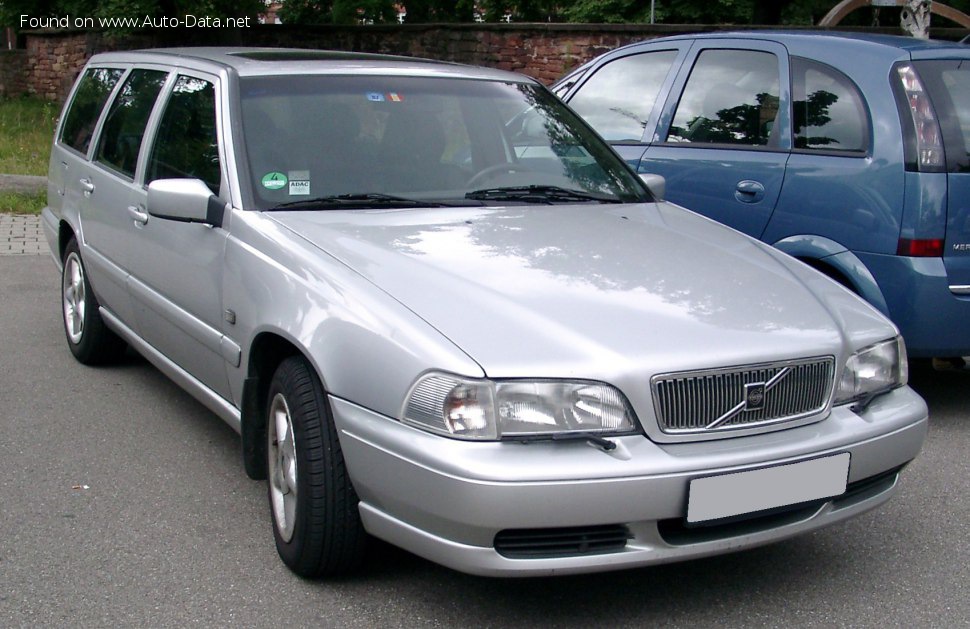
The Volvo V70 I 2.5 20V, produced between 1998 and 2000, represents Volvo’s initial foray into the premium, mid-size station wagon segment. Building upon the foundations laid by the 850 series, the V70 aimed to offer a more refined and sophisticated experience, blending practicality with Volvo’s renowned safety standards. While not initially a major seller in the United States – Volvo’s US market focus was more on sedans and SUVs at the time – the V70 I established a strong following in Europe as a versatile and comfortable family vehicle. It served as a crucial model in solidifying Volvo’s reputation for building durable, safe, and thoughtfully designed cars.
Volvo V70 I 2.5 20V: A Detailed Overview
The V70 I was positioned as a direct competitor to other European station wagons like the Audi A6 Avant, BMW 5 Series Touring, and Mercedes-Benz E-Class Estate. It distinguished itself through its spacious interior, comfortable ride, and emphasis on passenger safety. The “I” designation denotes the first generation of the V70, which was later superseded by more advanced iterations. The 2.5 20V variant, equipped with a 2.5-liter inline five-cylinder engine, was a popular choice, offering a balance of performance and fuel efficiency.
Engine & Performance
The heart of the Volvo V70 I 2.5 20V is a naturally aspirated 2.5-liter inline five-cylinder engine, designated the B5254S. This engine produces 165 horsepower at 6,100 rpm and 220 Newton-meters (162.26 lb.-ft.) of torque at 4,700 rpm. The engine’s configuration – an inline-five – was a Volvo hallmark, offering a unique engine note and a good balance between smoothness and power delivery. Power is delivered to the front wheels via a five-speed manual transmission. This configuration allows for a maximum speed of 209 km/h (129.87 mph). Fuel economy figures are rated at 15.0 l/100 km (15.7 US mpg, 18.8 UK mpg, 6.7 km/l) in urban driving, 7.8 l/100 km (30.2 US mpg, 36.2 UK mpg, 12.8 km/l) on the extra-urban cycle, and 10.5 l/100 km (22.4 US mpg, 26.9 UK mpg, 9.5 km/l) combined. While these figures aren’t exceptional by modern standards, they were competitive for the late 1990s.
Design & Features
The Volvo V70 I boasts a classic station wagon profile, characterized by its long roofline and generous cargo area. The body type is a five-door, five-seat station wagon (estate). Its design prioritizes practicality and functionality, with a focus on maximizing interior space. The interior is typically well-appointed, featuring comfortable seats and a user-friendly layout. Safety was, as always with Volvo, a paramount concern. The V70 I was equipped with standard features like Anti-lock Braking System (ABS), and a robust safety cage designed to protect occupants in the event of a collision. Other features included hydraulic power steering, ventilated front disc brakes, and disc brakes on the rear axle. The vehicle’s McPherson strut front suspension and coil spring rear suspension contribute to a comfortable ride quality. The drag coefficient of 0.32 is respectable for a vehicle of its size and shape.
Technical Specifications
| Brand | Volvo |
| Model | V70 |
| Generation | V70 I |
| Type (Engine) | 2.5 20V (165 Hp) |
| Start of production | 1998 |
| End of production | 2000 |
| Powertrain Architecture | Internal Combustion engine |
| Body type | Station wagon (estate) |
| Seats | 5 |
| Doors | 5 |
| Fuel consumption (urban) | 15.0 l/100 km (15.7 US mpg, 18.8 UK mpg, 6.7 km/l) |
| Fuel consumption (extra urban) | 7.8 l/100 km (30.2 US mpg, 36.2 UK mpg, 12.8 km/l) |
| Fuel consumption (combined) | 10.5 l/100 km (22.4 US mpg, 26.9 UK mpg, 9.5 km/l) |
| Fuel Type | Petrol (Gasoline) |
| Maximum speed | 209 km/h (129.87 mph) |
| Power | 165 Hp @ 6100 rpm |
| Torque | 220 Nm @ 4700 rpm (162.26 lb.-ft. @ 4700 rpm) |
| Engine layout | Front, Transverse |
| Engine Model/Code | B5254S |
| Engine displacement | 2435 cm3 (148.59 cu. in.) |
| Number of cylinders | 5 |
| Engine configuration | Inline |
| Cylinder Bore | 83 mm (3.27 in.) |
| Piston Stroke | 90 mm (3.54 in.) |
| Compression ratio | 10.3:1 |
| Number of valves per cylinder | 4 |
| Fuel injection system | Multi-port manifold injection |
| Engine aspiration | Naturally aspirated engine |
| Valvetrain | DOHC |
| Engine oil capacity | 5.8 l (6.13 US qt | 5.1 UK qt) |
| Coolant | 7.2 l (7.61 US qt | 6.34 UK qt) |
| Trunk (boot) space – minimum | 420 l (14.83 cu. ft.) |
| Trunk (boot) space – maximum | 1580 l (55.8 cu. ft.) |
| Fuel tank capacity | 70 l (18.49 US gal | 15.4 UK gal) |
| Length | 4730 mm (186.22 in.) |
| Width | 1760 mm (69.29 in.) |
| Height | 1430 mm (56.3 in.) |
| Wheelbase | 2660 mm (104.72 in.) |
| Front track | 1521 mm (59.88 in.) |
| Rear track | 1468 mm (57.8 in.) |
| Drag coefficient (Cd) | 0.32 |
| Drivetrain Architecture | ICE, Front wheel drive |
| Drive wheel | Front wheel drive |
| Number of gears and type of gearbox | 5 gears, manual transmission |
| Front suspension | Independent type McPherson |
| Rear suspension | Coil spring |
| Front brakes | Ventilated discs |
| Rear brakes | Disc |
| Assisting systems | ABS (Anti-lock braking system) |
| Steering type | Steering rack and pinion |
| Power steering | Hydraulic Steering |
| Tires size | 195/65 R15 |
| Wheel rims size | 15 |
The Volvo V70 I 2.5 20V, while not a performance icon, remains a respected vehicle for its blend of practicality, safety, and durability. It represents a significant step forward in Volvo’s station wagon lineage and laid the groundwork for the more advanced V70 models that followed. Its enduring appeal lies in its ability to provide a comfortable and secure driving experience for families and individuals alike.
