
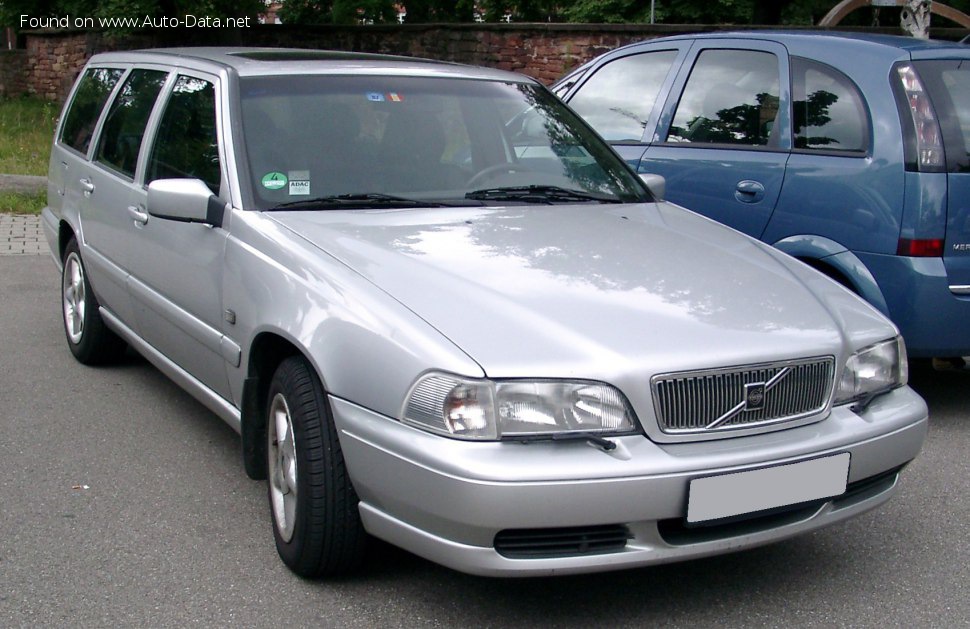
The Volvo V70 I 2.5 Bifuel, produced for a limited time in 1999, represents a unique offering from the Swedish automaker. This station wagon, primarily aimed at the European market, distinguished itself with its ability to run on both petrol and Compressed Natural Gas (CNG), offering a degree of fuel flexibility uncommon for the period. The V70 I, the first generation of the V70 series, built upon the success of the 850 estate, providing a more refined and spacious option within the premium wagon segment. While not officially sold in the United States, the V70’s design and engineering principles heavily influenced Volvo’s subsequent offerings in the North American market.
Volvo V70 I 2.5 Bifuel: A Dual-Fuel Pioneer
The V70 I 2.5 Bifuel was a response to growing environmental concerns and the desire for alternative fuel options in Europe. The “Bifuel” designation indicates the vehicle’s capability to seamlessly switch between petrol and CNG, allowing drivers to benefit from the lower emissions and potentially reduced running costs associated with CNG when available. This model was particularly popular in countries with established CNG infrastructure and incentives. The V70 I, in general, was lauded for its safety, practicality, and comfortable ride, establishing a strong reputation for Volvo in the estate car class.
Engine & Performance
At the heart of the V70 I 2.5 Bifuel lies a 2.435-liter, inline five-cylinder engine. When running on petrol, this engine produces 126 horsepower at 5400 rpm and 179 Nm (132.02 lb.-ft.) of torque at 3600 rpm. Switching to CNG boosts the power output to 144 horsepower at the same 5400 rpm, demonstrating the potential of CNG as a viable fuel source. The engine utilizes multi-port fuel injection and a double overhead camshaft (DOHC) valvetrain, contributing to its relatively efficient operation. Power is delivered to the front wheels via a five-speed automatic transmission (Geartronic), providing smooth and convenient gear changes. The weight-to-power ratio of 11.4 kg/Hp and a weight-to-torque ratio of 8 kg/Nm indicate a reasonable, though not particularly sporty, performance profile. Maximum speed is electronically limited to 180 km/h (111.85 mph). Fuel economy figures are notably different depending on the fuel used, with 14.2 l/100 km (16.6 US mpg) in urban settings and 8.0 l/100 km (29.4 US mpg) on the open road when running on petrol.
Design & Features
The Volvo V70 I boasts the classic, understated Scandinavian design aesthetic that Volvo was known for. Its station wagon (estate) body style prioritizes practicality and cargo space. The vehicle comfortably seats five passengers and offers a generous 420 liters (14.83 cu. ft.) of trunk space with the rear seats up, expanding to a substantial 1580 liters (55.8 cu. ft.) when folded down. The exterior dimensions are 4730 mm (186.22 in.) in length, 1760 mm (69.29 in.) in width, and 1430 mm (56.3 in.) in height. Safety was, and remains, a core Volvo value. The V70 I was equipped with ABS (Anti-lock Braking System) as standard, a crucial safety feature for the time. The suspension utilizes an independent McPherson strut setup at the front and coil springs at the rear, providing a comfortable and controlled ride. Hydraulic power steering ensures ease of maneuverability. The vehicle rides on 15-inch wheels with 195/60 R15 tires.
Technical Specifications
| Brand | Volvo |
| Model | V70 |
| Generation | V70 I |
| Type (Engine) | 2.5 Bifuel (126/144 Hp) Geartronic |
| Start of production | 1999 |
| End of production | 1999 |
| Powertrain Architecture | Internal Combustion engine |
| Body type | Station wagon (estate) |
| Seats | 5 |
| Doors | 5 |
| Fuel consumption (economy) – urban | 14.2 l/100 km (16.6 US mpg, 19.9 UK mpg, 7 km/l) |
| Fuel consumption (economy) – extra urban | 8.0 l/100 km (29.4 US mpg, 35.3 UK mpg, 12.5 km/l) |
| Fuel Type | Petrol / CNG |
| Maximum speed | 180 km/h (111.85 mph) |
| Weight-to-power ratio | 11.4 kg/Hp |
| Weight-to-torque ratio | 8 kg/Nm |
| Power | 126 Hp @ 5400 rpm (Petrol) / 144 Hp @ 5400 rpm (CNG) |
| Torque | 179 Nm @ 3600 rpm (132.02 lb.-ft. @ 3600 rpm) |
| Engine layout | Front, Transverse |
| Engine Model/Code | GB5252S2 |
| Engine displacement | 2435 cm3 (148.59 cu. in.) |
| Number of cylinders | 5 |
| Engine configuration | Inline |
| Cylinder Bore | 83 mm (3.27 in.) |
| Piston Stroke | 90 mm (3.54 in.) |
| Compression ratio | 10:1 |
| Number of valves per cylinder | 4 |
| Fuel injection system | Multi-port manifold injection |
| Engine aspiration | Naturally aspirated engine |
| Valvetrain | DOHC |
| Engine oil capacity | 5.8 l (6.13 US qt | 5.1 UK qt) |
| Coolant | 7.2 l (7.61 US qt | 6.34 UK qt) |
| Kerb Weight | 1434 kg (3161.43 lbs.) |
| Max. weight | 2020 kg (4453.34 lbs.) |
| Max load | 586 kg (1291.91 lbs.) |
| Trunk (boot) space – minimum | 420 l (14.83 cu. ft.) |
| Trunk (boot) space – maximum | 1580 l (55.8 cu. ft.) |
| Fuel tank capacity | 70 l (18.49 US gal | 15.4 UK gal) |
| Max. roof load | 100 kg (220.46 lbs.) |
| Permitted trailer load with brakes (12%) | 1600 kg (3527.4 lbs.) |
| Permitted trailer load without brakes | 700 kg (1543.24 lbs.) |
| Length | 4730 mm (186.22 in.) |
| Width | 1760 mm (69.29 in.) |
| Height | 1430 mm (56.3 in.) |
| Wheelbase | 2660 mm (104.72 in.) |
| Front track | 1520 mm (59.84 in.) |
| Rear (Back) track | 1470 mm (57.87 in.) |
| Ride height (ground clearance) | 140 mm (5.51 in.) |
| Drag coefficient (Cd) | 0.32 |
| Drivetrain Architecture | ICE drives front wheels |
| Drive wheel | Front wheel drive |
| Number of gears and type of gearbox | 5 gears, automatic transmission |
| Front suspension | Independent type McPherson |
| Rear suspension | Coil spring |
| Front brakes | Ventilated discs, 280 mm |
| Rear brakes | Disc, 295 mm |
| Assisting systems | ABS (Anti-lock braking system) |
| Steering type | Steering rack and pinion |
| Power steering | Hydraulic Steering |
| Tires size | 195/60 R15 |
| Wheel rims size | 15 |
The Volvo V70 I 2.5 Bifuel, though a short-lived model, represents an important step in Volvo’s commitment to alternative fuels and sustainable transportation. Its combination of practicality, safety, and fuel flexibility made it a compelling choice for environmentally conscious drivers in Europe during the late 1990s.
