
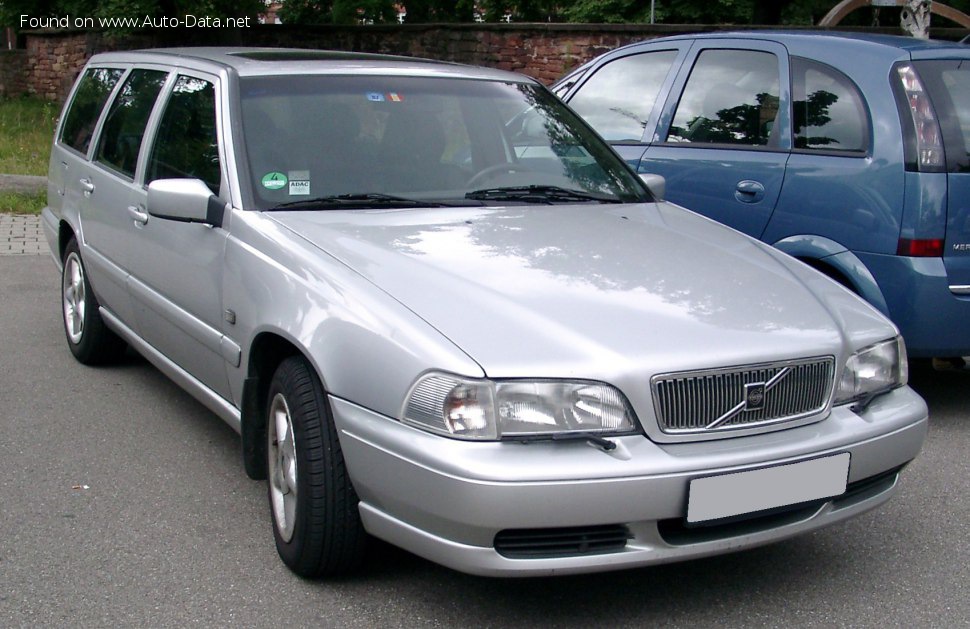
The Volvo V70 I 2.5 TDI, produced between 1996 and 2000, represents Volvo’s initial foray into the mid-size executive station wagon segment. Building upon the success of the 850 series, the V70 aimed to offer a more refined and spacious alternative to traditional sedans, appealing to buyers seeking practicality without sacrificing Scandinavian design and safety. This first generation V70 was primarily sold in Europe, where the station wagon body style enjoys significant popularity, and served as a key model in Volvo’s lineup, establishing a reputation for versatility and durability.
Volvo V70 I 2.5 TDI: An Overview
The V70 I, as the first generation is known, was a significant step forward for Volvo in terms of interior space and overall refinement. It offered a compelling blend of comfort, practicality, and understated elegance. The 2.5 TDI variant, equipped with a turbocharged diesel engine, was particularly popular in European markets due to its fuel efficiency and torque delivery. While not officially sold in the United States, the V70’s design principles and engineering advancements influenced subsequent Volvo models that were offered to American consumers.
Engine & Performance
The heart of the V70 I 2.5 TDI is a 2.5-liter inline five-cylinder diesel engine, designated the D5252T. This engine produces 140 horsepower at 4000 rpm and 290 Nm (213.89 lb.-ft.) of torque at 1900 rpm. The turbocharger significantly enhances low-end torque, providing strong acceleration and effortless cruising. Power is delivered to the front wheels via a five-speed manual transmission. Performance figures include a 0-100 km/h (0-62 mph) acceleration time of 10.2 seconds and a top speed of 200 km/h (124.27 mph). The engine’s fuel consumption is rated at 6.5 liters per 100 kilometers (36.2 US mpg combined), making it an economical choice for long-distance travel. The weight-to-power ratio is 11 kg/Hp, and the weight-to-torque ratio is 5.3 kg/Nm, indicating a reasonably efficient powertrain.
Design & Features
The Volvo V70 I features a classic station wagon profile, characterized by a long roofline and a spacious cargo area. The design emphasizes practicality and functionality, while still maintaining Volvo’s signature Scandinavian aesthetic. Inside, the V70 offers a comfortable and well-appointed cabin with seating for five passengers. Key features include a generous trunk space ranging from 420 liters (14.83 cu. ft.) with the rear seats up to 1580 liters (55.8 cu. ft.) with the seats folded down. Safety was, and remains, a core Volvo value. The V70 I incorporated features like ABS (Anti-lock Braking System) as standard equipment, reflecting Volvo’s commitment to occupant protection. The vehicle’s dimensions are substantial, measuring 4730 mm (186.22 in.) in length, 1760 mm (69.29 in.) in width, and 1430 mm (56.3 in.) in height. The wheelbase is 2660 mm (104.72 in.).
Technical Specifications
| Brand | Volvo |
| Model | V70 |
| Generation | V70 I |
| Type (Engine) | 2.5 TDI (140 Hp) |
| Start of production | 1996 |
| End of production | 2000 |
| Powertrain Architecture | Internal Combustion engine |
| Body type | Station wagon (estate) |
| Seats | 5 |
| Doors | 5 |
| Fuel consumption (urban) | 9 l/100 km (26.1 US mpg) |
| Fuel consumption (extra urban) | 5.5 l/100 km (42.8 US mpg) |
| Fuel consumption (combined) | 6.5 l/100 km (36.2 US mpg) |
| Fuel Type | Diesel |
| Acceleration 0 – 100 km/h | 10.2 sec |
| Acceleration 0 – 62 mph | 10.2 sec |
| Acceleration 0 – 60 mph | 9.7 sec |
| Maximum speed | 200 km/h (124.27 mph) |
| Weight-to-power ratio | 11 kg/Hp |
| Weight-to-torque ratio | 5.3 kg/Nm |
| Power | 140 Hp @ 4000 rpm |
| Torque | 290 Nm @ 1900 rpm (213.89 lb.-ft. @ 1900 rpm) |
| Engine layout | Front, Transverse |
| Engine Model/Code | D5252T |
| Engine displacement | 2461 cm3 (150.18 cu. in.) |
| Number of cylinders | 5 |
| Engine configuration | Inline |
| Cylinder Bore | 81 mm (3.19 in.) |
| Piston Stroke | 95.5 mm (3.76 in.) |
| Compression ratio | 20.5:1 |
| Number of valves per cylinder | 2 |
| Fuel injection system | Diesel Commonrail |
| Engine aspiration | Turbocharger |
| Valvetrain | OHC |
| Engine oil capacity | 6 l (6.34 US qt | 5.28 UK qt) |
| Coolant | 12.5 l (13.21 US qt | 11 UK qt) |
| Kerb Weight | 1540 kg (3395.12 lbs.) |
| Max. weight | 2000 kg (4409.25 lbs.) |
| Max load | 460 kg (1014.13 lbs.) |
| Trunk (boot) space – minimum | 420 l (14.83 cu. ft.) |
| Trunk (boot) space – maximum | 1580 l (55.8 cu. ft.) |
| Fuel tank capacity | 70 l (18.49 US gal | 15.4 UK gal) |
| Length | 4730 mm (186.22 in.) |
| Width | 1760 mm (69.29 in.) |
| Height | 1430 mm (56.3 in.) |
| Wheelbase | 2660 mm (104.72 in.) |
| Front track | 1520 mm (59.84 in.) |
| Rear track | 1470 mm (57.87 in.) |
| Drag coefficient (Cd) | 0.32 |
| Minimum turning circle | 10.5 m (34.45 ft.) |
| Drivetrain | Front wheel drive |
| Number of gears | 5 |
| Gearbox type | Manual transmission |
| Front suspension | Independent type McPherson |
| Rear suspension | Coil spring |
| Front brakes | Ventilated discs |
| Rear brakes | Disc |
| Assisting systems | ABS (Anti-lock braking system) |
| Steering type | Steering rack and pinion |
| Power steering | Hydraulic Steering |
| Tires size | 195/65 R15 |
| Wheel rims size | 15 |
The Volvo V70 I 2.5 TDI remains a popular choice among enthusiasts and collectors, appreciated for its blend of practicality, reliability, and Scandinavian design. It represents a significant milestone in Volvo’s history, paving the way for the continued success of the V70 model line and solidifying the brand’s reputation for building safe, comfortable, and versatile vehicles.
