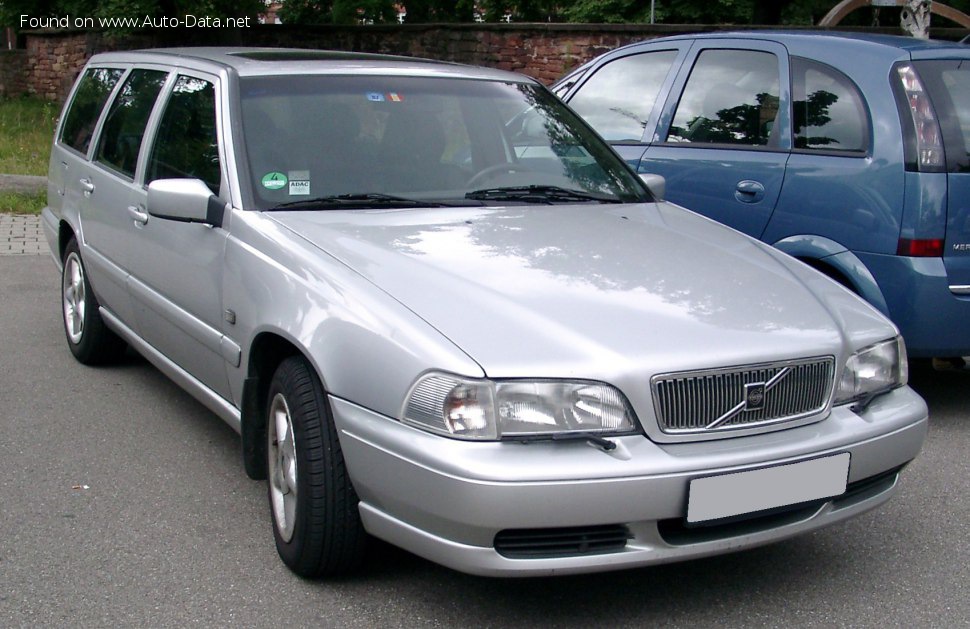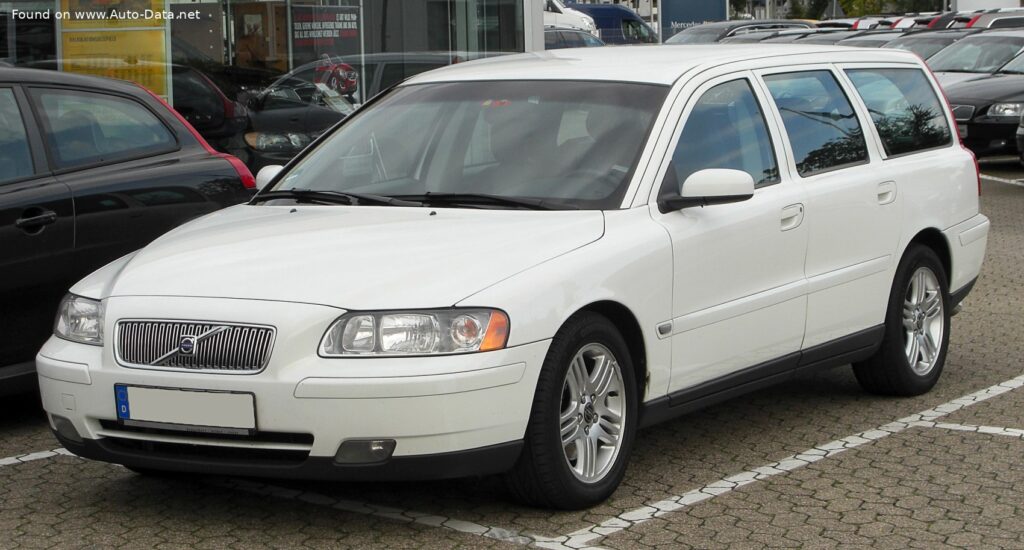
The Volvo V70 II (facelift 2004) 2.4 represents a refinement of Volvo’s popular mid-size station wagon, positioned as a practical and safe family vehicle. Introduced in 2004 as part of a mid-cycle refresh, this version of the V70 continued production through 2007. The V70, in general, served as Volvo’s core offering in the premium wagon segment, competing with vehicles like the Audi A6 Avant, BMW 5 Series Touring, and Mercedes-Benz E-Class Estate, primarily in the European market. While not widely sold in the United States, the V70 exemplified Volvo’s commitment to safety, functionality, and understated Scandinavian design.
Volvo V70 II (Facelift 2004) 2.4: Overview
The V70 II facelift brought subtle but important updates to the second-generation V70, enhancing its aesthetics and refining its mechanical components. The 2.4-liter engine variant, producing 140 horsepower, was a common configuration, offering a balance between fuel economy and adequate performance for everyday driving. This model prioritized comfort and practicality, making it a popular choice for families and individuals needing a versatile vehicle with ample cargo space.
Engine & Performance
The Volvo V70 II 2.4 is powered by a 2.4-liter inline five-cylinder gasoline engine, designated the B5244S2. This naturally aspirated engine produces 140 horsepower at 4500 rpm and 220 Newton-meters (162.26 lb.-ft.) of torque at 3300 rpm. The engine features multi-port fuel injection and a double overhead camshaft (DOHC) valvetrain. Power is delivered to the front wheels via a five-speed manual transmission. Acceleration from 0 to 100 km/h (0-62 mph) takes 10.5 seconds, with a calculated 0-60 mph time of 10 seconds. The vehicle achieves a maximum speed of 205 km/h (127.38 mph). Fuel economy, as measured by the NEDC standard, is rated at 9 liters per 100 kilometers (26.1 US mpg) combined, with 12.4 l/100 km (19 US mpg) in urban conditions and 6.9 l/100 km (34.1 US mpg) on the extra-urban cycle. CO2 emissions are rated at 214 g/km, meeting Euro 4 emission standards.
Design & Features
The V70 II (facelift 2004) maintains the classic Volvo station wagon profile – a long roofline extending to a vertically oriented tailgate. The 2004 facelift included minor cosmetic changes to the front and rear fascias, headlights, and grille, giving the car a more contemporary appearance. The interior is characterized by its functional design and emphasis on comfort. The V70 offers seating for five passengers and provides a generous 485 liters (17.13 cu. ft.) of trunk space with the rear seats up, expanding to 1641 liters (57.95 cu. ft.) when the rear seats are folded down. Safety features, a hallmark of Volvo, include an Anti-lock Braking System (ABS). The vehicle’s kerb weight is 1562 kg (3443.62 lbs), with a maximum permissible weight of 2100 kg (4629.71 lbs). The V70 is equipped with hydraulic power steering and rides on 205/55 R16 tires mounted on 7J x 16 inch wheel rims.
Technical Specifications
| Brand | Volvo |
| Model | V70 |
| Generation | V70 II (facelift 2004) |
| Type (Engine) | 2.4 (140 Hp) |
| Start of production | 2004 |
| End of production | 2007 |
| Powertrain Architecture | Internal Combustion engine |
| Body type | Station wagon (estate) |
| Seats | 5 |
| Doors | 5 |
| Fuel consumption (economy) – urban (NEDC) | 12.4 l/100 km (19 US mpg, 22.8 UK mpg) |
| Fuel consumption (economy) – extra urban (NEDC) | 6.9 l/100 km (34.1 US mpg, 40.9 UK mpg) |
| Fuel consumption (economy) – combined (NEDC) | 9 l/100 km (26.1 US mpg, 31.4 UK mpg) |
| CO2 emissions (NEDC) | 214 g/km |
| Fuel Type | Petrol (Gasoline) |
| Acceleration 0 – 100 km/h | 10.5 sec |
| Acceleration 0 – 62 mph | 10.5 sec |
| Acceleration 0 – 60 mph | 10 sec |
| Maximum speed | 205 km/h (127.38 mph) |
| Emission standard | Euro 4 |
| Weight-to-power ratio | 11.2 kg/Hp |
| Weight-to-torque ratio | 7.1 kg/Nm |
| Power | 140 Hp @ 4500 rpm |
| Torque | 220 Nm @ 3300 rpm (162.26 lb.-ft. @ 3300 rpm) |
| Engine layout | Front, Transverse |
| Engine Model/Code | B5244S2 |
| Engine displacement | 2435 cm3 (148.59 cu. in.) |
| Number of cylinders | 5 |
| Engine configuration | Inline |
| Cylinder Bore | 83 mm (3.27 in.) |
| Piston Stroke | 90 mm (3.54 in.) |
| Number of valves per cylinder | 4 |
| Fuel injection system | Multi-port manifold injection |
| Engine aspiration | Naturally aspirated engine |
| Valvetrain | DOHC |
| Engine oil capacity | 5.5 l (5.81 US qt | 4.84 UK qt) |
| Coolant | 8.8 l (9.3 US qt | 7.74 UK qt) |
| Kerb Weight | 1562 kg (3443.62 lbs.) |
| Max. weight | 2100 kg (4629.71 lbs.) |
| Max load | 538 kg (1186.09 lbs.) |
| Trunk (boot) space – minimum | 485 l (17.13 cu. ft.) |
| Trunk (boot) space – maximum | 1641 l (57.95 cu. ft.) |
| Fuel tank capacity | 70 l (18.49 US gal | 15.4 UK gal) |
| Max. roof load | 100 kg (220.46 lbs.) |
| Permitted trailer load with brakes (12%) | 1800 kg (3968.32 lbs.) |
| Permitted trailer load without brakes | 750 kg (1653.47 lbs.) |
| Permitted towbar download | 75 kg (165.35 lbs.) |
| Length | 4710 mm (185.43 in.) |
| Width | 1804 mm (71.02 in.) |
| Height | 1465 mm (57.68 in.) |
| Wheelbase | 2755 mm (108.46 in.) |
| Front track | 1551 mm (61.06 in.) |
| Rear (Back) track | 1548 mm (60.94 in.) |
| Minimum turning circle (turning diameter) | 11.9 m (39.04 ft.) |
| Drive wheel | Front wheel drive |
| Number of gears and type of gearbox | 5 gears, manual transmission |
| Front suspension | Independent, type McPherson with coil spring and anti-roll bar |
| Rear suspension | Independent multi-link suspension, Transverse stabilizer |
| Front brakes | Ventilated discs |
| Rear brakes | Disc |
| Assisting systems | ABS (Anti-lock braking system) |
| Steering type | Steering rack and pinion |
| Power steering | Hydraulic Steering |
| Tires size | 205/55 R16 |
| Wheel rims size | 7J x 16 |