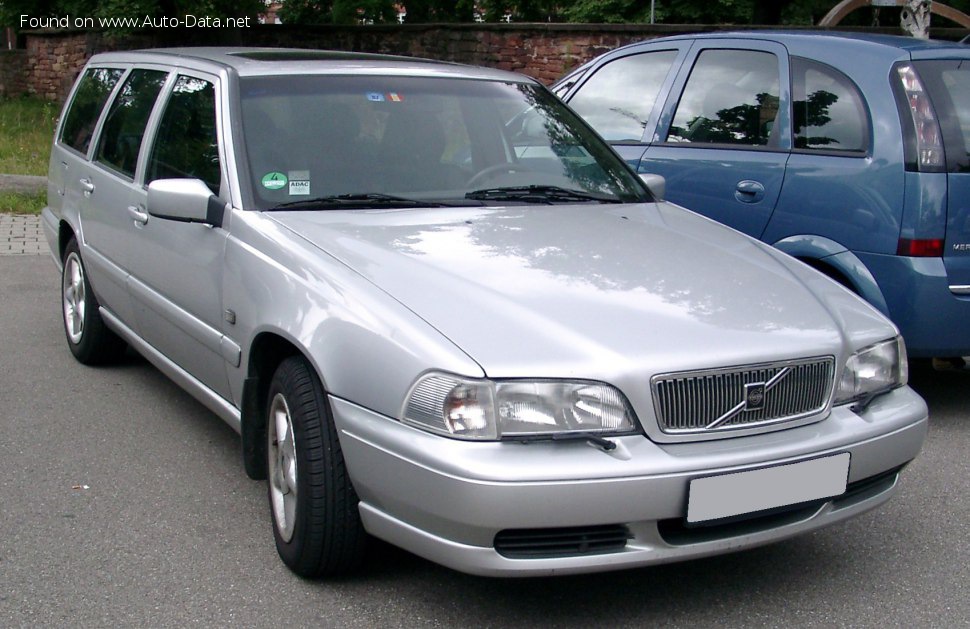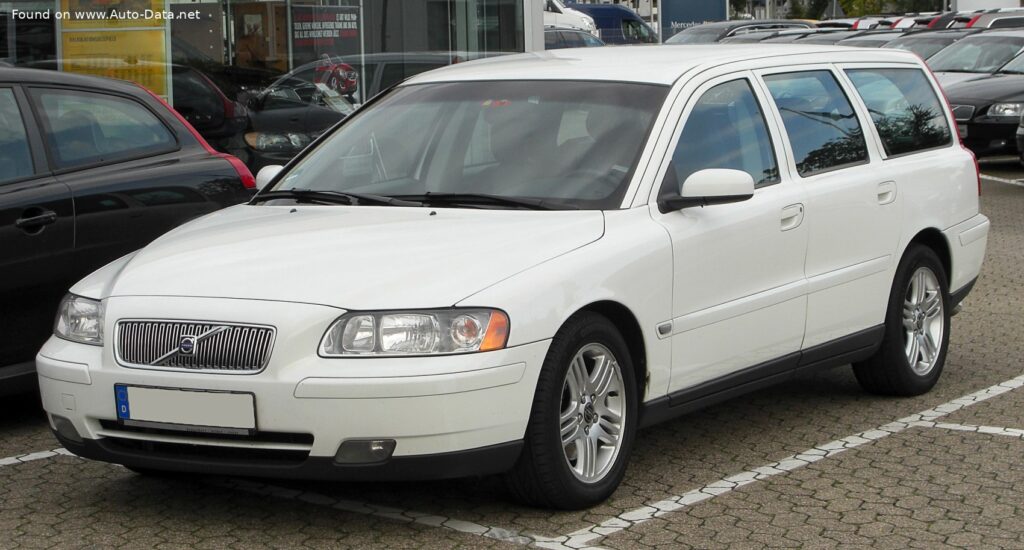
The Volvo V70 II, particularly the facelifted version introduced in 2004, represents Volvo’s commitment to the premium station wagon segment. Positioned above the S60 sedan, the V70 offered a compelling blend of practicality, safety, and Scandinavian design. This generation, produced from 2000 to 2007 (with the facelift spanning 2004-2007), was a key model for Volvo in Europe, where wagons maintain significant popularity. The 2.4 Bi-Fuel variant, discussed here, was specifically engineered to offer an alternative fuel option, primarily utilizing Compressed Natural Gas (CNG) alongside traditional gasoline, catering to markets with CNG infrastructure and incentives.
Volvo V70 II (2004-2007) 2.4 Bi-Fuel: An Overview
The V70 II facelift brought subtle but important changes to the exterior and interior, refining the aesthetics and enhancing the overall driving experience. The 2.4 Bi-Fuel model distinguished itself with the ability to run on either gasoline or CNG, offering potential cost savings and reduced emissions depending on fuel prices and availability. While not widely sold in the United States due to limited CNG infrastructure, the V70 remained a popular choice for families and individuals seeking a versatile and safe vehicle in European markets.
Engine & Performance
The heart of the V70 II 2.4 Bi-Fuel is a 2.4-liter inline five-cylinder engine, designated the B5244SG. This engine produces 140 horsepower at 4500 rpm and 220 Nm (162.26 lb.-ft.) of torque at 3300 rpm when running on gasoline. When switched to CNG, the engine maintains the same 140 horsepower output, albeit at a slightly higher 5800 rpm, with torque reduced to 192 Nm (141.7 lb.-ft.) at 4500 rpm. The engine utilizes multi-port fuel injection and a double overhead camshaft (DOHC) valvetrain. Acceleration from 0 to 100 km/h (0-62 mph) takes 10.5 seconds on gasoline, increasing slightly to 11 seconds on CNG. Top speed is rated at 205 km/h (127.38 mph). The engine’s transverse front-wheel-drive layout and a six-speed manual transmission contribute to a balanced driving experience. The weight-to-power ratio of 11.3 kg/Hp and weight-to-torque ratio of 7.2 kg/Nm indicate a reasonable level of performance for its class.
Design & Features
The V70 II is a five-door station wagon (estate) offering seating for five passengers. Its design prioritizes practicality and functionality, with a spacious interior and a large cargo area. The facelifted model features revised front and rear styling, including updated headlights and taillights. Safety was a paramount concern for Volvo, and the V70 II is equipped with an Anti-lock Braking System (ABS) as standard. The interior is characterized by its clean, Scandinavian design, focusing on ergonomics and comfort. The vehicle offers a generous trunk space of 485 liters (17.13 cu. ft.) with the rear seats up, expanding to a substantial 1641 liters (57.95 cu. ft.) when the rear seats are folded down. Additional features include hydraulic power steering, ventilated front disc brakes, and independent suspension systems – McPherson struts at the front and a multi-link setup at the rear – designed to provide a comfortable ride and stable handling.
Technical Specifications
| Brand | Volvo |
| Model | V70 |
| Generation | V70 II (facelift 2004) |
| Type (Engine) | 2.4 (140 Hp) Bi-Fuel |
| Start of production | 2004 |
| End of production | 2007 |
| Powertrain Architecture | Internal Combustion engine |
| Body type | Station wagon (estate) |
| Seats | 5 |
| Doors | 5 |
| Fuel consumption (economy) – combined (NEDC) | 9 l/100 km |
| Fuel consumption (economy) – combined (CNG) (NEDC) | 7.8 kg/100 km |
| CO2 emissions (NEDC) | 215 g/km |
| CO2 emissions (CNG) (NEDC) | 169 g/km |
| Fuel Type | Petrol / CNG |
| Acceleration 0 – 100 km/h | 10.5 sec |
| Acceleration 0 – 62 mph | 10.5 sec |
| Acceleration 0 – 100 km/h (CNG) | 11 sec |
| Acceleration 0 – 60 mph (Calculated by Auto-Data.net) | 10 sec |
| Maximum speed | 205 km/h (127.38 mph) |
| Emission standard | Euro 4 |
| Weight-to-power ratio | 11.3 kg/Hp |
| Weight-to-torque ratio | 7.2 kg/Nm |
| Power | 140 Hp @ 4500 rpm |
| Power per litre | 57.5 Hp/l |
| Power (CNG) | 140 Hp @ 5800 rpm |
| Power per litre (CNG) | 57.5 Hp/l |
| Torque | 220 Nm @ 3300 rpm (162.26 lb.-ft. @ 3300 rpm) |
| Torque (CNG) | 192 Nm @ 4500 rpm |
| Engine layout | Front, Transverse |
| Engine Model/Code | B5244SG |
| Engine displacement | 2435 cm3 (148.59 cu. in.) |
| Number of cylinders | 5 |
| Engine configuration | Inline |
| Cylinder Bore | 83 mm (3.27 in.) |
| Piston Stroke | 90 mm (3.54 in.) |
| Number of valves per cylinder | 4 |
| Fuel injection system | Multi-port manifold injection |
| Engine aspiration | Naturally aspirated engine |
| Valvetrain | DOHC |
| Engine oil capacity | 5.8 l (6.13 US qt | 5.1 UK qt) |
| Coolant | 8.8 l (9.3 US qt | 7.74 UK qt) |
| Kerb Weight | 1587 kg (3498.74 lbs.) |
| Max. weight | 2150 kg (4739.94 lbs.) |
| Max load | 563 kg (1241.2 lbs.) |
| Trunk (boot) space – minimum | 485 l (17.13 cu. ft.) |
| Trunk (boot) space – maximum | 1641 l (57.95 cu. ft.) |
| Fuel tank capacity | 29 l (7.66 US gal | 6.38 UK gal) |
| CNG cylinder capacity | 17.6 kg |
| Max. roof load | 100 kg (220.46 lbs.) |
| Permitted trailer load with brakes (12%) | 1800 kg (3968.32 lbs.) |
| Permitted trailer load without brakes | 750 kg (1653.47 lbs.) |
| Permitted towbar download | 75 kg (165.35 lbs.) |
| Length | 4710 mm (185.43 in.) |
| Width | 1804 mm (71.02 in.) |
| Height | 1468 mm (57.8 in.) |
| Wheelbase | 2755 mm (108.46 in.) |
| Front track | 1551 mm (61.06 in.) |
| Rear (Back) track | 1548 mm (60.94 in.) |
| Minimum turning circle (turning diameter) | 11.9 m (39.04 ft.) |
| Drive wheel | Front wheel drive |
| Number of gears and type of gearbox | 6 gears, manual transmission |
| Front suspension | Independent, type McPherson with coil spring and anti-roll bar |
| Rear suspension | Independent multi-link suspension, Transverse stabilizer |
| Front brakes | Ventilated discs |
| Rear brakes | Disc |
| Assisting systems | ABS (Anti-lock braking system) |
| Steering type | Steering rack and pinion |
| Power steering | Hydraulic Steering |
| Tires size | 205/55 R16 |
| Wheel rims size | 7J x 16 |