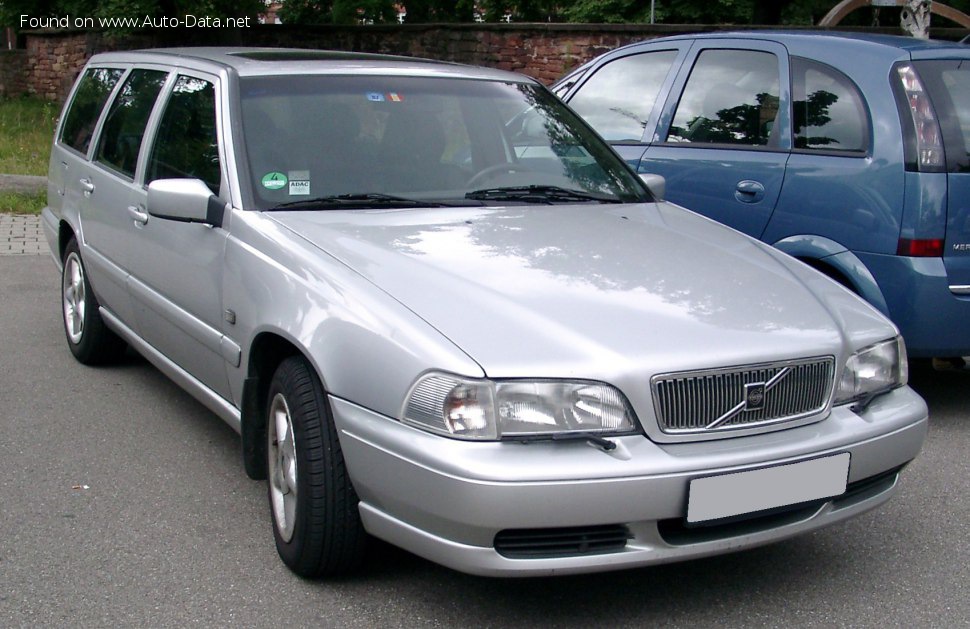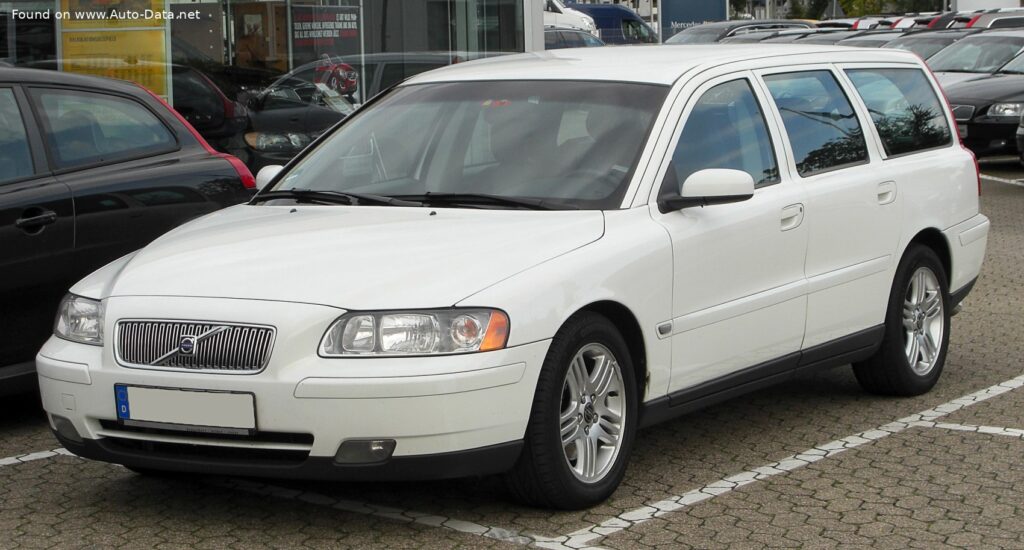
The Volvo V70 II, particularly the facelifted version introduced in 2004, represents a significant evolution in the Swedish automaker’s long-standing tradition of building practical, safe, and comfortable station wagons. Positioned within the mid-size executive car segment, the V70 aimed to provide a compelling alternative to more conventional saloons, offering increased versatility without sacrificing luxury or driving dynamics. The 2.5T variant, equipped with a turbocharged 2.5-liter engine and all-wheel drive (AWD), was a popular choice, balancing performance with efficiency and all-weather capability. Produced from 2004 to 2007, this iteration of the V70 built upon the success of the initial V70 II, refining its design and enhancing its technological offerings.
Volvo V70 II (Facelift 2004) 2.5T: A Detailed Overview
The V70 II, launched in 2000, was a crucial model for Volvo, replacing the original 850 and V70. The 2004 facelift brought subtle but important changes, including revised front and rear styling, updated interior materials, and enhancements to the engine range. The 2.5T model, with its 210 horsepower engine, became a mainstay of the lineup, appealing to buyers who needed a spacious and capable vehicle for both daily commuting and longer journeys. While not a high-volume seller in the United States (Volvo’s wagon sales were always niche), the V70 held a strong position in the European market, where estate cars remain exceptionally popular.
Engine & Performance
The heart of the V70 II 2.5T is Volvo’s B5254T2, a 2.5-liter inline five-cylinder turbocharged petrol engine. This engine produces 210 horsepower at 5000 rpm and 320 Nm (236.02 lb.-ft.) of torque between 1500 and 4500 rpm. The turbocharger and intercooler work in concert to deliver strong acceleration and responsive performance across a wide rev range. Power is delivered to all four wheels via a five-speed automatic transmission marketed as “Geartronic,” offering both fully automatic operation and manual gear selection. This AWD system provides enhanced traction and stability, particularly in adverse weather conditions. Acceleration from 0 to 100 km/h (0-62 mph) takes approximately 8 seconds, while the 0-60 mph sprint is achieved in 7.6 seconds. The V70 2.5T has a top speed of 220 km/h (136.7 mph).
Design & Features
The V70 II is a classically styled station wagon, characterized by its long roofline, spacious interior, and understated elegance. The 2004 facelift brought a revised front grille, headlights, and bumper, giving the car a more contemporary appearance. Inside, the V70 prioritizes comfort and practicality. The cabin is well-appointed, with supportive seats and a user-friendly layout. The rear seats offer ample legroom, and the cargo area is exceptionally versatile, providing 485 liters (17.13 cu. ft.) of space with the rear seats up and a substantial 1641 liters (57.95 cu. ft.) with them folded down. Safety was, and remains, a core Volvo value. The V70 II is equipped with a comprehensive suite of safety features, including ABS (Anti-lock Braking System), side impact protection system (SIPS), and a robust chassis designed to protect occupants in the event of a collision. Other notable features include hydraulic power steering, and a comfortable ride quality.
Technical Specifications
| Brand | Volvo |
| Model | V70 |
| Generation | V70 II (facelift 2004) |
| Type (Engine) | 2.5T (210 Hp) AWD Geartronic |
| Start of production | 2004 |
| End of production | 2007 |
| Powertrain Architecture | Internal Combustion engine |
| Body type | Station wagon (estate) |
| Seats | 5 |
| Doors | 5 |
| Fuel consumption (urban) | 14.8 l/100 km (15.9 US mpg, 19.1 UK mpg, 6.8 km/l) |
| Fuel consumption (extra urban) | 8.2 l/100 km (28.7 US mpg, 34.4 UK mpg, 12.2 km/l) |
| Fuel consumption (combined) | 10.6 l/100 km (22.2 US mpg, 26.6 UK mpg, 9.4 km/l) |
| CO2 emissions | 255 g/km |
| Fuel Type | Petrol (Gasoline) |
| Acceleration 0 – 100 km/h | 8 sec |
| Acceleration 0 – 62 mph | 8 sec |
| Acceleration 0 – 60 mph | 7.6 sec |
| Maximum speed | 220 km/h (136.7 mph) |
| Emission standard | Euro 4 |
| Weight-to-power ratio | 7.9 kg/Hp, 126.1 Hp/tonne |
| Weight-to-torque ratio | 5.2 kg/Nm, 192.1 Nm/tonne |
| Power | 210 Hp @ 5000 rpm |
| Power per litre | 83.3 Hp/l |
| Torque | 320 Nm @ 1500-4500 rpm (236.02 lb.-ft. @ 1500-4500 rpm) |
| Engine layout | Front, Transverse |
| Engine Model/Code | B5254T2 |
| Engine displacement | 2521 cm3 (153.84 cu. in.) |
| Number of cylinders | 5 |
| Engine configuration | Inline |
| Cylinder Bore | 83 mm (3.27 in.) |
| Piston Stroke | 93.2 mm (3.67 in.) |
| Number of valves per cylinder | 4 |
| Fuel injection system | Multi-port manifold injection |
| Engine aspiration | Turbocharger, Intercooler |
| Valvetrain | DOHC |
| Engine oil capacity | 5.5 l (5.81 US qt | 4.84 UK qt) |
| Kerb Weight | 1666 kg (3672.9 lbs.) |
| Max. weight | 2200 kg (4850.17 lbs.) |
| Max load | 534 kg (1177.27 lbs.) |
| Trunk (boot) space – minimum | 485 l (17.13 cu. ft.) |
| Trunk (boot) space – maximum | 1641 l (57.95 cu. ft.) |
| Fuel tank capacity | 72 l (19.02 US gal | 15.84 UK gal) |
| Max. roof load | 100 kg (220.46 lbs.) |
| Permitted trailer load with brakes (12%) | 1800 kg (3968.32 lbs.) |
| Permitted trailer load without brakes | 750 kg (1653.47 lbs.) |
| Permitted towbar download | 75 kg (165.35 lbs.) |
| Length | 4710 mm (185.43 in.) |
| Width | 1804 mm (71.02 in.) |
| Height | 1490 mm (58.66 in.) |
| Wheelbase | 2755 mm (108.46 in.) |
| Front track | 1551 mm (61.06 in.) |
| Rear track | 1548 mm (60.94 in.) |
| Minimum turning circle | 11.9 m (39.04 ft.) |
| Drivetrain Architecture | All wheel drive (4×4). ICE drives front wheels, rear wheels engaged via clutch. |
| Number of gears and type of gearbox | 5 gears, automatic transmission Geartronic |
| Front suspension | Independent, McPherson with coil spring and anti-roll bar |
| Rear suspension | Independent multi-link suspension, Transverse stabilizer |
| Front brakes | Ventilated discs |
| Rear brakes | Disc |
| Assisting systems | ABS (Anti-lock braking system) |
| Steering type | Steering rack and pinion |
| Power steering | Hydraulic Steering |
| Tires size | 205/55 R16 |
| Wheel rims size | 7J x 16 |
The Volvo V70 II 2.5T AWD Geartronic remains a compelling choice for those seeking a practical, safe, and comfortable station wagon. Its blend of performance, versatility, and Scandinavian design continues to appeal to a dedicated following.