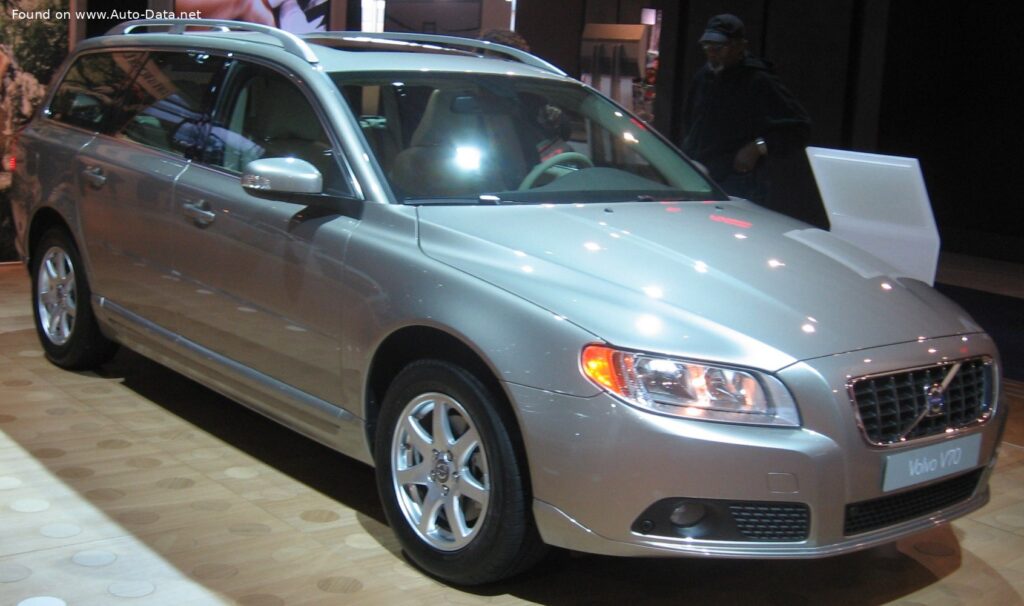
The Volvo V70 III 2.0 T (203 Hp) Automatic, produced between 2010 and 2011, represents the third generation of Volvo’s popular station wagon. Positioned within the mid-size executive wagon segment, the V70 aimed to blend practicality, comfort, and Scandinavian design with a focus on safety – hallmarks of the Volvo brand. While not officially sold in the United States during this generation, the V70 was a significant model in Europe, competing with vehicles like the Audi A6 Avant, BMW 5 Series Touring, and Mercedes-Benz E-Class Estate. This iteration offered a refined driving experience and a spacious interior, catering to families and individuals needing a versatile vehicle.
Volvo V70 III 2.0 T: An Overview
The V70 III, built on the Volvo P24 platform shared with other Volvo models of the era (like the S80 and XC70), continued Volvo’s tradition of building robust and reliable wagons. The 2.0 T variant, equipped with a turbocharged four-cylinder engine and an automatic transmission, provided a balance between performance and fuel efficiency. It was designed to appeal to buyers who prioritized a comfortable ride and ample cargo space over outright sportiness. The model year 2010-2011 saw minor refinements to the V70 III, focusing on improving interior materials and enhancing the overall driving experience.
Engine & Performance
The heart of the V70 III 2.0 T is a 2.0-liter inline four-cylinder engine, designated the B4204T6. This engine utilizes direct fuel injection and a turbocharger with an intercooler to produce 203 horsepower at 6000 rpm and 300 Nm (221.27 lb.-ft.) of torque between 1740 and 4020 rpm. The engine’s power-to-liter ratio is a respectable 101.6 hp/l. Power is delivered to the front wheels via a six-speed automatic transmission. This combination allows for a 0-100 km/h (0-62 mph) acceleration time of 8.9 seconds, and a 0-60 mph time of approximately 8.5 seconds, with a maximum speed of 225 km/h (139.81 mph). The weight-to-power ratio of 8.9 kg/Hp and a weight-to-torque ratio of 6 kg/Nm contribute to a responsive, if not overtly sporty, driving experience. Fuel consumption is rated at 8.5 l/100 km (27.7 US mpg), with CO2 emissions of 195 g/km.
Design & Features
The Volvo V70 III maintains the classic Volvo station wagon profile – a long roofline extending from the windshield to the rear, maximizing cargo capacity. The body type is a five-door, five-seat station wagon (estate). Its exterior design is characterized by clean lines and a relatively understated elegance, typical of Scandinavian design principles. Inside, the V70 III offers a spacious and comfortable cabin, with a focus on ergonomics and practicality. Key features include a generous trunk space of 575 liters (20.31 cu. ft.) minimum, which can be expanded by folding down the rear seats. Safety features, a Volvo hallmark, are comprehensive, including ABS (Anti-lock Braking System) and a robust chassis designed to protect occupants in the event of a collision. The vehicle’s dimensions are: length 4823 mm (189.88 in.), width 1907 mm (75.08 in.) with mirrors folded, and height 1547 mm (60.91 in.). The curb weight is 1803 kg (3974.93 lbs), with a maximum permissible weight of 2410 kg (5313.14 lbs).
Technical Specifications
| Brand | Volvo |
| Model | V70 |
| Generation | V70 III |
| Type (Engine) | 2.0 T (203 Hp) Automatic |
| Start of production | 2010 |
| End of production | 2011 |
| Powertrain Architecture | Internal Combustion engine |
| Body type | Station wagon (estate) |
| Seats | 5 |
| Doors | 5 |
| Fuel consumption (combined) | 8.5 l/100 km |
| Fuel consumption (US mpg) | 27.7 US mpg |
| Fuel consumption (UK mpg) | 33.2 UK mpg |
| CO2 emissions | 195 g/km |
| Fuel Type | Petrol (Gasoline) |
| Acceleration 0 – 100 km/h | 8.9 sec |
| Acceleration 0 – 62 mph | 8.9 sec |
| Acceleration 0 – 60 mph | 8.5 sec |
| Maximum speed | 225 km/h (139.81 mph) |
| Power | 203 Hp @ 6000 rpm |
| Torque | 300 Nm @ 1740-4020 rpm (221.27 lb.-ft. @ 1740-4020 rpm) |
| Maximum engine speed | 6500 rpm |
| Engine layout | Front, Transverse |
| Engine Model/Code | B4204T6 |
| Engine displacement | 1999 cm3 (121.99 cu. in.) |
| Number of cylinders | 4 |
| Engine configuration | Inline |
| Cylinder Bore | 87.5 mm (3.44 in.) |
| Piston Stroke | 83.1 mm (3.27 in.) |
| Compression ratio | 10:1 |
| Number of valves per cylinder | 4 |
| Fuel injection system | Direct injection |
| Engine aspiration | Turbocharger, Intercooler |
| Valvetrain | DOHC |
| Engine oil capacity | 5.4 l (5.71 US qt | 4.75 UK qt) |
| Kerb Weight | 1803 kg (3974.93 lbs.) |
| Max. weight | 2410 kg (5313.14 lbs.) |
| Max load | 607 kg (1338.21 lbs.) |
| Trunk (boot) space – minimum | 575 l (20.31 cu. ft.) |
| Fuel tank capacity | 70 l (18.49 US gal | 15.4 UK gal) |
| Max. roof load | 100 kg (220.46 lbs.) |
| Permitted trailer load with brakes (12%) | 1800 kg (3968.32 lbs.) |
| Permitted trailer load without brakes | 750 kg (1653.47 lbs.) |
| Length | 4823 mm (189.88 in.) |
| Width with mirrors folded | 1907 mm (75.08 in.) |
| Width including mirrors | 2106 mm (82.91 in.) |
| Height | 1547 mm (60.91 in.) |
| Wheelbase | 2816 mm (110.87 in.) |
| Front track | 1588 mm (62.52 in.) |
| Rear (Back) track | 1586 mm (62.44 in.) |
| Ride height (ground clearance) | 151 mm (5.94 in.) |
| Drag coefficient (Cd) | 0.31 |
| Minimum turning circle (turning diameter) | 11.7 m (38.39 ft.) |
| Drivetrain Architecture | Front wheel drive |
| Number of gears and type of gearbox | 6 gears, automatic transmission |
| Front suspension | Independent, type McPherson with coil spring and anti-roll bar |
| Rear suspension | Independent coil spring |
| Front brakes | Ventilated discs |
| Rear brakes | Disc |
The Volvo V70 III 2.0 T Automatic offered a compelling package for buyers seeking a practical, comfortable, and safe station wagon. While not a performance leader, its blend of efficiency, space, and Volvo’s renowned safety features made it a popular choice in the European market.