
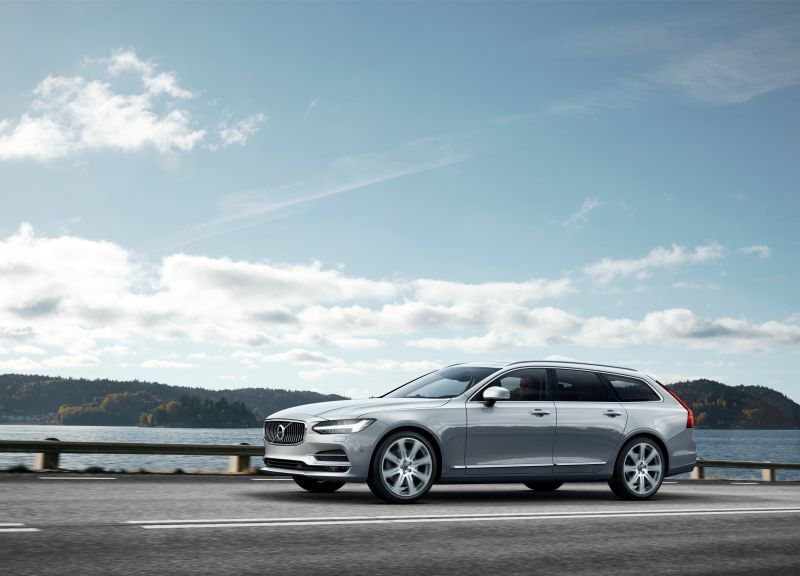
The Volvo V90, introduced in 2016, represents Volvo’s entry into the premium mid-size wagon segment. Positioned above the V60 and V40, the V90 aimed to combine practicality, luxury, and Scandinavian design. Built on Volvo’s Scalable Product Architecture (SPA) platform, it shares its underpinnings with the XC90 SUV and S90 sedan. The V90 was primarily marketed in Europe and other international markets, offering a sophisticated alternative to more conventional estate cars and SUVs. This article focuses on the 2016-2018 model year V90 equipped with the 2.0 D4 diesel engine, producing 190 horsepower.
Volvo V90 2.0 D4 (2016-2018): An Overview
The V90 2.0 D4 is a front-wheel-drive station wagon powered by a 2.0-liter turbocharged diesel engine. It was designed to appeal to buyers seeking a refined and spacious vehicle with excellent fuel economy. The D4 variant offered a balance between performance and efficiency, making it a popular choice in European markets where diesel engines were prevalent. The V90 distinguished itself through its elegant exterior styling, luxurious interior, and a comprehensive suite of safety features, embodying Volvo’s commitment to innovation and passenger protection.
Engine & Performance
The heart of the V90 2.0 D4 is a 2.0-liter inline-four cylinder diesel engine, designated D4204T14. This engine utilizes twin-turbocharging and a diesel commonrail fuel injection system to deliver a power output of 190 horsepower at 4250 rpm and 400 Nm (295.02 lb.-ft.) of torque between 1750 and 2500 rpm. The engine’s displacement is 1969 cm³ (120.16 cu. in.), resulting in a power-to-liter ratio of 96.5 hp/l. The engine is transversely mounted at the front of the vehicle. Acceleration from 0 to 100 km/h (0-62 mph) takes 8.5 seconds, while 0-60 mph is achieved in approximately 8.1 seconds. The V90 D4 has a maximum speed of 225 km/h (139.81 mph). Fuel consumption is rated at 4.5 l/100 km (52.3 US mpg, 62.8 UK mpg, 22.2 km/l), with CO2 emissions of 119 g/km, meeting Euro 6 emission standards.
Design & Features
The Volvo V90 boasts a sleek and contemporary station wagon design, characterized by its long roofline, sculpted body panels, and distinctive “Thor’s Hammer” LED daytime running lights. The vehicle’s interior is a hallmark of Scandinavian design, emphasizing simplicity, functionality, and high-quality materials. The cabin is spacious and comfortable, offering seating for five passengers. Key features include a large touchscreen infotainment system, a premium sound system, leather upholstery, and a panoramic sunroof.
Safety is paramount in Volvo’s design philosophy, and the V90 is equipped with a comprehensive suite of advanced safety technologies. These include City Safety (collision avoidance system), Pilot Assist (semi-autonomous driving assistance), Lane Keeping Aid, and Adaptive Cruise Control. The V90 also features a robust chassis and advanced braking systems, ensuring a secure and confident driving experience. The trunk offers a minimum capacity of 560 liters (19.78 cu. ft.), expanding to 1526 liters (53.89 cu. ft.) with the rear seats folded down.
Technical Specifications
| Brand | Volvo |
| Model | V90 |
| Generation | V90 (2016) |
| Type (Engine) | 2.0 D4 (190 Hp) |
| Start of production | 2016 |
| End of production | 2018 |
| Powertrain Architecture | Internal Combustion engine |
| Body type | Station wagon (estate) |
| Seats | 5 |
| Doors | 5 |
| Fuel consumption (combined) | 4.5 l/100 km |
| Fuel consumption (US mpg) | 52.3 US mpg |
| Fuel consumption (UK mpg) | 62.8 UK mpg |
| CO2 emissions | 119 g/km |
| Fuel Type | Diesel |
| Acceleration 0 – 100 km/h | 8.5 sec |
| Acceleration 0 – 62 mph | 8.5 sec |
| Acceleration 0 – 60 mph | 8.1 sec |
| Maximum speed | 225 km/h (139.81 mph) |
| Power | 190 Hp @ 4250 rpm |
| Torque | 400 Nm @ 1750-2500 rpm (295.02 lb.-ft. @ 1750-2500 rpm) |
| Maximum engine speed | 5000 rpm |
| Engine layout | Front, Transverse |
| Engine Model/Code | D4204T14 |
| Engine displacement | 1969 cm3 (120.16 cu. in.) |
| Number of cylinders | 4 |
| Engine configuration | Inline |
| Cylinder Bore | 82 mm (3.23 in.) |
| Piston Stroke | 93.2 mm (3.67 in.) |
| Compression ratio | 15.8:1 |
| Number of valves per cylinder | 4 |
| Fuel injection system | Diesel Commonrail |
| Engine aspiration | Twin-Turbo, Intercooler |
| Valvetrain | DOHC |
| Engine oil capacity | 5.2 l (5.49 US qt | 4.58 UK qt) |
| Trunk (boot) space – minimum | 560 l (19.78 cu. ft.) |
| Trunk (boot) space – maximum | 1526 l (53.89 cu. ft.) |
| Fuel tank capacity | 55 l (14.53 US gal | 12.1 UK gal) |
| Max. roof load | 100 kg (220.46 lbs.) |
| Permitted trailer load with brakes (12%) | 1800 kg (3968.32 lbs.) |
| Permitted trailer load without brakes | 750 kg (1653.47 lbs.) |
| Length | 4936 mm (194.33 in.) |
| Width | 1879 mm (73.98 in.) |
| Width with mirrors folded | 1895 mm (74.61 in.) |
| Width including mirrors | 2019 mm (79.49 in.) |
| Height | 1475 mm (58.07 in.) |
| Wheelbase | 2941 mm (115.79 in.) |
| Front track | 1617-1628 mm (63.66 – 64.09 in.) |
| Rear (Back) track | 1618-1629 mm (63.7 – 64.13 in.) |
| Ride height (ground clearance) | 153 mm (6.02 in.) |
| Drag coefficient (Cd) | 0.30-0.33 |
| Minimum turning circle (turning diameter) | 11.4 m (37.4 ft.) |
| Wading depth | 250 mm (9.84 in.) |
| Drivetrain Architecture | ICE drives front wheels |
| Drive wheel | Front wheel drive |
| Number of gears and type of gearbox | 6 gears, manual transmission |
| Front suspension | Double wishbone |
| Rear suspension | Independent multi-link spring suspension with stabilizer |
| Front brakes | Ventilated discs |
| Rear brakes | Disc |
| Assisting systems | ABS (Anti-lock braking system) |
| Steering type | Steering rack and pinion |
| Power steering | Electric Steering |
| Tires size | 225/55 R17 |
| Wheel rims size | 17 |
