
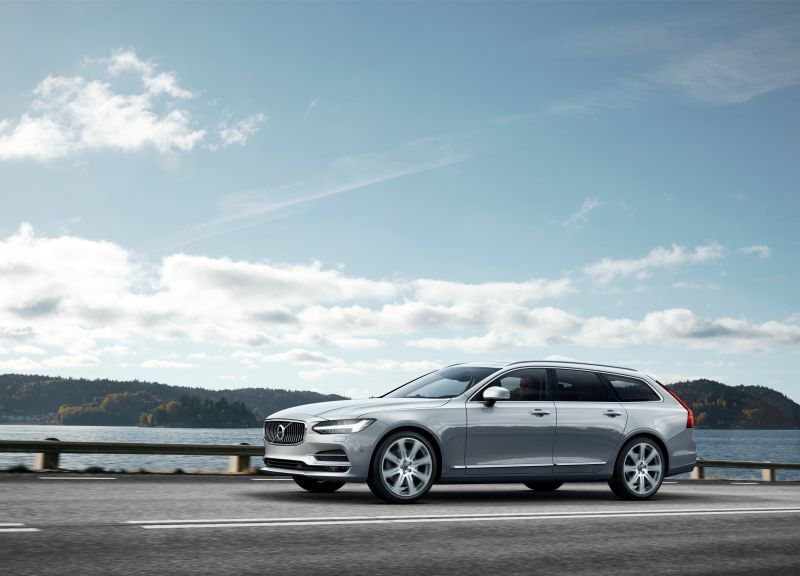
The Volvo V90, introduced in 2016, represents Volvo’s entry into the premium mid-size wagon segment. Positioned above the V60 and V40, the V90 aimed to combine practicality, luxury, and Scandinavian design. Built on Volvo’s Scalable Product Architecture (SPA) platform, it shares its underpinnings with the XC90 and S90 models. The V90 was not initially a high-volume seller in the United States, where wagons have a smaller market share, but it appealed to buyers seeking an alternative to traditional SUVs. This article focuses on the 2017-2018 model year V90 equipped with the 2.0 T4 engine.
Volvo V90 2.0 T4 (2016-2018): An Overview
The V90 2.0 T4, produced from 2017 to 2018, offered a balance of performance and efficiency within the V90 lineup. It served as the entry-level powertrain option, providing a more accessible price point while still delivering the Volvo brand’s signature refinement and safety features. The T4 designation indicates a turbocharged 2.0-liter four-cylinder engine, tuned to produce 190 horsepower. This model primarily targeted European markets, where wagons remain a popular body style, and was offered in limited quantities in North America.
Engine & Performance
The heart of the V90 2.0 T4 is a 2.0-liter inline-four cylinder engine, designated the B4204T31. This engine utilizes direct fuel injection and a turbocharger with an intercooler to achieve a power output of 190 horsepower at 5000 rpm and 300 Nm (221.27 lb.-ft.) of torque between 1600 and 4000 rpm. The engine’s power-to-liter ratio is 96.5 hp/l. Power is delivered to the front wheels via an eight-speed automatic transmission. This combination allows for a 0-100 km/h (0-62 mph) acceleration time of 8.9 seconds, and a calculated 0-60 mph time of 8.5 seconds. The V90 2.0 T4 has a maximum speed of 210 km/h (130.49 mph). Fuel economy is rated at 6.8 l/100 km (34.6 US mpg) combined, with 8.9 l/100 km (26.4 US mpg) in urban driving and 5.6 l/100 km (42 US mpg) on the extra-urban cycle. CO2 emissions are rated at 158 g/km, meeting Euro 6 emission standards.
Design & Features
The Volvo V90 is a five-door, five-seat station wagon (estate) characterized by its elegant and understated Scandinavian design. The exterior features clean lines, a sloping roofline, and distinctive “Thor’s Hammer” LED headlights. The interior is focused on minimalist luxury, with high-quality materials and a spacious cabin. Key features include comfortable seating, a large panoramic sunroof (optional), and a user-friendly infotainment system with a vertically oriented touchscreen. Safety is a paramount concern for Volvo, and the V90 2.0 T4 is equipped with a comprehensive suite of safety technologies, including ABS (Anti-lock Braking System), stability control, and a range of driver-assistance systems such as lane keeping assist and automatic emergency braking. The trunk offers a minimum capacity of 560 liters (19.78 cu. ft.), providing ample space for luggage and cargo. The fuel tank capacity is 55 liters (14.53 US gal).
Technical Specifications
| Brand | Volvo |
| Model | V90 |
| Generation | V90 (2016) |
| Type (Engine) | 2.0 T4 (190 Hp) Automatic |
| Start of production | 2017 |
| End of production | 2018 |
| Powertrain Architecture | Internal Combustion engine |
| Body type | Station wagon (estate) |
| Seats | 5 |
| Doors | 5 |
| Fuel consumption (urban) | 8.9 l/100 km (26.4 US mpg) |
| Fuel consumption (extra urban) | 5.6 l/100 km (42 US mpg) |
| Fuel consumption (combined) | 6.8 l/100 km (34.6 US mpg) |
| CO2 emissions | 158 g/km |
| Fuel Type | Petrol (Gasoline) |
| Acceleration 0 – 100 km/h | 8.9 sec |
| Acceleration 0 – 62 mph | 8.9 sec |
| Acceleration 0 – 60 mph | 8.5 sec |
| Maximum speed | 210 km/h (130.49 mph) |
| Emission standard | Euro 6 |
| Weight-to-power ratio | 9.4 kg/Hp |
| Weight-to-torque ratio | 6 kg/Nm |
| Power | 190 Hp @ 5000 rpm |
| Torque | 300 Nm @ 1600-4000 rpm (221.27 lb.-ft.) |
| Engine layout | Front, Transverse |
| Engine Model/Code | B4204T31 |
| Engine displacement | 1969 cm3 (120.16 cu. in.) |
| Number of cylinders | 4 |
| Engine configuration | Inline |
| Cylinder Bore | 82 mm (3.23 in.) |
| Piston Stroke | 93.2 mm (3.67 in.) |
| Number of valves per cylinder | 4 |
| Fuel injection system | Direct injection |
| Engine aspiration | Turbocharger, Intercooler |
| Valvetrain | DOHC |
| Engine oil capacity | 5.6 l (5.92 US qt | 4.93 UK qt) |
| Kerb Weight | 1785 kg (3935.25 lbs.) |
| Max. weight | 2300 kg (5070.63 lbs.) |
| Max load | 515 kg (1135.38 lbs.) |
| Trunk (boot) space – minimum | 560 l (19.78 cu. ft.) |
| Fuel tank capacity | 55 l (14.53 US gal | 12.1 UK gal) |
| Length | 4936 mm (194.33 in.) |
| Width | 1879 mm (73.98 in.) |
| Width including mirrors | 2019 mm (79.49 in.) |
| Height | 1475 mm (58.07 in.) |
| Wheelbase | 2941 mm (115.79 in.) |
| Front track | 1628 mm (64.09 in.) |
| Rear (Back) track | 1629 mm (64.13 in.) |
| Minimum turning circle | 11.4 m (37.4 ft.) |
| Drivetrain Architecture | Front wheel drive |
| Number of gears | 8 |
| Type of gearbox | Automatic transmission |
| Front brakes | Ventilated discs |
| Rear brakes | Disc |
| Steering type | Steering rack and pinion |
| Power steering | Electric Steering |
The Volvo V90 2.0 T4 offered a compelling package for buyers seeking a stylish, practical, and safe wagon. While not a mainstream success in all markets, it solidified Volvo’s commitment to offering alternatives to the ubiquitous SUV and showcased the brand’s dedication to Scandinavian design and engineering.
