
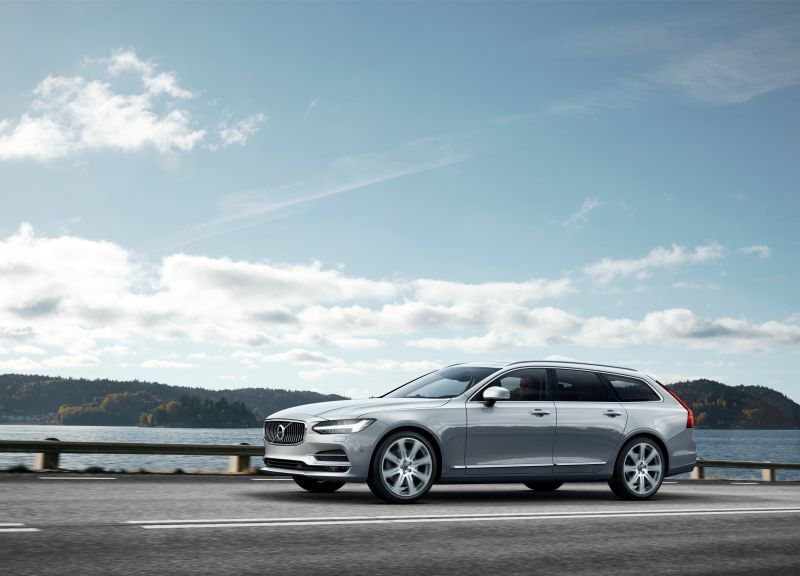
The Volvo V90, introduced for the 2017 model year, represents Volvo’s entry into the premium mid-size wagon segment. Building upon the success of the XC90 SUV, the V90 aimed to deliver the same Scandinavian luxury, safety, and technology in a more practical, estate body style. While not officially sold in the United States during its initial production run (2017-2018), the V90 was a significant model in Europe and other international markets, competing with vehicles like the Audi A6 Avant, BMW 5 Series Touring, and Mercedes-Benz E-Class Wagon. The 2.0 T6 AWD Automatic variant, detailed here, was a key offering, combining a potent turbocharged and supercharged engine with Volvo’s all-wheel-drive system.
Volvo V90 2.0 T6 (2016-2018): A Detailed Overview
The V90, part of Volvo’s 90 series, was designed to appeal to buyers seeking a sophisticated and versatile vehicle. It shared its Scalable Product Architecture (SPA) platform with the XC90 and S90, allowing for a high degree of engineering commonality and flexibility. The wagon body style offered a compelling alternative to the growing popularity of SUVs, providing ample cargo space and a more engaging driving experience. The T6 designation indicates a specific engine configuration, in this case, a 2.0-liter four-cylinder engine augmented by both a turbocharger and a supercharger, delivering a substantial power output.
Engine & Performance
The heart of the V90 2.0 T6 is Volvo’s Drive-E powertrain. This 2.0-liter inline-four cylinder engine (model code B4204T29) produces 310 horsepower at 5700 rpm and 400 Nm (295.02 lb.-ft.) of torque between 2200 and 5100 rpm. The combination of a turbocharger and a supercharger is crucial; the supercharger provides immediate low-end boost, eliminating turbo lag, while the turbocharger sustains power at higher engine speeds. This results in a responsive and linear power delivery. The engine features direct fuel injection and a double overhead camshaft (DOHC) valvetrain with four valves per cylinder. The engine displaces 1969 cm³ (120.16 cu. in.) and boasts a power-to-liter ratio of 157.4 hp/l. Power is delivered to all four wheels via an eight-speed automatic transmission and Volvo’s all-wheel-drive system. This configuration allows for a 0-60 mph (0-96 km/h) acceleration time of approximately 5.8 seconds and a 0-100 km/h (0-62 mph) time of 6.1 seconds, with a governed top speed of 250 km/h (155.34 mph). The weight-to-power ratio is 6.1 kg/Hp, and the weight-to-torque ratio is 4.7 kg/Nm.
Design & Features
The Volvo V90 is a five-door, five-seat station wagon (estate). Its exterior design embodies Volvo’s contemporary Scandinavian aesthetic, characterized by clean lines, a minimalist approach, and the distinctive “Thor’s Hammer” LED daytime running lights. The long roofline and sloping rear window contribute to a sleek and elegant profile. Inside, the V90 prioritizes comfort and luxury. The cabin is adorned with high-quality materials, including wood trim, leather upholstery, and metal accents. A large, vertically oriented touchscreen dominates the center console, controlling most of the vehicle’s functions. Standard and available features included a panoramic sunroof, premium audio system, heated and ventilated front seats, and a suite of advanced driver-assistance systems (ADAS). Safety was, as always with Volvo, a paramount concern. The V90 2.0 T6 came equipped with ABS, stability control, and a comprehensive airbag system. The Euro 6 emission standard was met, with CO2 emissions of 179 g/km.
Technical Specifications
| Brand | Volvo |
| Model | V90 |
| Generation | V90 (2016) |
| Type (Engine) | 2.0 T6 (310 Hp) AWD Automatic |
| Start of production | 2017 |
| End of production | 2018 |
| Powertrain Architecture | Internal Combustion engine |
| Body type | Station wagon (estate) |
| Seats | 5 |
| Doors | 5 |
| Fuel consumption (urban) | 9.9 l/100 km (23.8 US mpg, 28.5 UK mpg, 10.1 km/l) |
| Fuel consumption (extra urban) | 6.4 l/100 km (36.8 US mpg, 44.1 UK mpg, 15.6 km/l) |
| Fuel consumption (combined) | 7.7 l/100 km (30.5 US mpg, 36.7 UK mpg, 13 km/l) |
| CO2 emissions | 179 g/km |
| Fuel Type | Petrol (Gasoline) |
| Acceleration 0 – 100 km/h | 6.1 sec |
| Acceleration 0 – 62 mph | 6.1 sec |
| Acceleration 0 – 60 mph | 5.8 sec |
| Maximum speed | 250 km/h (155.34 mph) |
| Emission standard | Euro 6 |
| Weight-to-power ratio | 6.1 kg/Hp |
| Weight-to-torque ratio | 4.7 kg/Nm |
| Power | 310 Hp @ 5700 rpm |
| Torque | 400 Nm @ 2200-5100 rpm (295.02 lb.-ft. @ 2200-5100 rpm) |
| Engine layout | Front, Transverse |
| Engine Model/Code | B4204T29 |
| Engine displacement | 1969 cm3 (120.16 cu. in.) |
| Number of cylinders | 4 |
| Engine configuration | Inline |
| Cylinder Bore | 82 mm (3.23 in.) |
| Piston Stroke | 93.2 mm (3.67 in.) |
| Number of valves per cylinder | 4 |
| Fuel injection system | Direct injection |
| Engine aspiration | Turbocharger, Intercooler |
| Valvetrain | DOHC |
| Engine oil capacity | 5.6 l (5.92 US qt | 4.93 UK qt) |
| Kerb Weight | 1890 kg (4166.74 lbs.) |
| Max. weight | 2400 kg (5291.09 lbs.) |
| Max load | 510 kg (1124.36 lbs.) |
| Trunk (boot) space – minimum | 560 l (19.78 cu. ft.) |
| Fuel tank capacity | 60 l (15.85 US gal | 13.2 UK gal) |
| Length | 4936 mm (194.33 in.) |
| Width | 1879 mm (73.98 in.) |
| Width including mirrors | 2019 mm (79.49 in.) |
| Height | 1475 mm (58.07 in.) |
| Wheelbase | 2941 mm (115.79 in.) |
| Front track | 1628 mm (64.09 in.) |
| Rear (Back) track | 1629 mm (64.13 in.) |
| Minimum turning circle | 11.4 m (37.4 ft.) |
| Drive wheel | All wheel drive (4×4) |
| Number of gears | 8 |
| Type of gearbox | automatic transmission |
| Front brakes | Ventilated discs |
| Rear brakes | Disc |
| Steering type | Steering rack and pinion |
| Power steering | Electric Steering |
