
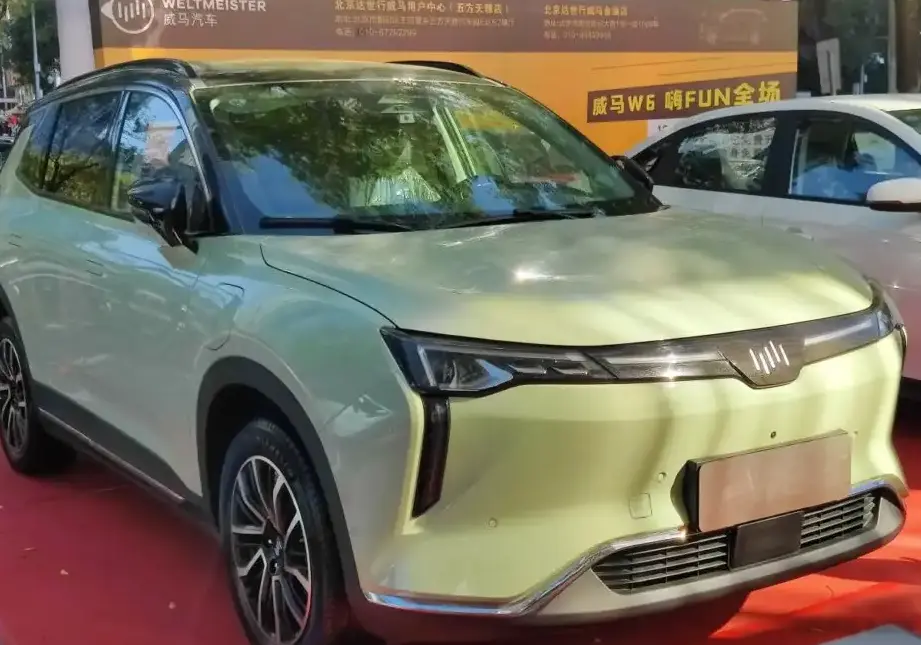
The Weltmeister W6 79 kWh, producing 218 horsepower, was an all-electric compact SUV produced by the Chinese manufacturer Weltmeister (now WM Motor) between January 2021 and 2022. Positioned as a mid-range offering in the W6 lineup, it represented Weltmeister’s attempt to enter the burgeoning electric vehicle market with a vehicle focused on range and practicality. The W6 was designed to compete with established and emerging EV manufacturers, primarily targeting the Chinese domestic market, though export ambitions were considered. It utilized a dedicated electric vehicle platform and showcased a relatively advanced suite of technology for its price point.
Technical Specifications
| Brand | Weltmeister |
| Model | W6 |
| Generation | W6 |
| Type (Engine) | 79 kWh (218 Hp) Electric |
| Start of production | January, 2021 |
| End of production | 2022 |
| Powertrain Architecture | BEV (Electric Vehicle) |
| Body type | SUV, Crossover |
| Seats | 5 |
| Doors | 5 |
| Fuel Type | Electricity |
| Acceleration 0 – 100 km/h | 8.8 sec |
| Acceleration 0 – 62 mph | 8.8 sec |
| Acceleration 0 – 60 mph | 8.4 sec |
| Gross battery capacity | 79 kWh |
| Battery technology | Lithium-ion (Li-Ion) |
| Battery location | Below the floor |
| All-electric range (NEDC) | 620 km (385.25 mi) |
| Electric motor power | 218 Hp |
| Electric motor Torque | 225 Nm (165.95 lb.-ft.) |
| Electric motor location | Front axle, Transverse |
| Electric motor type | Synchronous |
| System power | 218 Hp |
| System torque | 225 Nm (165.95 lb.-ft.) |
| Trunk (boot) space – minimum | 543 l (19.18 cu. ft.) |
| Trunk (boot) space – maximum | 1625 l (57.39 cu. ft.) |
| Length | 4620 mm (181.89 in.) |
| Width | 1847 mm (72.72 in.) |
| Height | 1730 mm (68.11 in.) |
| Wheelbase | 2715 mm (106.89 in.) |
| Ride height (ground clearance) | 170 mm (6.69 in.) |
| Drag coefficient (Cd) | 0.30 |
| Drivetrain Architecture | One electric motor drives the front wheels. |
| Drive wheel | Front wheel drive |
| Number of gears and type of gearbox | 1 gears, automatic transmission |
| Front suspension | Independent type McPherson, Transverse stabilizer |
| Rear suspension | Torsion |
| Front brakes | Ventilated discs |
| Rear brakes | Disc |
| Assisting systems | ABS (Anti-lock braking system) |
| Steering type | Steering rack and pinion |
| Power steering | Electric Steering |
| Tires size | 225/55 R18; 245/45 R19 |
| Wheel rims size | 18; 19 |
Powertrain & Engine Architecture
The Weltmeister W6 79 kWh is built around a front-wheel-drive, battery-electric vehicle (BEV) architecture. The heart of the system is a 79 kWh lithium-ion battery pack located under the vehicle floor, providing a NEDC-rated range of 620 kilometers (385.25 miles). The single electric motor, a synchronous type, is transversely mounted on the front axle and delivers a peak output of 218 horsepower and 225 Nm (165.95 lb.-ft.) of torque. The powertrain utilizes a single-speed automatic transmission, typical of most electric vehicles, providing seamless acceleration. The battery supports fast charging capabilities, though specific charging times varied depending on the charging infrastructure used. The battery management system (BMS) is a critical component, responsible for monitoring and controlling the battery’s temperature, voltage, and state of charge to ensure optimal performance and longevity.
Driving Characteristics
The W6 79 kWh offers a smooth and relatively quiet driving experience, characteristic of electric vehicles. Acceleration from 0 to 60 mph is achieved in approximately 8.4 seconds, making it competitive within its segment. The single-speed transmission provides instant torque delivery, resulting in brisk acceleration at lower speeds. While not a performance-oriented EV, the W6 provides adequate power for everyday driving situations. The front-wheel-drive configuration offers predictable handling, but can exhibit some torque steer under hard acceleration. The relatively low center of gravity, due to the battery pack’s placement, contributes to stable cornering. Compared to potential higher-performance variants (had they been offered), the 79 kWh model prioritizes range and efficiency over outright speed.
Equipment & Trim Levels
The W6 79 kWh came reasonably well-equipped, reflecting its positioning as a mid-range model. Standard features typically included a large touchscreen infotainment system, digital instrument cluster, automatic climate control, and a suite of advanced driver-assistance systems (ADAS) such as adaptive cruise control, lane keeping assist, and automatic emergency braking. Interior upholstery was generally a combination of fabric and leatherette, with options for full leather upgrades. Available options included a panoramic sunroof, premium audio system, and ventilated front seats. The exterior styling was modern and aerodynamic, with LED headlights and taillights. The W6 aimed to provide a comfortable and technologically advanced interior experience.
Chassis & Braking
The W6 utilizes an independent McPherson strut suspension setup at the front, paired with a torsion beam rear suspension. This configuration provides a balance between ride comfort and handling. Ventilated disc brakes are fitted to the front wheels, while solid discs are used at the rear. The braking system is augmented by an Anti-lock Braking System (ABS) and Electronic Brakeforce Distribution (EBD) for enhanced safety. Electric power steering provides light and precise steering feel. The vehicle’s relatively low weight, thanks to the battery pack and lightweight construction materials, contributes to its agility. Tire sizes varied depending on the trim level, with 18-inch and 19-inch alloy wheels available.
Market Reception & Comparison
The Weltmeister W6 79 kWh received mixed reviews from automotive critics. Praise was given for its competitive range, spacious interior, and advanced technology features. However, some criticisms were leveled at the vehicle’s build quality and the relative lack of brand recognition compared to established EV manufacturers. In terms of fuel economy (electricity consumption), the W6 performed competitively with other EVs in its class. Reliability data is limited due to the short production run and limited export numbers. Compared to other trims in the W6 lineup, the 79 kWh model offered a good balance between range and price, making it an attractive option for buyers prioritizing practicality and efficiency.
Legacy
The Weltmeister W6, while not a long-lived model, represented an important step for the Chinese EV industry. It demonstrated the capability of Chinese manufacturers to develop and produce competitive electric vehicles. The 79 kWh variant, in particular, offered a compelling combination of range, performance, and features. While the W6 is no longer in production, it remains a notable example of early Chinese EV design and engineering. On the used car market, the W6 79 kWh is relatively rare outside of China, and its long-term reliability remains a subject of ongoing observation. The vehicle’s battery health and the availability of replacement parts are key considerations for potential buyers.
