
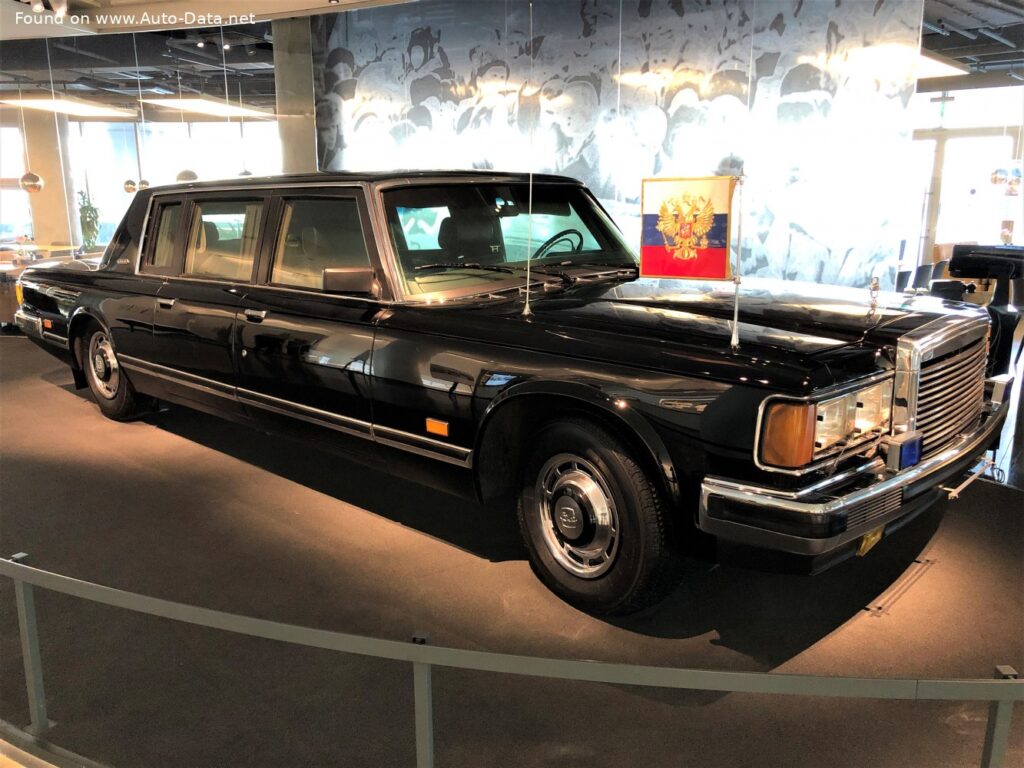
The ZIL 4104 7.7 V8 Pullman (315 Hp) was a luxury sedan produced by the ZIL automotive factory in the Soviet Union between 1978 and 1985. Representing the pinnacle of Soviet automotive engineering, the 4104 was designed for high-ranking government officials and dignitaries. It was a direct successor to the ZIL 114, continuing the tradition of large, opulent, and technologically advanced vehicles produced exclusively for the Soviet elite. The “Pullman” designation indicated an extended wheelbase version, offering even greater interior space and luxury. The 4104 was built on a dedicated platform and was not available for public sale.
Powertrain & Engine Architecture
The heart of the ZIL 4104 7.7 V8 Pullman was its 7.7-liter (7680 cm3 or 468.66 cu. in.) naturally aspirated V8 engine. Designated internally as the 7.7, this engine produced 315 horsepower at 4600 rpm and a substantial 608 Nm (448.44 lb.-ft.) of torque at 2900 rpm. The engine featured a cast iron block and aluminum cylinder heads, with a 9.3:1 compression ratio. It utilized a carburetor fuel injection system, a common feature for the time, though somewhat archaic compared to contemporary fuel injection technologies. The valvetrain employed an overhead camshaft (OHC) design with two valves per cylinder. The engine was mounted longitudinally in the front of the vehicle.
Power was transmitted to the rear wheels via a 3-speed automatic transmission. Details regarding the specific design of this automatic transmission are scarce, but it was a robust unit designed to handle the engine’s significant torque output and the vehicle’s substantial weight. The transmission was not electronically controlled, relying on hydraulic and mechanical linkages for gear selection.
Engine Specifications
The 7.7 V8 engine boasted a cylinder bore of 108 mm (4.25 in.) and a piston stroke of 105 mm (4.13 in.). Engine oil capacity was 12 liters (12.68 US qt | 10.56 UK qt). The engine’s power-to-weight ratio was 10.6 kg/Hp, or 94.5 Hp/tonne, while the torque-to-weight ratio was 5.5 kg/Nm, or 182.3 Nm/tonne. The engine’s power per liter was 41 Hp/l.
Driving Characteristics
The ZIL 4104 7.7 V8 Pullman was not designed for sporty handling. Its primary focus was on providing a smooth, comfortable, and dignified ride for its passengers. The large displacement V8 engine delivered ample torque, allowing for effortless acceleration despite the vehicle’s considerable weight. Acceleration from 0 to 100 km/h (0-62 mph) took approximately 12 seconds, and 0 to 60 mph was achieved in around 11.4 seconds. The top speed was rated at 190 km/h (118.06 mph).
The 3-speed automatic transmission, while providing convenience, lacked the refinement and responsiveness of more modern automatic gearboxes. Gear changes were noticeable, and the transmission did not offer the close ratios found in performance-oriented vehicles. The focus was on smooth, predictable shifts rather than rapid acceleration. The substantial weight of the vehicle (3335 kg or 7352.42 lbs. kerb weight) contributed to a somewhat ponderous feel, particularly in corners.
Equipment & Trim Levels
As a vehicle intended for the Soviet elite, the ZIL 4104 7.7 V8 Pullman was exceptionally well-equipped. Standard features included luxurious leather upholstery, power-adjustable seats, a comprehensive sound system, and extensive wood trim throughout the interior. The extended wheelbase “Pullman” version offered even more space for rear-seat passengers, often including features like a fold-out writing table, individual reading lamps, and a dedicated climate control system for the rear compartment.
Optional extras were limited, as the vehicle was already comprehensively equipped. However, some customization was possible, including the selection of different interior color schemes and the addition of specialized communication equipment. The dashboard layout was typically analog, with a full suite of gauges monitoring engine performance and vehicle systems.
Chassis & Braking
The ZIL 4104 7.7 V8 Pullman featured a robust chassis designed to withstand the vehicle’s weight and provide a comfortable ride. Both front and rear suspension utilized coil springs. The front suspension was a conventional coil spring setup, while the rear suspension also employed coil springs. Braking was provided by disc brakes on all four wheels, a relatively advanced feature for a Soviet-built vehicle of the era. An Anti-lock Braking System (ABS) was included as standard equipment, further enhancing safety. Power steering, utilizing a hydraulic system, was also standard, making maneuvering the large sedan easier.
The vehicle rode on 245/70 R16 tires. The front track measured 1643 mm (64.69 in.), while the rear track was slightly wider at 1663 mm (65.47 in.).
Market Reception & Comparison
The ZIL 4104 7.7 V8 Pullman was not subject to traditional market reception, as it was not available for public purchase. Its evaluation was primarily internal, focusing on its suitability for its intended purpose – transporting high-ranking officials. Critics within the Soviet automotive industry praised the vehicle’s build quality, luxurious appointments, and smooth ride. However, its fuel consumption (22 l/100 km or 10.7 US mpg) was considered extremely high, even by the standards of large luxury cars.
Compared to other trims within the ZIL 4104 range (which included shorter wheelbase versions with different engine options), the 7.7 V8 Pullman represented the ultimate expression of luxury and performance. It was significantly more powerful and refined than the lower-spec models, offering a superior driving experience and a more opulent interior.
Technical Specifications
| Brand | ZIL |
| Model | 4104 |
| Generation | 4104 |
| Type (Engine) | 7.7 V8 Pullman (315 Hp) |
| Start of production | 1978 |
| End of production | 1985 |
| Body type | Sedan |
| Seats | 7 |
| Doors | 4 |
| Fuel consumption (combined) | 22 l/100 km |
| Fuel consumption (US mpg) | 10.7 |
| Fuel consumption (UK mpg) | 12.8 |
| Fuel consumption (km/l) | 4.5 |
| Fuel Type | Petrol (Gasoline) |
| Acceleration 0 – 100 km/h | 12 sec |
| Acceleration 0 – 62 mph | 12 sec |
| Acceleration 0 – 60 mph | 11.4 sec |
| Maximum speed | 190 km/h |
| Maximum speed (mph) | 118.06 |
| Weight-to-power ratio | 10.6 kg/Hp |
| Weight-to-torque ratio | 5.5 kg/Nm |
| Power | 315 Hp @ 4600 rpm |
| Power per litre | 41 Hp/l |
| Torque | 608 Nm @ 2900 rpm |
| Torque (lb.-ft.) | 448.44 @ 2900 rpm |
| Engine layout | Front, Longitudinal |
| Engine displacement | 7680 cm3 |
| Engine displacement (cu. in.) | 468.66 |
| Number of cylinders | 8 |
| Engine configuration | V-engine |
| Cylinder Bore | 108 mm |
| Cylinder Bore (in.) | 4.25 |
| Piston Stroke | 105 mm |
| Piston Stroke (in.) | 4.13 |
| Compression ratio | 9.3:1 |
| Number of valves per cylinder | 2 |
| Fuel injection system | Carburettor |
| Engine aspiration | Naturally aspirated |
| Valvetrain | OHC |
| Engine oil capacity | 12 l |
| Engine oil capacity (US qt) | 12.68 |
| Engine oil capacity (UK qt) | 10.56 |
| Kerb Weight | 3335 kg |
| Kerb Weight (lbs.) | 7352.42 |
| Max. weight | 3800 kg |
| Max. weight (lbs.) | 8377.57 |
| Max load | 465 kg |
| Max load (lbs.) | 1025.15 |
| Fuel tank capacity | 120 l |
| Fuel tank capacity (US gal) | 31.7 |
| Fuel tank capacity (UK gal) | 26.4 |
| Length | 6339 mm |
| Length (in.) | 249.57 |
| Width | 2089 mm |
| Width (in.) | 82.24 |
| Height | 1500 mm |
| Height (in.) | 59.06 |
| Wheelbase | 3880 mm |
| Wheelbase (in.) | 152.76 |
| Front track | 1643 mm |
| Front track (in.) | 64.69 |
| Rear track | 1663 mm |
| Rear track (in.) | 65.47 |
| Drivetrain Architecture | Rear wheel drive |
| Number of gears | 3 |
| Gearbox type | Automatic transmission |
| Front suspension | Coil spring |
| Rear suspension | Coil spring |
| Front brakes | Disc |
| Rear brakes | Disc |
| Assisting systems | ABS, Hydraulic Steering |
| Tires size | 245/70 R16 |
Legacy
The ZIL 4104 7.7 V8 Pullman represents a fascinating chapter in Soviet automotive history. While not widely known outside of specialist circles, it stands as a testament to the engineering capabilities of the Soviet Union. Today, surviving examples are highly sought after by collectors, representing a unique and historically significant vehicle. The 7.7 V8 engine, while thirsty, is generally considered to be a reliable unit, provided it receives regular maintenance. Parts availability can be challenging, but a dedicated network of enthusiasts and specialists exists to support the preservation of these iconic vehicles. The ZIL 4104 continues to be a symbol of Soviet power and prestige, and a reminder of a bygone era.
